· 33 sources · Updated · Verified
AI SRE and Agent Security Market Map 2026: Funding, 35+ Tools and M&A
The AI production reliability market beyond Traversal's $120M raise: compare AI SRE, agent observability and red teaming, 35+ tools, real acquisitions and unit economics.

Editorial team
Acquisition
Arize AI
AI SRE, AI Observability and Agent Security in 2026: The Market Map
Updated November 5, 2026. An evidence-led guide to the companies, funding, acquisitions, products and business models behind the next generation of AI infrastructure.
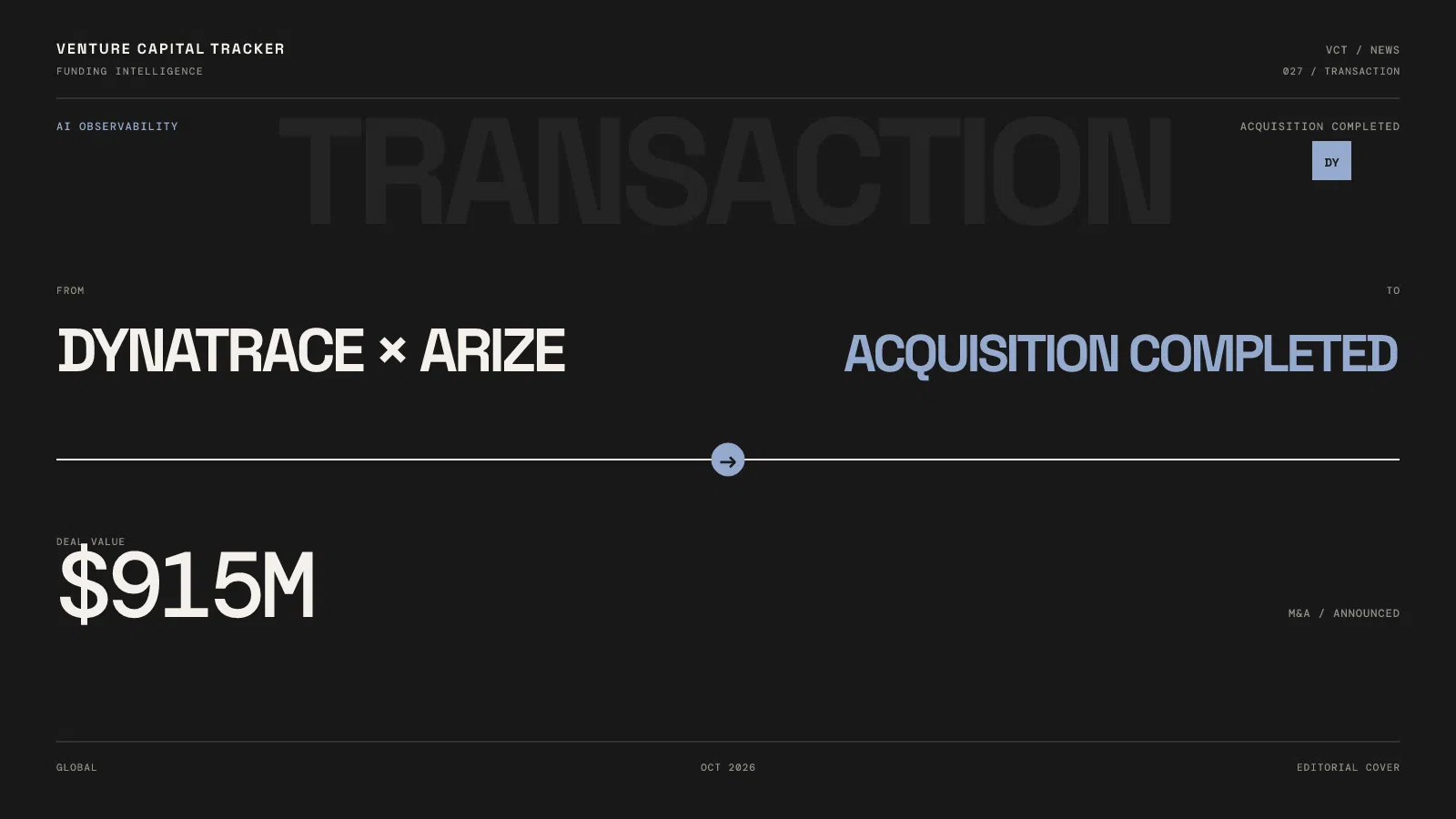
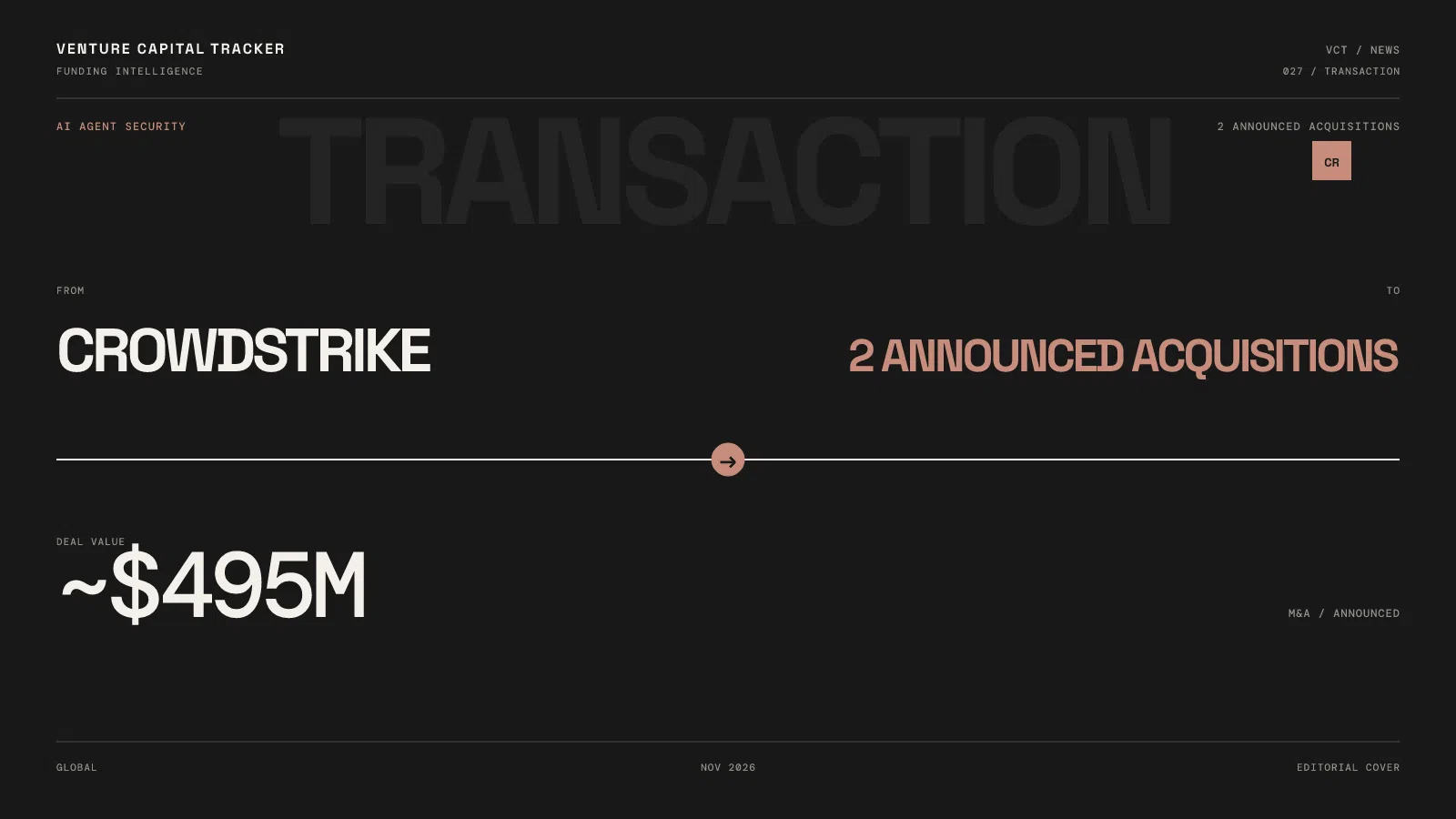
The biggest new AI infrastructure market may be the software that keeps AI-enabled systems functioning, observable and safe. On November 3, Traversal announced a $120 million Series B at a $1 billion valuation. The same day, CrowdStrike announced agreements to acquire AI observability company Fiddler AI and offensive-testing firm Dreadnode. Two months earlier, Dynatrace announced a $915 million acquisition of Arize, which closed on October 1. Those are not three versions of the same product. They illustrate distinct software categories beginning to converge.
This guide explains what each category actually does, which companies compete, how buyers evaluate them, which claims can be verified and where the investment thesis can fail. It also compares real funding and M&A records rather than confusing venture funding, private valuations, acquisition agreements and completed sales.
Key findings
- AI SRE investigates and helps resolve outages in production software and infrastructure. Its buyers are platform engineering, DevOps, SRE and IT operations.
- AI observability and evaluation explain what language models and AI agents did, how well tasks were completed, what traces cost and whether behavior changed. Its buyers include AI product engineers, ML teams, platform teams and AI governance.
- Adversarial AI testing attacks models and agents under controlled conditions before deployment and as a regression test. Its buyers are application security, red teams and AI security.
- AI runtime protection and posture management aim to discover agents, limit privileges, detect abuse and enforce policy while systems operate.
- Incident response platforms such as Rootly, incident.io and PagerDuty coordinate people and processes; their new AI features compete with standalone investigators but do not automatically replace observability or security systems.
The commercial opportunity is the connection between these layers: producing code faster is not the same as safely operating it, and a technically healthy service is not evidence that its AI agents took correct or authorized actions.
The essential distinction: four failures, four controls
Imagine an agent deployed to help finance teams. It reads customer records, invokes an internal payments API and writes notes to a CRM. Four different failures are possible.
| Failure | System that can help | What it must prove |
|---|---|---|
| A deployment causes latency, dropped requests or broken dependencies | AI SRE | Which change or component caused the incident, with supporting telemetry |
| The agent returns false information or chooses the wrong workflow | AI evaluation / observability | Which prompt, retrieval step, tool call or decision led to the outcome |
| A hostile document instructs the agent to export customer data | Adversarial AI testing | Whether the attack works in a realistic test with representative permissions |
| A production agent attempts an unauthorized action | Runtime security / identity control | Whether privileges, policy and detection actually prevent the action |
No vendor should be described as covering every layer merely because its marketing says "agentic AI." A high-quality hallucination detector is not a Kubernetes root-cause engine; a successful red-team test is not a runtime firewall; an agent trace is not proof of regulatory compliance.
Why the money is moving: three independent signals
1. Downtime is costly — but $600 billion is not an AI-SRE market estimate
Splunk and Oxford Economics surveyed 2,000 executives from Global 2000 companies and estimated that unplanned downtime costs those companies approximately $600 billion per year, up 50% in two years. The study also reported that many disruptions originate in network/IT environments, cybersecurity incidents and applications or infrastructure. This is a broad estimate of enterprise downtime and its knock-on effects, not the annual spending capacity for AI SRE or a measurement of downtime caused exclusively by AI-generated code.
The newsletter claim that engineers spend seven hours per week troubleshooting also appears in Traversal marketing. Without a verifiable sampling design or original survey it should be treated as vendor-supplied context, not a universal engineer average.
2. Investors are financing the operational side of code generation
Traversal disclosed $120M Series B at a $1B valuation on November 3, 2026, led by Kleiner Perkins, Redpoint Ventures and Khosla Ventures. Resolve AI announced $125M Series A at a $1B valuation in February 2026, followed by a $40M extension at $1.5B in April. These are sharply higher financing benchmarks than the earlier incident-agent seed rounds.
At the opposite end of the capital spectrum, Cleric announced $4.3M seed in 2024 and another $5.5M in 2025, NeuBird announced $22M seed in 2024, and Causely announced $8.8M seed in 2023. The competitive set is not uniformly funded: differentiation may depend on evidence, integrations, governance, distribution and customer-specific results more than headline capital raised.
3. Large strategic acquirers are consolidating the lifecycle
These completed deals provide better market evidence than rumor-based private company valuations:
| Buyer / company | Announced or closed | Transaction value | What the buyer obtains |
|---|---|---|---|
| Dynatrace / Arize AI | Closed Oct 1, 2026 | $915M disclosed | AI-agent evaluation and tracing connected to enterprise observability |
| Palo Alto Networks / Protect AI | Closed Jul 22, 2025 | $634.5M in buyer filing | Model and AI supply-chain security, scanning and posture |
| Check Point / Lakera | Closed Oct 22, 2025 | ~$201.8M in buyer filing | Prompt-injection defense and AI runtime controls |
| Cisco / Galileo | Completed May 22, 2026 | Undisclosed | AI evaluation and agent observability for Cisco/Splunk |
| ClickHouse / Langfuse | Announced Jan 2026 | Undisclosed | Developer-facing AI traces, prompts and evaluation infrastructure |
| CrowdStrike / Fiddler AI | Agreement Nov 3, 2026 | ~$400M reported | AI-agent behavior and observability |
| CrowdStrike / Dreadnode | Agreement Nov 3, 2026 | ~$95M reported | Automated adversarial AI security testing |
Important accounting: Dynatrace's $915M comprises cash and employee equity-linked consideration; Palo Alto's $634.5M purchase consideration includes replacement awards attributed to prior services. Those are buyer-disclosed transaction measurements, not all cash paid to common shareholders. The two CrowdStrike prices come from media reporting and the transactions had not closed as of November 5, 2026. Adding these rows together is not a defensible addressable-market estimate.
The AI SRE market: who actually competes?
AI SRE, short for artificial-intelligence site reliability engineering, uses models and agentic workflows to investigate production signals, correlate infrastructure and software changes, test candidate causes and support remediation. Traditional AIOps typically centered on alert correlation and statistical anomaly detection. Modern AI SRE systems may run multi-step investigations, query connected tools and return evidence; some can propose code or execute approved actions.
Standalone investigators and causal engines
| Product | Best-fit buyer or problem | Differentiator | What to verify |
|---|---|---|---|
| Traversal | Complex, interdependent enterprise systems | Production World Model; causal search | Evidence quality, integration depth, read-only versus write permissions |
| Resolve AI | Enterprise-wide production investigation | Production-specific agents and operational memory | Remediation approval paths, custom model access, telemetry costs |
| Cleric | On-call investigation with strong evidence | Conversational, evidence-linked SRE agent | Exact current action permissions and recurring incident learning |
| NeuBird Hawkeye | ITOps with existing signal platforms | Cross-system operations agent | Time to meaningful first result, connector fidelity |
| Causely | Kubernetes services with complex dependencies | Causal topology and RCA modeling | Reliability of discovered dependency graph |
| Sherlocks AI | Evidence-first multivendor investigation | Parallel specialized investigative agents | VPC deployment model, results reproducibility |
| Oppex Nova | Combined on-call, paging and AI investigation | Lower-friction packaging for smaller teams | Vendor-reported pricing, retention and real remediation safety |
| Ciroos | Operational AI assistants and incident context | Agentic operations interface | Maturity, connectors and customer validation |
These are product-fit categories, not an independent performance ranking. Public vendors rarely publish comparable blind incident benchmarks, which makes a universal "best AI SRE" ranking misleading.
Incumbents and workflow-led competitors
| Product | Existing distribution advantage | AI-SRE use case or limit |
|---|---|---|
| Datadog Bits Investigation | Datadog's metrics, logs, traces and deployment telemetry | Strong when key evidence already sits in Datadog; inspect AI-credit pricing and external connectors |
| Dynatrace Intelligence | Application topology and broad APM deployments | Cross-stack investigation; since Oct 2026 also owns Arize AI for agent evaluation |
| PagerDuty SRE Agent | On-call routing, alerting and incident history | Investigations tied to workflow and automation; validate metered AI actions |
| Rootly AI SRE | Incident declaration and team coordination | AI incident assistance embedded in the response workflow |
| incident.io Investigations | Slack-centric incident workflows and retrospectives | AI-assisted diagnoses and incident knowledge alongside response |
| Komodor Klaudia | Kubernetes change histories and workload context | Especially relevant to pod, deployment, OOM, rollout and scheduling failures |
| Grafana Assistant | Open telemetry, Prometheus/Loki/Tempo users | AI investigation in a Grafana-oriented monitoring environment |
| New Relic AI operations | Established APM and logs platform | Context from the New Relic telemetry estate |
| BigPanda | Event correlation and enterprise IT operations | AIOps event reduction and incident coordination |
| CAST AI | Kubernetes efficiency and automated cloud operations | Adjacent optimization/automation, not a universal substitute for cross-stack RCA |
For a company already paying a substantial Datadog or Dynatrace bill, the rational comparison may be incremental AI investigation cost versus a standalone six-figure agent contract, not a simplistic product-feature checklist. Price varies materially with existing telemetry coverage, retention, event ingestion, seats and AI investigation volume.
AI agent observability: model and behavior quality are different from uptime
An application can return HTTP 200 while an agent quietly executes a wrong business task. This is why LLM/agent tracing and evaluation formed a separate market.
| Product | What teams typically use it for | Structural difference |
|---|---|---|
| Fiddler AI | Enterprise model monitoring, agent behavior, governance and evaluation | Established model explainability moving into CrowdStrike's planned Falcon Observe |
| Arize AI / Phoenix | Agent tracing, evaluation, experimentation, monitoring | Dynatrace acquired Arize Oct 2026; Phoenix remains open source |
| Langfuse | Open-source tracing, prompt versions, eval datasets and costs | ClickHouse ownership; self-hosting and open infrastructure orientation |
| LangSmith | LangChain/LangGraph runs and evaluation workflows | Strong alignment with LangChain ecosystem |
| Galileo / Splunk Agent Observability | LLM evaluation, quality monitoring and agent visibility | Cisco completed acquisition May 2026 |
| Braintrust | Experiment-driven LLM evals and regression workflows | Developer-oriented prompt/test loops |
| WhyLabs | Data quality, model drift and LLM monitoring | Broader ML monitoring heritage |
| Comet Opik | Open-source LLM traces and evaluation | Developer experimentation and self-hosted options |
| Weights & Biases Weave | LLM evaluation and experiment traces | Adjacency to model development and experiment management |
Teams should measure trace sampling bias, evaluation-label quality, the accuracy of task-completion assessments, privacy of prompts, retention costs, cross-framework coverage and the ability to connect an AI failure back to its effect on the user. A rich tracing UI without useful evaluations is usually a dashboard, not proof of safe agent behavior.
AI red teaming, agent security and runtime protection
Threats can originate in user inputs, retrieved documents, tool outputs, software dependencies, model artifacts, excessive permissions or malicious external services. Their mitigations differ.
| Product / framework | Primary emphasis | Buyer caveat |
|---|---|---|
| Dreadnode | Offensive agent testing; attack simulations | Test coverage must match actual agent tools and permissions |
| Promptfoo | Developer-first LLM red teaming and eval automation | Open-source and commercial capabilities vary; OpenAI acquisition announced in 2026 |
| Giskard | LLM application quality and security testing | Test datasets and paid versus open tooling differ |
| Mindgard | Continuous AI security testing and red teaming | Evaluate independently with your own threat scenarios |
| Microsoft PyRIT | Open-source adversarial testing orchestration | Framework, not turnkey enterprise risk coverage |
| NVIDIA garak | Open-source LLM vulnerability scanner | Scanner results do not necessarily model your full agent attack surface |
| Noma Security | AI inventory, posture, risk and runtime policy | Different components must be validated separately |
| HiddenLayer | AI asset, model and agent security | Compare model scanning versus runtime monitoring breadth |
| Lakera | Prompt injection defense and runtime classification | Check Point acquired it in 2025; test bypass and false positive rates |
| Protect AI | AI model scanning and supply-chain security | Palo Alto Networks acquired it in 2025 |
| Patronus AI | LLM safety and quality evaluations | Evaluation does not automatically block malicious tool execution |
| CalypsoAI | AI security evaluation and control | Validate ongoing product availability and owner integrations |
| OWASP LLM Security and GenAI guidance | Open guidance and risk taxonomy | Useful as a requirements baseline, not a commercial vendor |
Security hierarchy: Red-team the system before release; constrain privileged agents through identity and least privilege; monitor actual production agent behavior; add runtime protective controls; and preserve incident evidence for review. Guardrails can fail, and no predeployment test exhausts the space of prompt-injection attacks.
What practitioners actually report using
Open discussions among SRE and LLM engineers show three competing operating models, not universal adoption of one category:
- Existing observability plus AI assistance: Datadog, Grafana, Prometheus, OpenTelemetry and alerting tools remain primary; a built-in assistant or external agent helps query them.
- Dedicated SRE investigator: Resolve, Traversal, Cleric and peers query multiple telemetry sources, return a causal hypothesis and hand findings to an on-call engineer.
- Developer-owned AI tooling: Engineers integrate coding agents with internal APIs or MCP tools, using GitHub changes, Kubernetes context, logs and runbooks. For LLM products, some combine Langfuse or Phoenix with promptfoo, custom eval datasets and security controls.
Reddit threads from r/sre, r/devops, r/LLMDevs and r/Observability contain examples of all three. Engineers repeatedly ask for read-only default access, human approval before production changes and evidence links rather than confident prose. These are individual practitioner accounts and may include vendor employees. They are not representative customer-market-share surveys. Named customer logos in press releases also cannot establish how many active seats, agents or workloads a platform supports.
An honest comparison therefore includes the do-nothing-with-a-new-vendor option: can a trained engineer using existing observability, an LLM coding assistant and internal runbooks meet the requirement more cheaply and safely?
A realistic Kubernetes incident: what to benchmark
Suppose an API deployed to a managed Kubernetes service suddenly shows increased 5xx responses after an application release. DB connections are saturated, some pods restarted, DNS retries increased and a downstream cache shows elevated latency.
A weak AI investigator summarizes the most visible anomaly ("DNS is broken") and proposes restarting production. A strong investigator should:
- Build a timeline of deployments, traffic, pod restarts, HPA changes, DB connection counts, network symptoms, traces and service dependencies.
- Test at least two competing causal chains, including one in which DNS retries are a consequence of overload rather than the cause.
- Attach direct links to relevant spans, release diffs, logs and infrastructure records.
- Clearly distinguish observed data, inference, hypothesis and approved corrective action.
- Propose a reversible change with rollback criteria, guardrails and a way to validate improvement.
- Escalate to the responsible engineer if evidence is insufficient.
This is a more meaningful procurement benchmark than “solved in two minutes” marketing. Production incident tests should include ambiguous cases, novel failures and events where doing nothing automatically is the safest answer.
AI SRE unit economics: when does it pay?
Consider an entirely illustrative engineering team, not a vendor forecast:
| Input | Example |
|---|---|
| Material production incidents per year | 200 |
| Engineer hours potentially saved per incident | 2.5 |
| Engineers otherwise involved in each investigation | 3 |
| Fully loaded engineering labor cost | $120/hour |
| Annual gross investigation-labor value | $180,000 |
| Annual tool, integration and training expense | $150,000 |
| Simplified annual net benefit | $30,000 |
| Simple cost-based ROI | 20% |
The formula is incidents × hours saved × people affected × loaded hourly rate. It only works if those hours are genuinely removed or productively redeployed; a faster alert summary might not save three engineers' hours. Include false alerts, ingestion and evaluation charges, extra telemetry retention, training, vendor implementation and security review in actual procurement. Count avoided outage losses separately and only when reductions are evidenced, to prevent double counting.
A second, more conservative test: 100 incidents/year × 1.0 hour saved × 2 engineers × $100/hour = $20,000 annual labor value. That would not justify a $150,000 annual contract on saved debugging time alone. The headline $600B downtime estimate does not change your company's own financial arithmetic.
An RFP scorecard that is harder to game
Use 8–12 real historical production incidents, plus carefully staged failures, and give vendors read-only access to a representative environment before any remediation permissions are granted.
| Dimension | Suggested weight | Evidence to collect |
|---|---|---|
| Accuracy of root cause with primary-signal citations | 25% | Correct diagnosis and reproducible source links |
| Integration coverage and time to onboarding | 15% | Real connectors across current systems |
| Safe-by-default permission and approval model | 15% | Identity scope, audit logs, rollback and controls |
| Time actually saved for the on-call team | 15% | Baseline versus measured incident timeline |
| Security, privacy and data residency | 10% | Data-processing terms, code access and storage |
| Operational robustness under partial outages | 10% | Missing telemetry, stale logs, failure modes |
| Total annual cost and vendor portability | 10% | AI credits, ingest, retention, services and export |
Score every product against the same incidents, including failures where a plausible but wrong diagnosis is costly. Report false confidence, not just “RCA delivered.” Decide in advance whether remediation is prohibited, approval-only or policy-automated. Do not confuse product demos with independent field trials.
Three market scenarios through 2029
Bull case: AI-generated software changes expand the scale and variety of systems to manage. Buyers require continuous investigation, testing and agent observability. Strong vendors can monetize measurable savings and become cross-category operating platforms.
Base case: Observability incumbents and security consolidators bundle much of this functionality. Independent specialists retain value in complex multivendor deployments, developer experience and difficult evaluation/research niches, but standalone category pricing faces pressure.
Bear case: Agents remain unreliable on unfamiliar systems, evaluations produce false reassurance, data access and legal constraints slow procurement, and generic coding agents with internal tools absorb common tasks. Vendors with expensive investigation loops or weak differentiated data struggle to deliver provable ROI.
Gartner's January 2026 Market Guide for AI SRE Tooling validates that analysts see an emerging category. Vendor reproductions cite a projection that 85% of enterprises may use AI SRE by 2029 versus under 5% in 2025, but the freely available Gartner summary does not independently expose that exact projection. Treat it as a vendor-attributed forecast, not verified measured adoption. A separate Gartner April 2026 analysis found many infrastructure AI initiatives lagging meaningful ROI: this is the material counterweight to the hype.
What investors should underwrite
The product question: what proprietary value survives when frontier models become cheaper and observability platforms embed agents? Defensible ingredients may include deep integration history, service topology and verified runbooks, specialized evaluation datasets, hard-won security research or distribution through an incumbent.
The revenue question: evaluate absolute ARR, expansion, renewal and gross margin — not only "9x growth," which can start from a tiny base. Analyze how much of revenue is model-inference cost, telemetry ingestion, support and onboarding. An autonomous agent that needs substantial human supervision may not achieve software-like gross margins.
The market structure question: buyers may consolidate observability, production operations and security under a single platform, but engineering teams still need open instrumentation and specialist tools. The likely winner is not necessarily the company with the largest funding round; it may be the team that reliably proves causality and risk reduction while remaining interoperable.
Related VCT company research
Start with the deep dives: Traversal's $120M Series B and AI SRE funding history, CrowdStrike's proposed Fiddler and Dreadnode acquisitions, and Dynatrace's completed $915M Arize acquisition. Compare Resolve AI, Cleric, Rootly, Arize, Langfuse, Noma Security, Promptfoo and Dreadnode at the company level.
Methodology and disclosures
Information was checked through November 5, 2026 against company and acquirer releases, buyer filings, the Splunk/Oxford Economics research, Gartner's public Market Guide summary, independent media, historical financing announcements and practitioner discussions. Deal terms are attributed as company-disclosed, filing-confirmed, media-reported or undisclosed. Seed and Series A packages with undisclosed allocations remain aggregate to avoid double counting. Community opinions and vendor performance claims are labeled as such. Price estimates, company valuation and venture funding are not interchangeable. This is editorial analysis, not investment or security advice.
Last updated:
Editorial note: AI tools assisted with research, structure, or drafting. Venture Capital Tracker retains human editorial responsibility for factual accuracy, relevance, and source quality before publication.