· 19 sources · Updated · Verified
Dynatrace Acquires Arize AI for $915M: Deal Economics and AI Observability
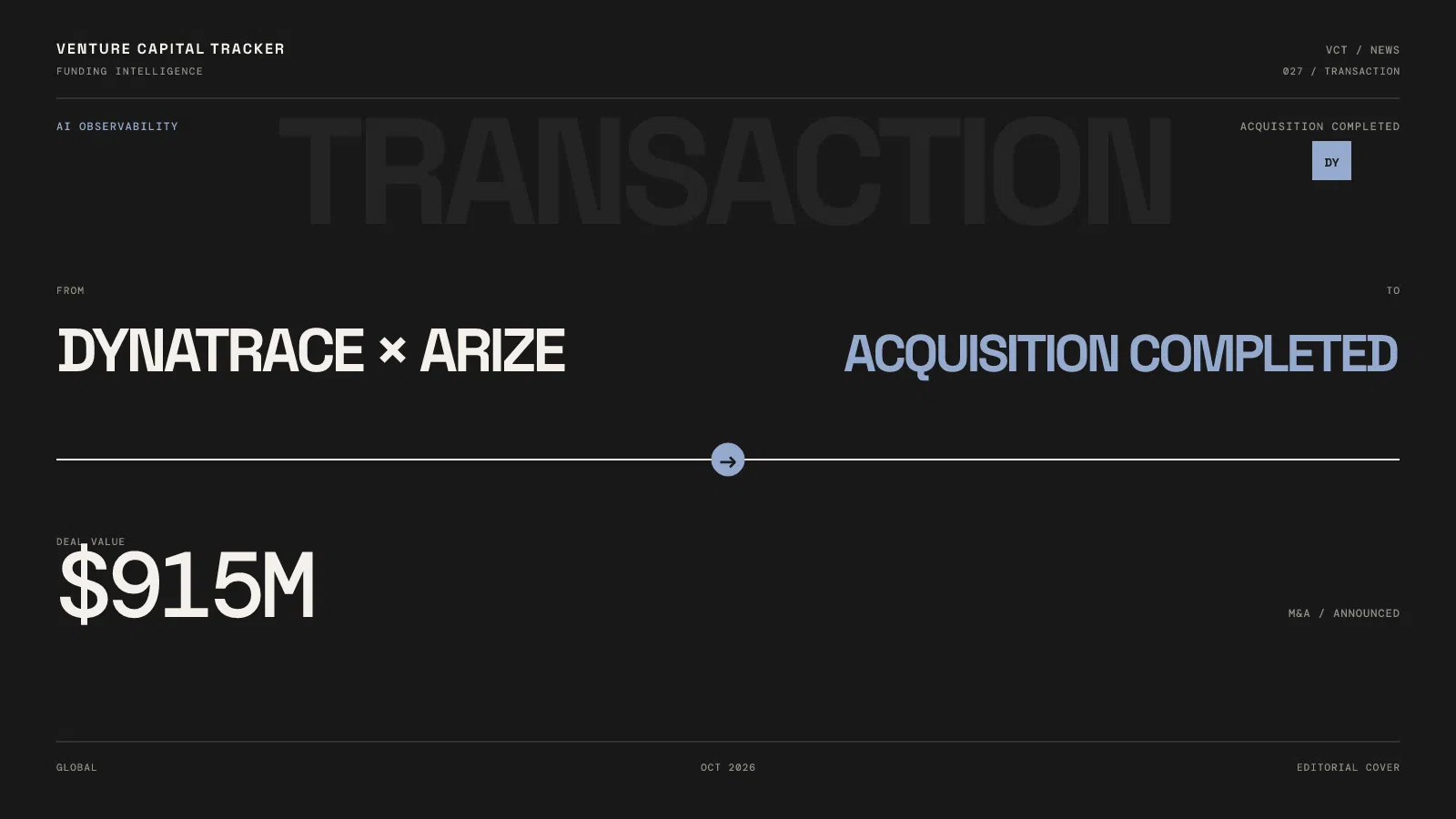
Dynatrace completed its $915M Arize AI acquisition on Oct 1, 2026. Cash and RSU details from its SEC filing, Arize's funding history, Phoenix, AX, competitors and unit economics.

Editorial team
Acquisition
Arize AI
Dynatrace Acquires Arize for $915M: The AI Observability Deal Explained
Updated November 5, 2026. The acquisition was completed October 1 — unlike CrowdStrike's pending Fiddler AI and Dreadnode agreements.
Dynatrace completed its acquisition of Arize AI on October 1, 2026, following an August 13 agreement valued at $915 million. This is one of the clearest publicly disclosed examples of a major observability platform buying the infrastructure required to observe and evaluate generative AI applications and agents.
The explanation is straightforward: traditional observability tells you whether software is running; agent observability must also help you determine whether the software is making good decisions. Combining both under one roof could make enterprise AI operations easier. It could also raise integration complexity and the price of keeping every agent trace.
Verified transaction facts
| Item | Detail |
|---|---|
| Acquirer | Dynatrace (NYSE: DT) |
| Acquired company | Arize AI |
| Announced | August 13, 2026 |
| Completed | October 1, 2026 |
| Announced valuation | $915M, subject to customary adjustments |
| Consideration disclosed by Dynatrace | $815.9M cash at closing plus restricted stock and RSUs valued at $98.2M |
| Additional employment-related RSUs | $26M issued to Arize employees, vesting over future service |
| Core products | Arize AX and Phoenix, combined with Dynatrace full-stack observability |
| Founders | Jason Lopatecki and Aparna Dhinakaran, both joining Dynatrace |
Dynatrace's November 3, 2026 Form 10-Q provides the unusually specific cash and equity information above. Its $915M announcement is a transaction valuation, not the same as cash paid to selling shareholders. Restricted shares and RSUs with future-service obligations require proper accounting and cannot simply be treated as immediate investor proceeds. The separate $26M employee awards should not be casually added to the published $915M price.
Dynatrace expected the transaction to contribute approximately 200 basis points to annual recurring revenue growth while reducing non-GAAP operating margin by approximately 175 basis points in fiscal 2027. These are management projections made at announcement, not achieved financial results.
What exactly did Dynatrace buy?
Arize provides tools for observing and evaluating machine-learning models, LLM applications and AI agents. Conventional application-performance monitoring can reveal an endpoint's latency and error rate; Arize can inspect the application-specific AI workflow inside that request.
A simple retrieval-augmented customer-service agent might perform several steps:
- Accept a user question and fetch relevant help-center content.
- Choose an embedding model and retrieve documents from a vector index.
- Generate a response with a language model.
- Invoke tools such as an order lookup or return request.
- Decide whether the user's task has been satisfied.
A conventional APM trace can show whether those calls succeeded and how long they took. An AI observability trace should expose the model, prompt version, retrieved context, tool calls, agent trajectory, token usage and final output. An evaluation system then checks whether the agent completed the intended task, cited appropriate evidence, followed policy and avoided dangerous or low-quality results.
This is where combining Arize with Dynatrace might matter: a single investigation could connect a poor agent decision to slow retrieval, a misconfigured application release, a failed cloud dependency or a changed model rather than forcing AI engineering and SRE teams to look in separate places.
Phoenix versus Arize AX
Arize has an important two-part product story.
Phoenix is the developer-oriented, open-source tracing and evaluation ecosystem. It helps teams instrument LLM/agent applications, inspect execution paths, construct evaluations and run experiments. Its open-source status can reduce adoption friction and allow developers to try tools before buying a full enterprise platform.
Arize AX is the company's enterprise-oriented offering for running evaluations, managing observability and supporting organizational workflows at scale. Companies should examine commercial contracts and deployment models, because using Phoenix does not imply that all AX functionality is free or self-hostable.
Dynatrace said Phoenix would remain open source and that Arize tools would continue to be available as integration proceeds. That is the acquirer's stated plan, not a binding guarantee of all future licenses, hosting models or prices.
Arize funding history before the acquisition
Arize's historical venture financing spans the transition from conventional model monitoring to LLM and agent evaluation.
| Period | Round | Reported amount | Confidence |
|---|---|---|---|
| February 2020 | Seed | ~$4M | Historical database-reported; precise announcement day unverified |
| September 2021 | Series A | $19M | Historical database/industry reports |
| September 2022 | Series B | $38M | Historical company coverage |
| February 20, 2025 | Series C | $70M | Company-confirmed; led by Adams Street Partners |
| August 13, 2026 | Dynatrace acquisition signed | $915M deal valuation | Buyer-confirmed |
| October 1, 2026 | Acquisition completed | $815.9M cash at close plus employee equity consideration | Buyer filing-confirmed |
The four listed pre-acquisition funding rounds sum to approximately $131 million. That is not the total cash distributed to investors, and it should not be treated as a perfectly audited lifetime funding total: early-round numbers rely partly on historical industry databases and additional secondary transactions may not be public.
The simple ratio $915M / $131M ≈ 7.0× measures deal valuation relative to the reported aggregate capital raised — not a venture investor's return, founder proceeds, MOIC or profitability. Share classes, price preferences, dilution, ownership, founder and employee equity, possible earn-outs and retention awards all matter.
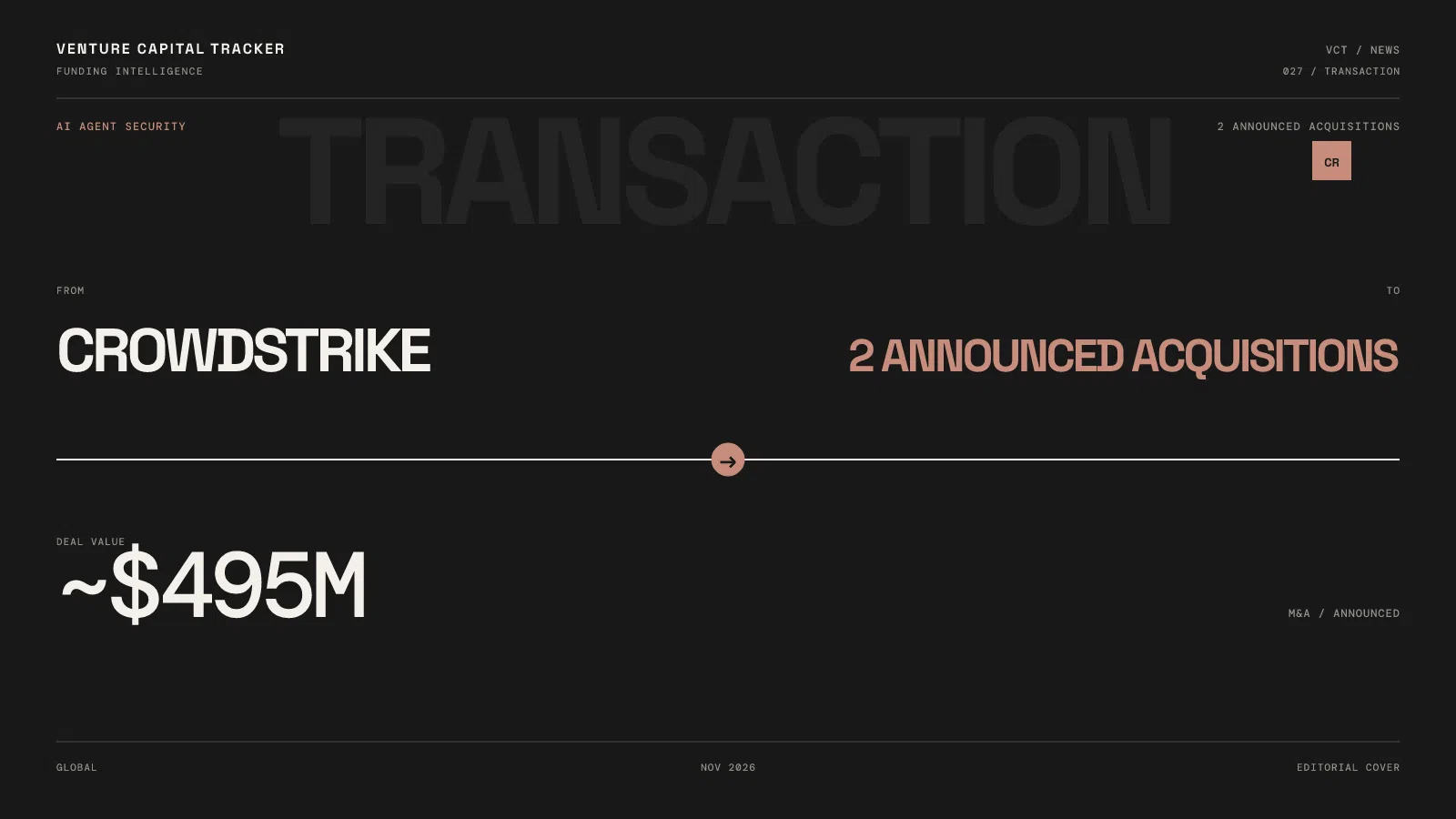
This financial distinction is important when comparing with CrowdStrike's proposed ~$400M Fiddler transaction, where the price is media-reported and the deal had not closed as of November 5.
What motivated the buyer?
Dynatrace brings a large enterprise customer base, rich infrastructure and application telemetry, dependency context, an AI observability distribution channel and a platform for operating software at scale.
Arize brings a developer-facing product, evaluation experience, AI-specific traces, experiment workflows and an open-source community. The combination could strengthen three business cases:
- Cross-selling: offer agent evaluation to customers already paying for Dynatrace observability.
- Customer expansion: bring Phoenix and AX users into full-stack monitoring when AI systems become production-critical.
- Product differentiation: troubleshoot agent reliability, security-adjacent behaviors and infrastructure performance together.
The real competitive moat is not that an LLM generated a trace. Instrumentation and basic evaluation are becoming more available through open-source tooling. The difficult part is connecting an agent's actual task quality, model/tool decisions, cloud dependencies and operational incidents reliably, economically and with the right data controls.
How this compares with CrowdStrike, Cisco and ClickHouse
| Buyer and acquired product | Acquisition status by Nov 5, 2026 | Strategic starting point |
|---|---|---|
| Dynatrace / Arize | Completed; disclosed $915M valuation | Application/infra observability plus AI-agent evaluation |
| CrowdStrike / Fiddler AI | Pending; ~$400M media-reported | Endpoint/identity/security telemetry plus agent behavior accountability |
| Cisco / Galileo | Completed May 22, 2026; price undisclosed | Enterprise network/observability plus AI evaluations |
| ClickHouse / Langfuse | Announced Jan 2026; price undisclosed | Analytics database plus developer-oriented AI tracing |
| Check Point / Lakera | Completed Oct 22, 2025; ~$201.8M in buyer filing | Security platform plus AI prompt-injection protection |
| Palo Alto Networks / Protect AI | Completed Jul 22, 2025; $634.5M in buyer filing | Security platform plus model supply-chain and asset protection |
The categories overlap, but they are not identical. Arize is primarily an evaluation and observability acquisition. Fiddler intersects both that category and security governance; Dreadnode focuses on adversarial testing; Lakera emphasizes runtime protection. A buyer can own several complementary products without owning every underlying capability on day one.
Read VCT's CrowdStrike/Fiddler/Dreadnode transaction analysis for the differences between agent observation, predeployment security testing and enforcement.
What enterprise users should compare: Arize, Fiddler, Langfuse and others
The most practical alternative is usually not switching the whole APM stack. It is picking a tracing and evaluation architecture based on the frameworks and datasets a team already uses.
| Platform | Common fit | What to test |
|---|---|---|
| Arize / Phoenix | LLM and agent observability plus large-enterprise monitoring | Phoenix openness, AX plans, Dynatrace integration timing and trace retention |
| Fiddler AI | Governance and model/agent explainability | Comparison with Fiddler's existing product and future Falcon Observe |
| Langfuse | Developer teams using open-source evaluation and trace storage | Hosted/self-hosted performance, data portability, ClickHouse integration |
| LangSmith | LangChain and LangGraph-centric agents | Cross-framework tracing, integrated testing and evaluation prices |
| Braintrust | Developer experiments and evaluation-driven development | Human labels, regressions, dataset management and CI fit |
| WhyLabs | Model monitoring and data-quality-heavy ML systems | Production drift and data monitoring depth |
| Comet Opik | Open-source evaluation and tracing workflows | Deployment, evaluation quality and access controls |
| Galileo | Enterprise agent evaluations with Cisco integration | Current product access, Splunk/Cisco roadmap and contract boundaries |
Technical evaluation rule: run the same agent and same evaluation dataset through shortlisted tools. Compare trace completeness, error attribution, experiment management, annotations, prompt/data privacy, debugging value, false positives and real cost. A shiny visualization is not a substitute for a correct diagnosis.
Example: why HTTP 200 can still be failure
An insurance assistant might generate a response in 700 milliseconds, with 100% successful API calls, but hallucinate a policy exclusion and incorrectly deny a claim. Dynatrace-style APM alone would show good technical uptime. An agent evaluation should assess the task outcome, document grounding and policy conformance; Arize/Phoenix-style tracing should help identify which retrieved document, prompt or tool response caused the error. The integration's value is in tying that explanation to application version, deployment time, error logs and infrastructure data.
In contrast, a prompt injection that steals claim data may require security testing and runtime access controls. Evaluating factuality is not the same as stopping data exfiltration.
Is $915M rational? The buyer's unit economics
Consider a purely illustrative enterprise with 2,000 production AI agents and many applications. Imagine it spends $1.5M annually on existing APM and would otherwise pay a specialist $400k/year for agent observability, evaluation and support. Integrating the capabilities might improve attach rates, reduce tooling overlap or make customers less likely to leave the broader platform.
However, $915M cannot be justified with that one example. A buyer must model installed-base cross-sell, net retention, evaluation workloads, infrastructure and inference costs, integration spending, sales capacity and the opportunity cost of cash used. If 500 enterprise customers each eventually spend an additional $100k ARR, that is $50M hypothetical incremental ARR; it is neither a forecast nor proof of how much Arize actually earns.
Trace cost is a significant risk: agent workloads can produce many nested spans and evaluation calls per user-visible task. A trace-rich organization can generate growing ingestion and retention expense even when model inference gets cheaper. Evaluate sampling policies, token redaction, retention tiers, storage location, cloud-egress cost and the cost of scoring every trace.
A technical procurement checklist
- Can OpenTelemetry instrumentation be reused across both products and existing tracing stacks? Ensure exported data can be migrated if contracts change.
- Can evaluations be repeated reproducibly against prompt/model versions and stable datasets, not only scored through opaque LLM judges?
- Does root cause link AI behavior to runtime evidence? Verify whether the platform can identify retrieval changes, tool failures, deployment regressions and infrastructure bottlenecks.
- Are agent traces protected? Prompts, retrieved documents and tool arguments can expose personal data, credentials or business secrets.
- Can storage and model costs be predicted? Sample realistic workloads and review per-trace, per-evaluation and per-user terms.
- Which features are actually shipped versus proposed integrations? Require a release-specific demonstration on your current Dynatrace or Phoenix estate.
Risks in the Arize acquisition thesis
Open source versus monetization. Phoenix may win developer trust precisely because it is independent and portable. Heavy-handed bundling or restrictive changes can erode that advantage. Dynatrace's public commitment is useful, but adoption data and licensing behavior will be better evidence.
Integration complexity. Tracing an AI agent's intermediate tool calls and scoring its task quality require semantics distinct from infrastructure metrics. Linking these may take more engineering than the press release suggests.
Specialist competition. Langfuse, Braintrust, LangSmith, WhyLabs, Fiddler and open-source stacks compete for the same developer workflows. The broad Dynatrace sales channel may help distribution, but enterprise procurement can also increase friction for small teams.
ROI proof. Evaluating every agent call is expensive and still imperfect. LLM-as-judge scores can vary; human reference labels are costly; strong observability does not automatically equal safe behavior. The value must be measured in faster debugging, improved agent task success and fewer production incidents.
Pressure on independent vendors. The acquisition supports the category's strategic importance, yet also raises the risk that basic AI observability becomes bundled into major APM platforms, reducing long-run standalone prices.
The larger investment thesis
This acquisition confirms that AI application reliability now includes behavior, not just infrastructure performance. Models and autonomous agents can return technically successful responses that are economically, operationally or legally wrong. Enterprise observability vendors have reason to move from measuring infrastructure health toward explaining the whole task.
Dynatrace now owns one of the most visible AI evaluation ecosystems. The crucial question is whether it can turn the combination into an integrated, measurable improvement in production agent quality without making tracing and evaluations prohibitively expensive.
For full industry context, including standalone AI SRE companies such as Traversal and Resolve, agent security companies, strategic acquirers and buyer economics, see VCT's 2026 AI SRE, observability and agent security market map. For the security consolidation path, see CrowdStrike's proposed Fiddler and Dreadnode acquisitions.
Methodology: Acquisition dates and buyer accounting come from Dynatrace press releases and its November 2026 Form 10-Q; early financing data uses company disclosures and separately identified historical database reporting. Performance claims and management projections are identified as such, rather than presented as proven outcomes.
Follow Venture Capital Tracker on Google
Add VCT as a preferred source to see more of our venture-capital reporting in Google Search.
Last updated:
Editorial note: AI tools assisted with research, structure, or drafting. Venture Capital Tracker retains human editorial responsibility for factual accuracy, relevance, and source quality before publication.