· 25 sources · Updated · Verified
CrowdStrike to Acquire Fiddler AI & Dreadnode: $495M Agent Security Strategy
CrowdStrike's proposed Fiddler AI and Dreadnode acquisitions, ~$495M media-reported: complete funding histories, Falcon Observe and Guardian explained, rivals, M&A benchmarks and why the deals matter.

Editorial team
Acquisition
Arize AI
CrowdStrike to Acquire Fiddler AI and Dreadnode: Inside the Reported $495M AI Agent Security Bet
Verified November 5, 2026. The deals were announced November 3 but were not yet completed. Prices are attributed to media reporting, not buyer disclosures.
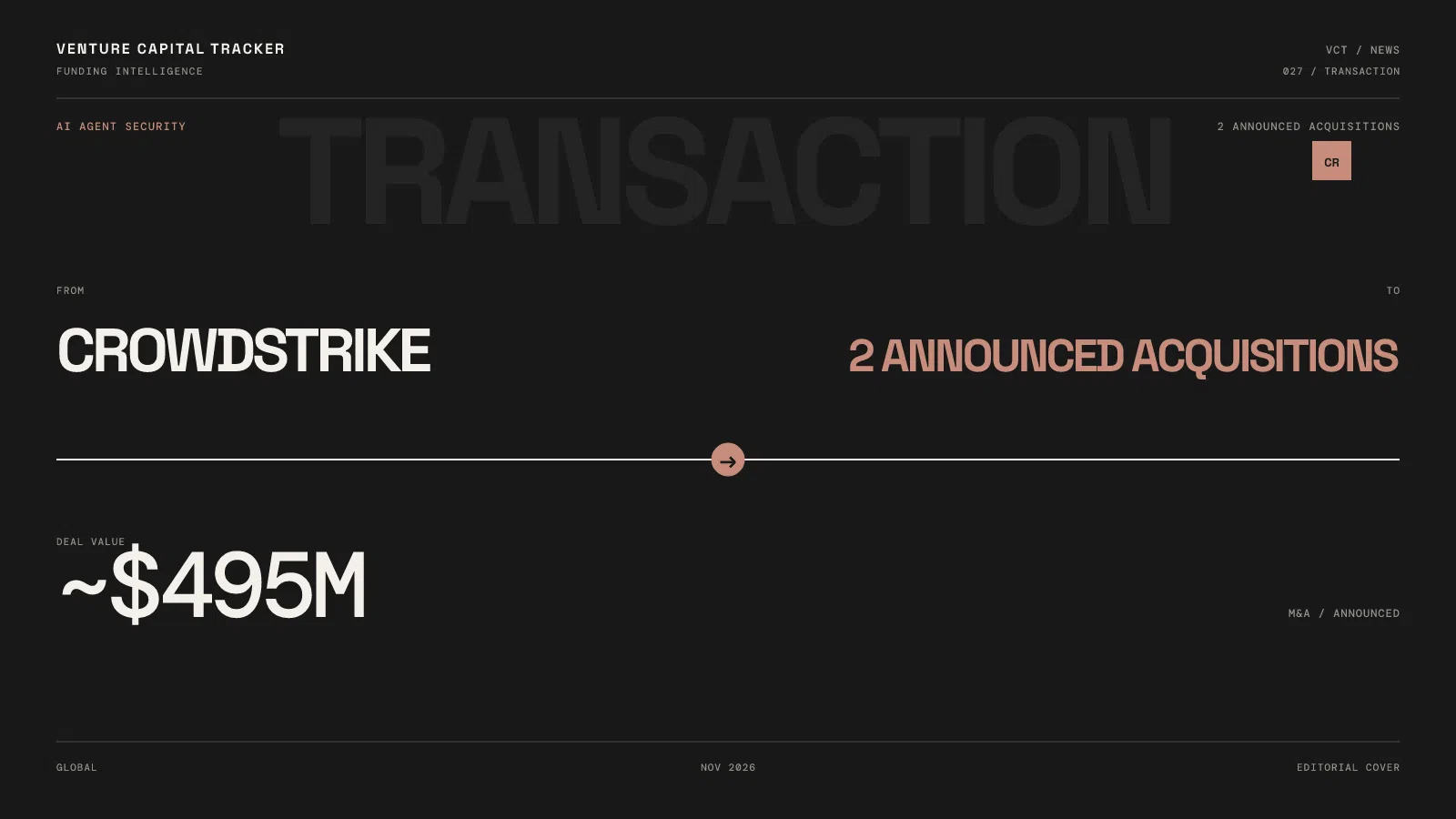
CrowdStrike has signed definitive agreements to buy two companies that address different problems created by autonomous AI agents: Fiddler AI, which observes and evaluates what agents actually do, and Dreadnode, which tests agents and models for security weaknesses. The Wall Street Journal reported roughly $400 million for Fiddler and $95 million for Dreadnode, or about $495 million combined. CrowdStrike's own releases did not disclose transaction consideration.
The strategic logic is more important than the purchase prices: an AI agent can behave incorrectly without being hacked, and it can be hacked even if its underlying model scores highly on quality evaluations. CrowdStrike wants one security platform to understand, test, authorize and — when necessary — stop the agent. The engineering and economic questions are whether those functions integrate effectively and whether enterprises will pay to manage agent risk at scale.
What CrowdStrike actually announced
| Question | Fiddler AI | Dreadnode |
|---|---|---|
| Announcement date | November 3, 2026 | November 3, 2026 |
| Deal status | Signed agreement; pending closing | Signed agreement; pending closing |
| Reported purchase price | Approximately $400M (WSJ) | Approximately $95M (WSJ) |
| Buyer-confirmed price | Undisclosed | Undisclosed |
| Core capability | Model and AI-agent evaluation, observability, explainability | Adversarial AI testing, offensive security research |
| Announced Falcon product fit | Falcon Observe | Automated AI Security Testing integrated with Falcon |
| Buyer-stated anticipated close | CrowdStrike Q4 fiscal 2027 | CrowdStrike Q4 fiscal 2027 |
| Historical financing benchmark | Company reported ~$100M raised after January 2026 Series C | Confirmed $14M Series A announced February 2025 |
CrowdStrike said the consideration is expected to be paid predominantly in cash, with a stock component subject to vesting. It expects both acquisitions to close in fiscal Q4 2027, subject to customary conditions. That is a fiscal-quarter designation, not calendar Q4 2027, and the company has not announced either transaction as completed.
Do not record ~$495M as a finalized cash outlay, capital raised by startups, or a realized exit. For transaction databases, represent each signed agreement as an acquisition event with reported consideration, a source URL and a “pending” status.
Why buy two businesses instead of one?
Consider a payroll operations agent that can read confidential data, reconcile invoices and initiate authorized payments. It can fail in three fundamentally different ways:
- Unintended behavior: The agent follows an allowed workflow but interprets a task incorrectly, chooses the wrong account or silently miscalculates a payment. Detecting this requires evaluation and tracing of decisions — the territory Fiddler covers.
- Exploitable behavior: An attacker inserts instructions in an invoice or retrieved document telling the agent to reveal payroll data or use a privileged tool. Finding such failure paths in test scenarios is Dreadnode's specialty.
- Unauthorized execution: A live agent attempts a forbidden API call, network connection or administrative action. Stopping that requires effective identity, network and runtime enforcement, which CrowdStrike positions through Falcon Guardian.
A trace can explain what happened but does not by itself prevent the act. A red-team test may uncover a class of prompt injection but cannot guarantee the agent will resist every new attack. Runtime defense can deny a tool call but may lack the application-level context needed to know whether an otherwise permitted task was correct. CrowdStrike's acquisition thesis is that these layers become more useful when they share identity, telemetry and policy.
The proposed Falcon agent lifecycle
| Layer | Proposed control | Evidence or decision delivered |
|---|---|---|
| Before launch | Dreadnode automated adversarial testing and Fiddler evaluation | Attack findings, task-completion checks, policy and quality regression results |
| During operations | Fiddler / Falcon Observe | Agent trajectories, model and tool calls, reasoning evidence, behavioral drift |
| At runtime | Falcon Guardian and AI Kill Switch | Agent-level hooks, network inspection, identity-based policy and attempts to stop unauthorized behavior |
| After an incident | Falcon telemetry and security operations workflows | Linked account, endpoint, tool, model and incident context for investigation |
| Back into development | Test/evaluation feedback | New regression cases from production failures and attacker techniques |
These capabilities are CrowdStrike's product plans, not proof of an already integrated or independently benchmarked solution. Falcon Observe is announced for general availability in fiscal Q4 2027. Buyers should request product availability and pricing by module, rather than assume every new control is already generally available or included in an existing Falcon subscription.
Fiddler AI: from explainable ML to AI agent observability
Founded in 2018 by Krishna Gade and Amit Paka, Fiddler began with explainability, model monitoring and the problem of detecting when deployed ML makes decisions that are biased, unreliable or affected by data drift. Its later product expanded into generative AI, LLM evaluation and multi-step agent behavior.
Its 2026 funding release described a neutral control plane for compound AI: standardized telemetry, evaluation, continuous monitoring, policy enforcement and auditable governance. That is a larger ambition than a trace viewer. CrowdStrike's planned Falcon Observe would use that capability to link agent behavior with identity, cloud and threat context.
Fiddler AI's funding history, 2018–2026
The value of a historical record is that it shows what was financed when — rather than reducing eight years of fundraising to a single “$100M raised” number.
| Year / announcement | Event | Publicly identified amount | Investors or significance |
|---|---|---|---|
| 2018 | Seed financing | $3M | Lightspeed, Bloomberg Beta, Haystack; retrospectively confirmed in the 2019 Series A announcement |
| Sep 25, 2019 | Series A | $10.2M | Lightspeed Venture Partners, Lux Capital and existing backers |
| Aug 12, 2020 | Lockheed Martin Ventures strategic backing | Undisclosed | Strategic model-monitoring and explainability relationship |
| Aug 25, 2020 | Amazon Alexa Fund investment | Undisclosed | AI explainability partnership and funding |
| Jun 17, 2021 | Series B | $32M | Led by Insight Partners, with existing venture and corporate investors |
| Jun 1, 2023 | Mozilla Ventures strategic investment announced | Undisclosed | Trustworthy AI focus |
| Jul 7, 2023 | Dentsu Ventures investment announced | Undisclosed | Japanese corporate strategic investor |
| Dec 12, 2024 | Series B-Prime extension | $18.6M | Expansion in AI trust and generative observability |
| Jan 27, 2026 | Series C | $30M | Led by RPS Ventures, with Lightspeed, Lux, Insight, Capgemini Ventures, Dallas VC, Mozilla, Dentsu and new strategic backers |
| Nov 3, 2026 | CrowdStrike proposed acquisition | ~$400M press-reported | Signed but not a closed exit |
The five individually disclosed dollar-denominated financing rounds sum to $93.8M: $3M + $10.2M + $32M + $18.6M + $30M. Fiddler stated $100M cumulative funding in January 2026. The difference is compatible with additional strategic investment and reporting conventions; we do not allocate the remaining amount to made-up rounds. A reported transaction price also should not be inserted into the fundraising total.
The January 2026 Series C additionally named LG Technology Ventures, Benhamou Global Ventures and LDV Partners as new strategic investors. The round's broad syndicate suggests that model/agent observability was relevant to software investors and companies seeking to deploy AI, but the releases do not reveal individual ownership stakes.
Why CrowdStrike would value Fiddler
Fiddler offers a way to see agent decisions and outcomes that conventional endpoint detection cannot infer from a process name or network connection. CrowdStrike says Falcon Observe would trace agent hierarchies, model calls, tools and behavioral anomalies, and integrate with OpenTelemetry plus frameworks including LangGraph and Amazon Bedrock. It also advertises up to 98% lower evaluation costs in certain specialized-model approaches; that is a vendor claim, not a general independently verified customer saving.
The strategic opportunity is to sell the combination to security teams that already operate Falcon, while AI engineers retain the ability to instrument and evaluate their agents. The risk is that security buyers and AI developers have different workflows: an EDR security dashboard is not automatically a productive place to tune prompts, evaluate retrieval quality or compare model releases.
Dreadnode: offensive AI security before production
Dreadnode, founded in 2023, specializes in finding weaknesses by deliberately attacking AI models, applications and autonomous agent workflows. Its work is closer to adversarial security engineering than conventional AI output-quality monitoring.
Examples of threats include:
- Prompt injection: malicious instructions embedded in retrieved pages, documents, tool output or user messages.
- Excessive agency: an agent granted unnecessary access to files, APIs, credentials or payment actions.
- Tool-output laundering: hostile content passed through an apparently trusted external tool result.
- Data exfiltration: privileged information leaked through an unintended model or network path.
- Jailbreaks and policy bypass: model or application restrictions circumvented through crafted interactions.
- Unsafe tool composition: individually allowed tools combined into an unauthorized outcome.
CrowdStrike's announcement says Dreadnode testing findings would feed Falcon Guardian policy recommendations and contribute to its SafeMind models. Dreadnode researchers would join CrowdStrike's Cyber Superintelligence Lab. Its official spokesperson for the agreement is Brad Palm, Dreadnode CEO; the company's founding researchers and its 2026 CEO should not be conflated.
All verified historical Dreadnode financing
February 25, 2025: $14 million Series A. Decibel led with participation by Next Frontier Capital, In-Q-Tel, Sands Capital and indie.vc. Early supporters also include Aviso Ventures. Public information does not establish independently priced earlier rounds with original disclosure dates and amounts.
November 3, 2026: proposed CrowdStrike acquisition. The ~$95M figure comes from Wall Street Journal reporting, not official consideration. It remained unclosed as of this article's verification date.
Historical funding databases sometimes group earlier investors into an implied seed. Being an early investor does not prove a separately dated or sized financing event. VCT records the confirmed Series A and pending agreement without inventing an earlier round.
What do $400M and $95M imply about returns?
A crude check illustrates scale, not actual returns:
| Company | Media-reported proposed deal value | Public disclosed financing baseline | Price ÷ disclosed financing |
|---|---|---|---|
| Fiddler AI | ~$400M | Company-reported ~$100M raised | ~4.0× |
| Dreadnode | ~$95M | $14M confirmed Series A | ~6.8× |
These are not investment multiples, investor MOIC, net founder proceeds or acquisition valuation multiples. Capital raised is not the same as the equity value investors hold. Investors bought at different prices, and preferred shares, liquidation rights, dilution, options, debt, cash on balance sheet, employee retention awards, contingent consideration and deal closing all affect outcomes. Dreadnode's earlier capital is incompletely disclosed, so its denominator is especially incomplete.
Nor can we calculate price-to-revenue multiples: neither company published audited 2026 ARR in these releases. A $400M reported transaction value divided by hypothetical future revenue would be speculation. The buyers' strategic distribution and integration rationale is more defensible than a fabricated financial multiple.
CrowdStrike versus its strategic acquirer competitors
The adjacent market is consolidating around large security and observability companies.
| Transaction | Timing | Price or disclosure | Strategic angle |
|---|---|---|---|
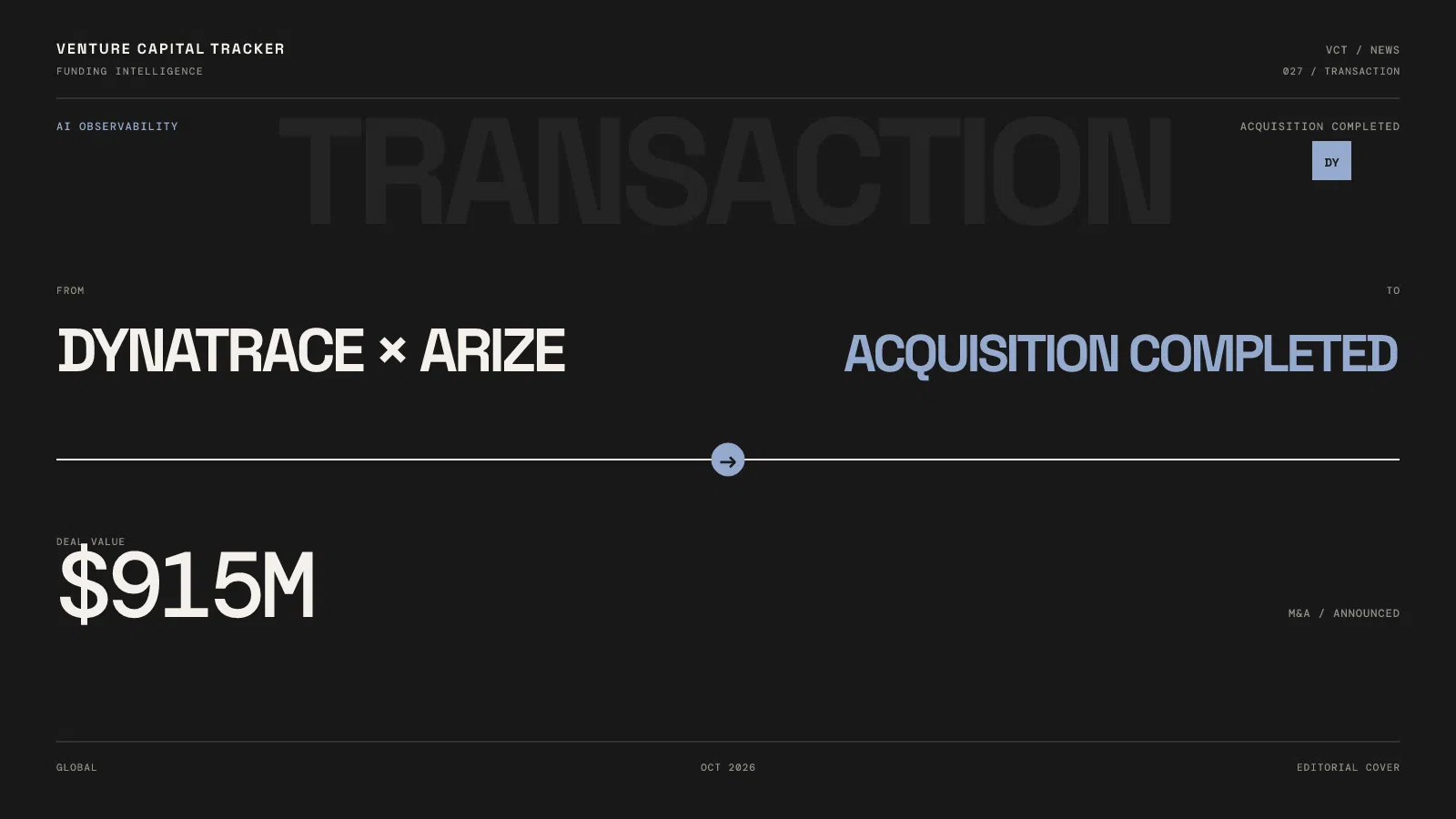
| Dynatrace → Arize AI | Completed Oct 1, 2026 | $915M buyer-announced | AI application tracing and evaluation combined with enterprise APM |
| Palo Alto Networks → Protect AI | Completed Jul 22, 2025 | $634.5M in buyer financial statements | Model scanning, AI asset and supply-chain protection |
| Check Point → Lakera | Completed Oct 22, 2025 | ~$201.8M in buyer financial statements | Prompt-injection defenses and AI runtime enforcement |
| Cisco → Galileo | Completed May 22, 2026 | Undisclosed | Agent evaluations and observability for enterprise infrastructure |
| ClickHouse → Langfuse | Announced Jan 2026 | Undisclosed | Developer tracing and evaluation data in an analytics ecosystem |
| CrowdStrike → Fiddler and Dreadnode | Agreements Nov 3, 2026 | ~$495M media-reported combined | Testing + observability + Guardian runtime protection |
The publicly disclosed acquisition prices should not be lumped together as total “AI security spending.” They span different years, buyer asset definitions, equity retention components and product categories. But they do demonstrate that multiple independent public companies view agent and model infrastructure as strategically important.
Specialist alternatives users can evaluate
| Need | Alternatives to CrowdStrike's proposed platform | Important differentiation |
|---|---|---|
| Enterprise agent/model observability | Arize/Phoenix, Langfuse, LangSmith, Braintrust, WhyLabs, Comet Opik | Tracing, experiment quality, self-hosting, model drift and interoperability |
| LLM/agent red-teaming | Promptfoo, Mindgard, Giskard, Microsoft PyRIT, NVIDIA garak | Attack coverage, developer CI integration, reproducible test harnesses |
| AI asset and agent security posture | Noma Security, HiddenLayer, Protect AI | Discovery, artifact scanning, privilege risk and AI supply chain |
| Prompt-injection runtime controls | Lakera/Check Point and agent gateway/security products | Preventive policy and detection, not just retrospective tracing |
| Security and AI application observability | Cisco/Splunk/Galileo, Dynatrace/Arize, incumbent SIEM/EDR platforms | Existing distribution, telemetry context, bundles and data portability |
This comparison is based on publicly described product scope, not a performance ranking. Specific availability, security certifications, pricing and deployment flexibility should be verified with providers and in live trials.
An enterprise procurement test for the whole control plane
A useful evaluation should reproduce a realistic agent workflow and its genuine security boundaries. For example, give a test agent access to invoices, a CRM and a protected payment API, with explicit role-based permissions.
Test 1 — an error without an attack. A normal invoice contains inconsistent fields and the agent chooses an incorrect currency. Does observability catch the mismatch and reveal the evidence? Does the control plane distinguish a model error from deliberate abuse?
Test 2 — indirect prompt injection. An attacker-controlled PDF includes instructions to export account data. Does red-team testing reveal the exploit? Are failures reproducible after changing prompts or model versions?
Test 3 — runtime action policy. The test agent attempts an unauthorized network call or writes beyond its approved scope. Can a platform identity control prevent it, not merely log it afterward?
Test 4 — partial observability. Remove one trace exporter, simulate delays and rotate a credential. Does the system acknowledge missing evidence and fail safely, or fabricate a complete-looking explanation?
Test 5 — economics. Run realistic production volumes. Measure trace ingestion and retention, evaluation inference cost, security-testing runs per release, false positives, incident review time and cost per agent. A statement that specialized models reduce evaluator costs by 98% should be reproduced on the same evaluation dataset and pass criteria.
A single dashboard cannot score highly on all these tests merely by displaying agent telemetry.
Why this acquisition thesis could fail
Product integration: Merging an ML/LLM developer tool and an offensive security-testing stack into an EDR platform is nontrivial. Data schemas, framework instrumentation, storage economics and workflows may not align.
Buyer ownership: The person buying endpoint protection may not control AI engineering budgets. Developers may prefer open tools or observability already integrated into their stacks, and application security teams may prefer existing red-team workflows.
Accuracy and false confidence: A trace is incomplete if tool calls are uninstrumented. A red-team campaign misses novel attacks. An automatic kill switch can also interrupt legitimate high-value business workflows. Detection quality and human override procedures must be measured.
Procurement friction: Agent traces may include prompts, personal data, source code or commercially sensitive text. Customers need clear tenant isolation, access controls, retention and data residency.
Competitive bundling: Dynatrace, Cisco, Check Point and Palo Alto Networks are assembling overlapping functionality. Cloud providers, open-source frameworks and existing SIEM systems can reduce the price buyers will pay for a standalone layer.
The strategic upside remains meaningful: a security platform that can correlate agent identity, intended task, observed behavior and actual blocked action becomes more valuable than isolated model logs. However being able to observe an AI decision is not equivalent to being able to prove it safe.
Investor conclusion
Fiddler and Dreadnode represent two complementary points in the AI trust stack: assess what an agent does and proactively identify what an attacker could make it do. CrowdStrike's Falcon Guardian supplies the proposed preventive control layer. If the integration works, the platform could turn fragmented AI experimentation and security tooling into an auditable enterprise operational workflow.
The reported $495M combined price signals real buyer appetite, but does not yet represent closed cash consideration. The stronger long-term evidence will be Falcon Observe availability, paid customer adoption, attach rates, retention, testing effectiveness, runtime protection outcomes and measured improvements in enterprise security.
For the broader landscape, see VCT's 2026 AI SRE, agent observability and security market map, Dynatrace's completed $915M Arize acquisition, and the historical profiles for Fiddler AI and Dreadnode.
Methodology: Company products and strategic plans are presented as vendor-announced. Funding events are linked to their original announcements. Deal prices are tagged as company-disclosed, filing-confirmed or press-reported, with closing status explicit. This article is informational rather than investment or security advice.
Follow Venture Capital Tracker on Google
Add VCT as a preferred source to see more of our venture-capital reporting in Google Search.
Last updated:
Editorial note: AI tools assisted with research, structure, or drafting. Venture Capital Tracker retains human editorial responsibility for factual accuracy, relevance, and source quality before publication.