· 8 sources · Verified
Isomorphic Labs Raises $5B Series C: What IsoDDE Must Prove Before Human Trials
The key test is not whether an AI model can predict a molecular interaction, but whether its designs become safe, effective treatments. The company is financing both pharmaceutical partnerships and its own preclinical drug pipeline.

Editorial team
Isomorphic Labs' immediate challenge is to turn convincing computer predictions into physical molecules that survive laboratory testing and, eventually, human trials. Its proprietary Isomorphic Labs Drug Design Engine (IsoDDE) is designed to identify where a medicine might bind to a biological target, predict its interactions and help scientists select promising candidates. That work can accelerate discovery; it cannot establish a drug's safety or effectiveness in patients.
Deal details & investors
Funding event
Isomorphic Labs
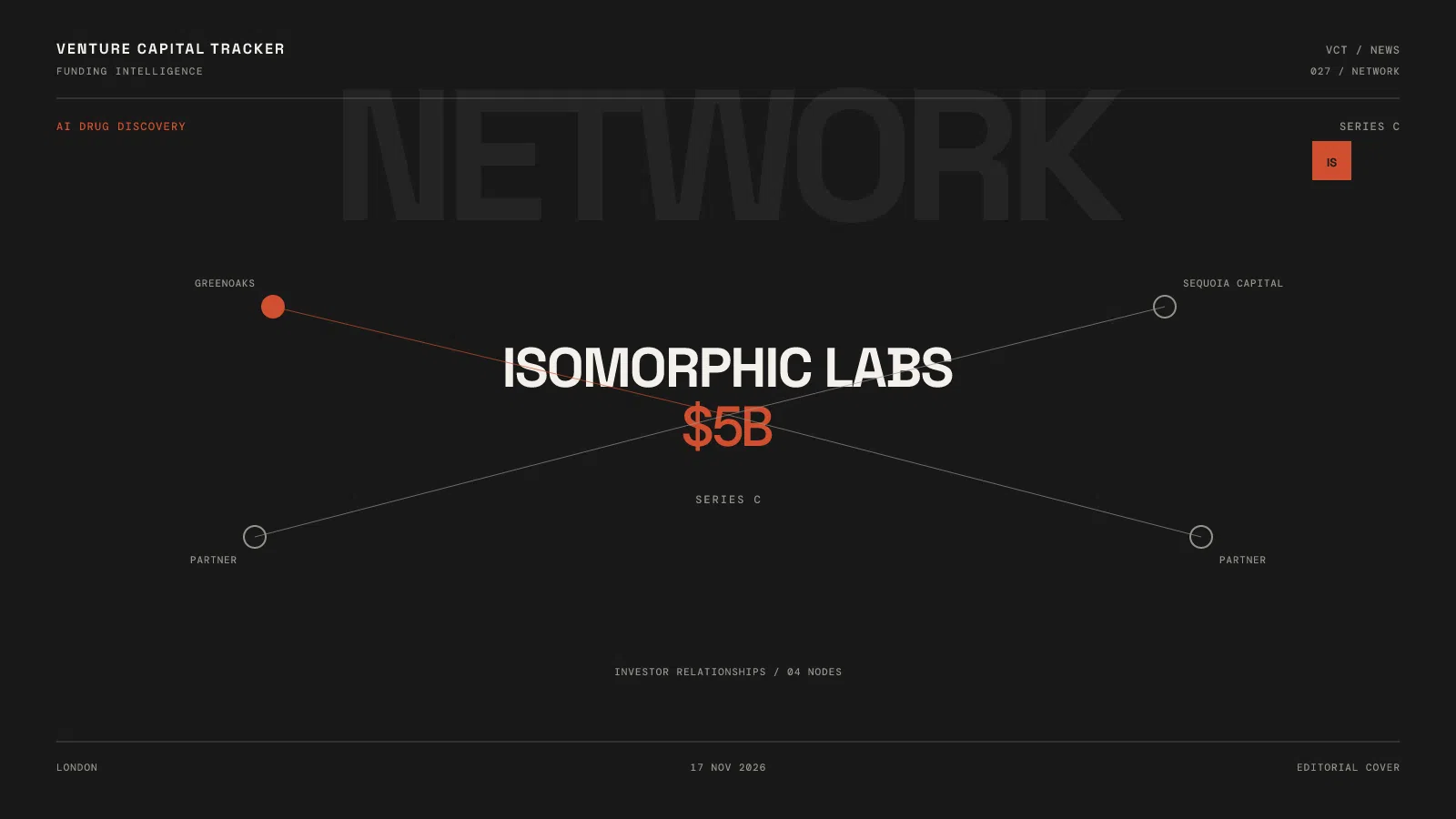
Led by Greenoaks , Sequoia Capital
The company announced its Series C on November 17, 2026, naming Greenoaks and Sequoia Capital as co-leads, with Andreessen Horowitz (a16z) among new investors. Alphabet and earlier backers including Thrive Capital, MGX, GV, CapitalG, Temasek and the UK Sovereign AI Fund also participated. The issuer did not give a valuation, individual investor checks or an exact legal completion date.
That distinction matters because Isomorphic operates two different pharmaceutical businesses: it develops research programs with large drugmakers and pursues therapeutic assets of its own. These routes can produce different contractual payments, ownership rights, clinical obligations and financial risks.
How IsoDDE actually fits into drug development
The company is not selling a self-serve AI chatbot for scientists. IsoDDE is an integrated research capability used by medicinal chemists, structural biologists and computational drug designers. A practical illustrative research workflow follows five stages; it is not a hands-on VCT product test or a claim that any specific candidate has cleared them.
- Choose a disease mechanism and target. Scientists identify a protein, pathway or biological interaction relevant to a disease. This involves biological evidence and clinical judgment; the model cannot establish the target's therapeutic relevance by itself.
- Predict structures, pockets and interactions. IsoDDE helps model a target's structure, identify potential binding pockets and estimate how small molecules or biologics interact with it. A cryptic pocket is a site that may not appear in an unbound protein structure.
- Design and prioritize candidate molecules. Researchers use predictions of binding geometry and affinity—the strength of binding—to select chemical designs worth synthesizing. High computational scores are hypotheses to test, not proof of drug activity.
- Make and test the molecules. Laboratory experiments check whether compounds really bind, behave as predicted and show the required properties. Chemistry, off-target effects, delivery and stability can overturn an attractive simulation.
- Advance through preclinical and clinical gates. A candidate needs repeatable efficacy signals, acceptable toxicology, manufacturing controls and regulatory authorization before human studies. Human safety and effectiveness remain unproven until clinical evidence exists.
Isomorphic's February 2026 technical explanation says IsoDDE more than doubled AlphaFold 3's accuracy on the hardest, selected protein–ligand generalization subset of a specific benchmark. It also reports improved antibody–antigen predictions and binding-affinity modeling. Those are company-reported computational benchmark results, not a universal twofold speed-up in drug discovery and certainly not a doubling of clinical success. Evaluation on novel molecules, experimentally confirmed predictions and candidate outcomes matter more to patients than a headline model score.
The 2025–26 clinical-readiness gap
The most decision-useful question is whether the discovery engine can create investigational medicines, not just better structural predictions. Reporting from WIRED on April 24, 2026 describes president Max Jaderberg preparing for human studies, without giving a start date. WIRED also documented that the company had earlier discussed entering the clinic by the end of 2025.
The November 17 funding announcement still describes moving first therapeutic programs towards clinical trials. That does not prove a drug has failed or the program is stalled; it shows that a verified first human dosing milestone should not be inferred from fundraising or AI benchmarks. A meaningful future update would identify the candidate, disease, study registration or regulatory milestone, trial phase and evidence of dosing. The distinction between preclinical progress and human efficacy data is central to judging this investment.
For context, Isomorphic's internally described work includes oncology and immunology. Investors should not confuse a broad disease category with a publicly verified clinical-stage asset or an approved medicine.
Where revenue might come from—and where it does not
The business has at least two routes to potential economic value. In partnered discovery, pharmaceutical companies pay for agreed research work and may owe milestone payments if programs reach specified steps; negotiated royalties can depend on future approved-drug sales. In an internal pipeline, Isomorphic may retain more therapeutic rights but must finance more of the expensive preclinical, clinical and manufacturing journey, subject to undisclosed asset-level arrangements.
The company's January 7, 2024 announcement disclosed $45 million upfront from Eli Lilly and $37.5 million upfront from Novartis—$82.5 million in reported initial contract payments. It described nearly $3 billion in possible aggregate deal value, excluding potential royalties. That maximum includes conditional milestones; it is not $3 billion of cash already received, recurring revenue or company valuation. Subsequent collaboration expansions and a Johnson & Johnson research agreement should be assessed by their own disclosed terms rather than automatically added to known cash receipts.
Isomorphic does not publish a standard subscription price for IsoDDE or audited revenue for these partnerships. A founder comparing it with a pay-per-seat software company would be using the wrong unit economics: molecule ownership, program-specific payments, clinical development spending and the probability of reaching milestones are the relevant questions.
Financing history: three separate rounds, not three valuations
The existing VCT company profile and linked investment-event records distinguish new proceeds from historical capital. The externally disclosed chronology is:
| Announcement | Capital reported | What is actually known |
|---|---|---|
| March 31, 2025 | $600M | First external financing, led by Thrive Capital; the company's release does not call it Series A |
| May 12, 2026 | $2.1B | Separate Series B led by Thrive |
| November 17, 2026 | $5B | Series C co-led by Greenoaks and Sequoia |
Those three announcements total $7.7 billion in disclosed external financing. This arithmetic is neither a cash-balance estimate nor evidence that the company has spent or collected that amount in sales. The Series C alone represents approximately 65% of the combined disclosed round amounts; it does not show the ownership dilution because the cap table and terms are private.
Valuation requires a different evidence standard. Press reporting has placed the new round's valuation at approximately $50 billion, but the November 17 issuer announcement does not confirm that figure or say whether it is pre- or post-money. It should therefore remain a reported estimate, not an official transaction term. A comparison of a reported valuation with round size is not enough to establish dilution, investor rights or how much money changed hands at closing.
Why investors are underwriting two risks at once
Greenoaks and Sequoia are co-leading a much larger financing than Isomorphic's earlier round, while Alphabet and existing outside investors are continuing to support it. The original company statement explains that capital will fund further development of IsoDDE, expanded biological research and the infrastructure required to advance internally designed drug programs toward the clinic.
That strategy combines platform risk—whether software predictions generalize to unseen biology—with drug development risk—whether individually developed therapies prove safe, effective, manufacturable and commercially viable. Strong results on the former do not eliminate the latter.
There is a third question: whether pharma collaborations validate a repeatable, scalable business model. An agreement with Lilly or Novartis demonstrates customer interest and the willingness to fund specific research. It does not, without more disclosure, establish profitable per-program economics, successful clinical candidates or guaranteed downstream royalty income.
What alternatives are investors really comparing?
A simple "AI versus traditional pharma" narrative is misleading. Researchers may mix these approaches within the same program.
| Approach | Practical distinction | Evidence to demand |
|---|---|---|
| Isomorphic's IsoDDE and therapeutic development | Proprietary design research plus partnered and internal assets | Novel-target experimental validation and clinical advancement |
| Insilico Medicine | AI-led target and compound discovery with its own development pipeline | Registered studies, molecule-specific safety/efficacy and ownership |
| Recursion | Experimental-data-rich biological discovery and therapeutic programs | Program progression and reproducibility of data-to-candidate decisions |
| Schrödinger | Physics-based molecular design software and internal therapeutics | Value of software licensing separately from medicine development |
| Medicinal chemistry teams and CROs | Experimental synthesis, assays and outsourced research execution | Turnaround, reproducibility, total program cost and validation quality |
More financing alone cannot settle this comparison. Independent assay reproduction, clear ownership of intellectual property, disease-specific patient outcomes and the time and cost per candidate reaching a real clinical milestone are stronger indicators of value.
This distinction connects the investment to broader AI drug-discovery company comparisons and to biotech investors' clinical-stage mandates. Those sectors fund different stages of the same long product-development chain.
The next facts worth checking
The core questions now are concrete: Which first drug will enter a registered human study, and when? How many chemically synthesized molecules have independently replicated their claimed properties? Which therapeutic rights remain with Isomorphic rather than partners? What are the recognized research revenues and costs, as distinct from contractual milestone ceilings? And what, precisely, is the valuation basis in the latest financing?
The Series C strengthens the balance sheet available for these experiments, but it does not answer them. The first well-documented human trial and subsequent results—not another benchmark chart—will be the more consequential evidence of clinical progress.
Follow Venture Capital Tracker on Google
Add VCT as a preferred source to see more of our venture-capital reporting in Google Search.
Editorial note: AI tools assisted with research, structure, or drafting. Venture Capital Tracker retains human editorial responsibility for factual accuracy, relevance, and source quality before publication.