· 25 sources · Updated · Verified
Optimizely Malware Hit 178 Brands: Which Startups Can Prevent Vendor Attacks, and What Do They Cost?
Optimizely and DebugBear exposed the browser supply chain. Compare 7 client-side security vendors, verified and indicative prices, blocking features, customers, funding and investors.

By Venture Capital Tracker
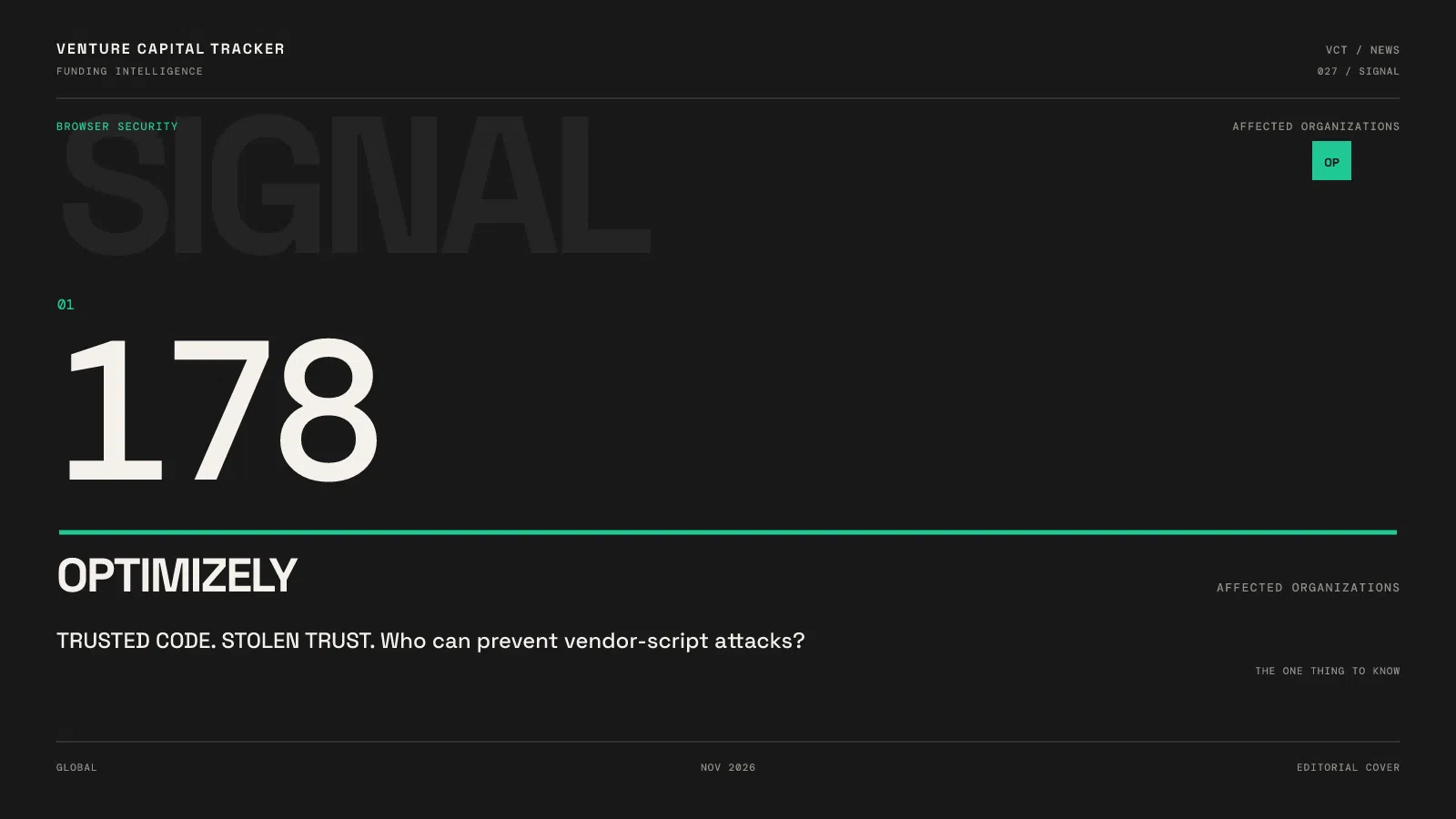
The November 16, 2026 Optimizely incident placed malicious JavaScript into 188 snippets across 178 organizations. The affected sites included major media, finance, travel and technology brands. Less than three weeks earlier, attackers abused a DebugBear monitoring integration on Polymarket and extracted approximately $2.7 million from users. The common failure was not an unpatched customer server: it was browser code delivered through a previously trusted third-party dependency.
Deal details & investors
Funding event
Feroot Security
Led by True Ventures
The question for website operators is practical: which security products can block malicious actions before a visitor loses money or data—and how much do those protections actually cost? We examined official product capabilities, vendor pricing pages, a UK government procurement filing, an AWS Marketplace offer, published customer disclosures and startup financing announcements. Prices and plan allowances below were checked on November 17, 2026.
How the two supply-chain attacks worked
Report URI researchers found that attackers inserted JavaScript into Optimizely Web projects. Optimizely said a vulnerability in its Experimentation account-signup flow enabled unauthorized access and that it subsequently blocked the issue and removed malicious code. The trusted Optimizely snippets continued to load from expected vendor URLs. The payload could replace cryptocurrency wallet addresses, skim card details from accessible checkout forms, collect page and cookie data, and route some iPhones toward exploit kits. The 178 count is affected organizations, not confirmed compromised users or stolen accounts.
On October 29, a different attack exploited a DebugBear Real User Monitoring dependency loaded by Polymarket. DebugBear later attributed the incident to DNS records compromised via its domain registrar. Malicious JavaScript used legitimate Polymarket application functions and authenticated sessions to move or sell assets. Approximately $2.7 million was stolen; Polymarket announced about $3.9 million in compensation, including trading-related losses. The two incidents have no confirmed common attacker. Report URI's Optimizely investigation and Polymarket technical analysis document the mechanisms.
These cases expose two separate defense challenges: detect or refuse malicious vendor code, and prevent even approved browser code from abusing sensitive data and transactions.
Prevention is not the same as monitoring
A dashboard reporting that a script changed does not necessarily protect the first affected visitor. The controls worth paying extra for are:
- Script pinning and loading controls. Subresource Integrity (SRI) can refuse changed fixed-version files; enforced Content Security Policy (CSP) can block unapproved scripts and destinations. Dynamic Optimizely snippets complicate pinning.
- Per-script browser permissions. Runtime enforcement can deny specific third-party scripts access to payment fields, cookies, local storage, clipboard APIs, new script injection and network destinations.
- Isolated execution. Cross-origin sandboxed iframes or isolated integrations can reduce the rights of vendor code, although they do not fit every analytics or personalization product.
- Application-side authorization. Sensitive trading, wallet, checkout and account actions must be checked independently of browser JavaScript. A trusted script can misuse a valid first-party API, as Polymarket illustrated.
- Continuous detection and response. Inventories, code-change alerts, attack simulation and rapid revocation are still essential, but should complement preventive policy.
No product listed below has independently demonstrated that it blocked these exact two historical incidents at a deployed customer. The protection claims describe advertised technical capabilities and their realistic scope.
Client-side security pricing: verified quotes vs published reference points
All prices are USD unless marked otherwise. Monthly equivalents divide a known annual amount by 12; they do not imply month-to-month billing. Historical procurement documents and third-party directory values are not live contract offers.
| Vendor and relevant tier | Published or discoverable price | Annual reference | Scope and evidentiary status |
|---|---|---|---|
| cside Business | $99/month | $1,188 at monthly rate | Vendor list price; 100,000 protected payment-page views/month; granular per-vendor permissions |
| Source Defense Essentials | $98/month equivalent | $1,176, billed annually | Vendor-displayed discounted plan; 100K monthly page views, monitoring only |
| Source Defense Standard | $197/month equivalent | $2,364, billed annually | 250K views, up to 3 domains, on-demand blocking |
| Source Defense Professional | $315/month equivalent | $3,780, billed annually | 500K views, up to 10 domains, custom runtime policies with optional automation |
| Cloudflare Client-Side Security Advanced | $0.099 per 1,000 requests | $1,188/year at 1M billable requests/month | Vendor-metered add-on; cost depends on eligible requests, not protected checkout visits |
| Jscrambler Webpage Integrity | $7,000 Visibility / $20,000 PCI / $75,000 Full for a small deployment | Term not stated in the 2024 WPI matrix | Actual UK G-Cloud procurement rate card; do not label these as confirmed annual license prices |
| HUMAN Security Code Defender | $7,200/month | $86,400 at twelve times the month-to-month listing | Vendor-sold AWS Marketplace offer for below 10M monthly unique visitors; negotiated annual contracts may differ |
| Feroot Security historical Starter | ~$415/month equivalent | From $5,000/year | Historical Feroot-published entry figure; current full runtime-protection scope and price require a quote |
| Reflectiz entry level | ~$417/month equivalent | From $5,000/year | Third-party SourceForge listing, not vendor-confirmed; module/coverage unknown |
Avoid misleading comparisons: Cloudflare charges for eligible HTTP requests; HUMAN's full-site tier charges by monthly unique visitor; cside and Source Defense meter protected page views and/or events; Jscrambler quotes deployment scope and payment-page count; and Reflectiz measures assets and purchased hubs. A $99/month option and a $7,200/month option may cover radically different amounts of traffic and functionality.
Jscrambler: a procurement document reveals the real product ladder
The UK G-Cloud 14 Webpage Integrity rate card lists:
| Webpage Integrity tier | Small | Medium | Large | What the tier is described as buying |
|---|---|---|---|---|
| Visibility | $7,000 | $15,000 | $25,000 | Visibility into sensitive-data exposure |
| PCI DSS v4 | $20,000 | $50,000 | $90,000 | Payment-page protection |
| Full Client-Side Protection | $75,000 | $125,000 | $175,000 | Full-site protection with expert management and remediation |
The filing associates small with up to two different payment pages, medium up to five and large up to eight, with further assumptions around annual transactions and full-site views. The Webpage Integrity pricing table does not explicitly label its billing period. For illustration only, if the small figures were annual, they would translate to roughly $583, $1,667 and $6,250 per month respectively. Confirm period, traffic limits, remediation and support in a new quotation.
A separate page in the same filing quotes Jscrambler Code Integrity at $25,000/year Starter, $50,000/year Enterprise and Managed from $75,000. Code Integrity is a different product for protecting application JavaScript; its prices must not be substituted for third-party vendor-script protection.
What do buyers actually get for the money?
1. cside — low-cost per-vendor runtime controls
Relevant buy: Script Security Business, $99/month for 100,000 configured payment-page views, with scaling to $499/month for 500,000 views. The separate $99 Device Intelligence/fingerprinting product is not included simply because both are called Business.
Business includes a third-party dependency graph, script payload analysis, granular per-vendor permissions, 30 days of script history, PCI DSS 4.0.1 evidence tools and a 14-day trial. Permissions can restrict form-field access, browser storage, clipboard operations, network APIs and additional script loads. Enterprise adds 90-day history, SSO, a 99.9% SLA and dedicated support. The free tier has 2,000 page views and CSP-only unauthorized-code blocking, not the Business hybrid model.
Attack relevance: Strong potential for restricting an Optimizely experiment script before it accesses card data or manipulates the clipboard. Polymarket-style first-party trading calls still require server-side limits. Company: founded 2024; $6M seed announced September 2024 led by Uncork Capital, with Mantis VC, PrimeSet, Scribble Ventures and Roar Ventures; announced cumulative funding of $7.7M. Price and feature grid · Funding announcement.
2. Source Defense — inexpensive monitoring, higher-tier active defense
Its pricing page makes the key difference explicit:
- Essentials ($1,176/year): inventory, changes, threat-domain intelligence, payment-data access monitoring, alerts, 100K page views, one domain and 30-day retention. No active policy enforcement.
- Standard ($2,364/year): behavioral baselines, manual/on-demand blocking, 250K views, three domains and 60-day retention.
- Professional ($3,780/year): custom runtime policies, optional automated enforcement, advanced field-level investigation, SSO/RBAC, 500K views, 10 domains and 90-day retention.
- Enterprise (quote): custom volume, 18-month retention, SIEM, API, webhooks and enterprise support/SLA.
The advertised figures are annually billed and display promotional/bundle savings; separate PCI and broader client-side solutions may alter the actual quote. Attack relevance: Professional is the logical comparison for proactive least-privilege browser enforcement; Essentials is not.
Company: founded 2014; April 2022 $27M Series B led by Springtide Ventures, alongside JVP, AllegisCyber, Global Brain, Connecticut Innovations, NightDragon and Capital One Ventures. Product and pricing comparison · Funding announcement.
3. Jscrambler — premium full-site control and managed remediation
Relevant buy: Webpage Integrity PCI or Full Client-Side Protection, not the Visibility-only package. Its documented Webpage Integrity controls include field-, cookie- and storage-level data fencing, behavioral drift detection and outbound network-transfer restrictions. It provides audits and customer support, with the historical procurement matrix separately identifying a managed full-site option.
Attack relevance: Strong for preventing third-party payment skimming and unexpected transfers without disabling every analytics script. Confirm whether full-site coverage includes clipboard manipulation, first-party APIs, remediation SLAs, custom policy support and support for complex dynamic vendors.
Company: founded 2014 in Portugal. Funding included more than $2.3M seed extension in March 2018 led by Sonae IM (now Bright Pixel) with Portugal Ventures, $15M Series A in September 2021 led by Ace Capital Partners, and a $5.2M investment in February 2025 subscribed by Iberis Capital. Webpage Integrity · 2025 funding announcement.
4. HUMAN Security — payment-only protection versus whole-site Code Defender
HUMAN's documentation distinguishes three tiers, whose billing bases are not interchangeable:
| Package | Documented scope | Pricing basis |
|---|---|---|
| Core | PCI DSS payment-page inventories and compliance | Monthly payment-page views; quotation |
| Premium | Core plus active protection of cardholder data on payment pages | Monthly payment-page views; quotation |
| Elite | Broader site-wide visibility, data leak prevention and script monitoring | Monthly unique visitors; quotation |
An AWS Marketplace offer sold by HUMAN lists CODE DEFENDER at $7,200 for one month for an enterprise configuration below 10M monthly unique visitors, or $86,400 over 12 months at that monthly rate. This is not a confirmed current annual Elite quotation; the feature package and overages require an offer-specific contract. Another AWS listing shows nominal $0.01 private-offer placeholders, which are not real license prices.
Attack relevance: HUMAN documents fine-grained browser-action mitigation and automated controls to block risky field reads, external transfers and cookie operations. Buyers seeking general Optimizely-style full-site protection should test the whole-site configuration rather than assuming payment-only Core suffices.
Company: roots in White Ops, founded 2012. HUMAN announced over $50M growth capital in October 2024, led by WestCap, alongside Goldman Sachs, ClearSky, NightDragon and Vertex Ventures US. Licensing guide · Product controls · Funding announcement.
5. Feroot Security — historical affordable entry, but confirm enforcement package
Feroot's own historical guide stated Starter packages from $5,000/year for browser-side security and PCI workflows. Its current website offers Assess, Govern and Enterprise tiers across PaymentGuard, DXSecure and privacy products, all by quote. The historical $5K number cannot establish what a November 2026 full-prevention deployment costs.
For payment security, Feroot describes:
- Assess: up to 10 sites/apps and 20 payment pages, script inventory, integrity checks, PCI evidence and security rules.
- Govern: up to 20 sites/apps and unlimited payment pages, stronger policy governance and payment-field protection.
- Enterprise: larger portfolios, up to 5,000 domains, combined privacy/security modules and an enterprise SLA.
Feroot's PaymentGuard documentation says runtime policy enforcement is optional and can restrict scripts from touching card, email and password fields. Its current plan matrix also lists blocking and runtime control for the tiers; a quotation should clarify whether this is switched on by default, an add-on or requires configuration.
Attack relevance: PCI and formjacking prevention on sensitive flows; test whether generalized DOM, clipboard and first-party transaction manipulation are covered. Company: founded 2017; $14M Series A announced November 2025 led by True Ventures with Industry Ventures, Preface Ventures and Y Combinator; the company reported $25M total funding. Historical price · Current packages · Funding.
6. Reflectiz — third-party $5K entry reference, agentless monitoring and containment
SourceForge lists Reflectiz from $5,000/year, depending on number of assets and features. That is an unverified third-party starting point, not a published offer from Reflectiz. The vendor's own package page requires a quote.
The Security Hub Standard package lists browser-execution analysis, alerting, AI-assisted script approvals, deobfuscation, on-demand script blocking, API/SIEM integrations and post-authentication flow monitoring. Professional adds multi-site governance, exposure ratings, reporting and customer-success support. Enterprise adds SSO/RBAC, custom workflows and deeper integrations. Its PCI Module is separately purchasable, with script monitoring, iframe and fourth-party detection, header-change evidence and exports for assessors.
Reflectiz uses agentless remote browser analysis rather than a sensor running in every actual visitor session. This lowers deployment effort, but cannot be equated with preconfigured fine-grained access restrictions on the real visitor's browser. Its primary preventive action is containment after discovery through blocking policies.
Company: founded in the late 2010s; announced a $22M Series B in October 2025 led by Fulcrum Equity Partners, alongside Capri Ventures, YYM Ventures and AFG Partners. Current package matrix · Series B announcement.
7. Cloudflare — low usage price, but browser-native CSP restrictions
Cloudflare lists Client-Side Security Advanced at $0.099 per 1,000 eligible requests. At exactly one million billable requests in a month that is $99/month; at ten million requests it is $990/month. The billable request count is not necessarily equivalent to HTML views or transactions. A 2026 Cloudflare community discussion specifically raised concern that the product's estimated request volume could include asset traffic; confirm billable scope in the dashboard.
Basic Client-Side Security collects script information on all plans, with additional connection/cookie monitoring on Business and Enterprise. Advanced adds malicious-script detection, code-change alerts and positive blocking through content-security rules (five rules in the documented feature table).
Attack relevance: CSP can block unapproved second-stage scripts or outbound destinations. It is not equivalent to isolating a previously allowed Optimizely script from the page's sensitive fields or Polymarket's legitimate APIs. Company: founded 2009; now publicly traded (NYSE: NET), so should be labeled an incumbent, not an emerging startup. Pricing · Feature availability.
The investor map: who funded preventive browser security?
This is more than a list of vendors. It is a category financed by seed-stage cybersecurity investors, growth-equity funds and corporate venture capital.
| Security company | Selected verified round | Lead investor | Other named participants |
|---|---|---|---|
| cside | $6M seed, 2024 | Uncork Capital | Mantis VC, PrimeSet; returning Scribble Ventures and Roar Ventures |
| Jscrambler | $15M Series A, 2021 | Ace Capital Partners | Sonae IM/Bright Pixel, Portugal Ventures |
| Jscrambler | $5.2M follow-on, 2025 | Iberis Capital (sole subscriber) | — |
| Source Defense | $27M Series B, 2022 | Springtide Ventures | JVP, AllegisCyber, Global Brain, Connecticut Innovations, NightDragon, Capital One Ventures |
| HUMAN Security | Over $50M growth capital, 2024 | WestCap | Goldman Sachs, ClearSky, NightDragon, Vertex Ventures US |
| Feroot Security | $14M Series A, 2025 | True Ventures | Industry Ventures, Preface Ventures, Y Combinator, existing investors |
| Reflectiz | $22M Series B, 2025 | Fulcrum Equity Partners | Capri Ventures, YYM Ventures, AFG Partners, others |
These are funding-round amounts, not vendor product prices or company valuations. Investors and funding dates are linked to the company and investment-event profiles in Venture Capital Tracker.
Six questions to ask before paying for prevention
- What is blocked before the first victim? Show a preconfigured policy denying a trusted vendor script access to a card field, clipboard and unauthorized request. Detection alone does not pass.
- What happens when a trusted script changes but its URL does not? Test same-domain updates and secondary loaders without warning labels.
- What happens when malicious JavaScript calls a legitimate same-origin API? Require transaction-layer authorization. No browser-side vendor should promise that simply inspecting URLs solves this.
- What pages and sessions are covered? Compare all-site coverage, payment-only coverage, actual-user sensors, remote scans, geographic targeting and authenticated flows.
- What is the total billing basis? Confirm domains, protected pages, page views, visitor counting, event quotas, overages, retention, SIEM/SSO, support and policy-management costs.
- Can the product run under an enforced CSP, with a tag manager, and without breaking checkout? Test performance, false positives, failure modes and rollback on a staging environment before production.
Verdict: the best products differ by budget and threat model
For small websites that want active controls, cside Business is the clearest published $99/month benchmark. For mid-market ecommerce, Source Defense Professional adds documented policy-driven protection at a displayed $3,780/year; compare its contract and PCI bundle scope carefully. For regulated enterprises with full-site requirements, Jscrambler and HUMAN have the longer enterprise histories, but priced procurement offers show that full protection may cost tens of thousands annually. Feroot is a credible PCI and sensitive-data option with a historical $5K starter reference, whereas Reflectiz is particularly interesting for agentless dependency discovery and containment.
The crucial procurement rule is simple: do not compare a monitoring plan with an active-blocking plan as though they prevent the same attack.
Research methodology (November 17, 2026): prices are labeled vendor list, public procurement, marketplace offer, historical vendor reference or third-party directory. Monthly equivalents of annual prices are arithmetic only. No vendor's advertised coverage is presented as independently validated prevention of the Optimizely or Polymarket incidents.
Last updated:
Editorial note: AI tools assisted with research, structure, or drafting. Venture Capital Tracker retains human editorial responsibility for factual accuracy, relevance, and source quality before publication.