· 9 sources · Verified
Sofinnova Crossover II Closes at €725M: The EIF Commitment and Biotech Founder Fit
A European Investment Bank report traces substantial institutional backing to 2024. For clinical-stage founders, the real test is whether concentrated crossover capital can finance decisive trial data and commercialization without assuming an IPO will be available.

By Venture Capital Tracker Editorial Desk
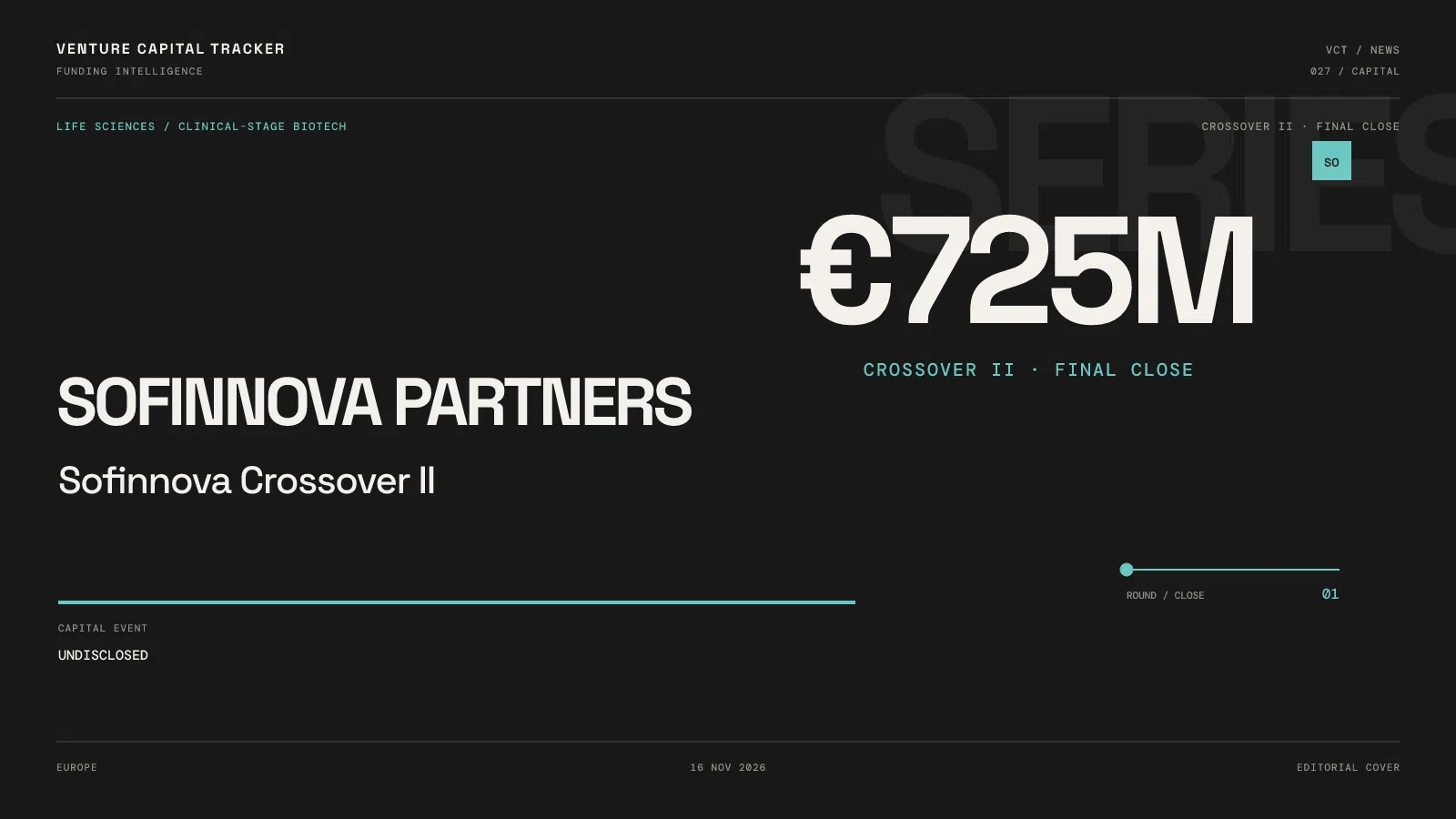
Sofinnova Partners is building a relatively concentrated portfolio of clinical-stage biopharma and medical-device businesses, not opening a broad seed fund. Its Crossover II vehicle targets approximately 15 companies, primarily European, that have made enough scientific or clinical progress to need significantly larger, longer-horizon rounds before a potential product launch. The manager names Hemab Therapeutics, CellCentric and Neurent Medical as investments already made.
Deal details & investors
Fund close
Sofinnova Partners
Backed by European Tech Champions Initiative / EIF
That distinction matters to both founders and limited partners (LPs). A startup with a credible laboratory discovery but no evidence in patients may be too early for this strategy. A company with clinical evidence, a defensible development plan and an impending expensive trial could be a better fit—but the investment case still depends on trial outcomes, regulatory decisions, future financing and market access. There is no guarantee of an IPO or acquisition, and a fund commitment is not the same thing as cash already invested in patients' treatments.
What a crossover investor actually buys
Crossover refers to capital invested around the transition from later-stage private development to potential public-market or commercial scale. The term does not mean every portfolio business will list. Sofinnova's strategy description explicitly covers public and private clinical-stage biotech and medtech companies with initial proof of concept.
For a drug developer, the operative question is whether the next trial can generate evidence robust enough to support regulatory progress, a pivotal study, a licensing discussion or a future financing. That involves patient recruitment, trial design, manufacturing readiness, safety monitoring and potentially years before meaningful revenue. For a medical-device company, the route may also require clinical validation, approvals, clinician adoption, reimbursement and commercial distribution. A crossover fund invests in that progression; it does not eliminate those risks.
The manager has not published a universal minimum cheque size, ownership target, fund fees or carried interest for Crossover II. Nor has it disclosed the precise legal closing date separately from its November 16, 2026 announcement. The claim that its €725M fund finalized fundraising is a GP-issued final-close statement, not evidence that it deployed that sum on the announcement day.
The €250M LP entry that predates the headline
The most revealing independent source sits in a government investment ledger, not a funding-news recap. On page 58 of the European Investment Bank Group's 2024 Lending Report, under European Investment Fund (EIF) signatures in France, equity, the line for “SOFINNOVA CROSSOVER II” records €250.0 million. The table is explicitly dated as at December 2024. The original EIB report supplies an unusually concrete anchor for institutional participation.
Sofinnova's November 2026 announcement separately names the European Tech Champions Initiative, an EIF-managed fund of funds, as a backer. It is reasonable to connect the two as evidence that EIF-related institutional capital was associated with this vehicle well before the final-close announcement. It is not reasonable to present the €250M as an extra 2026 injection on top of the final fund size, assume every euro has already been called or deployed, or assert the full LP schedule is public.
The 2024 signature equals roughly 34% of the eventual €725M fund total arithmetically, but that percentage is not a disclosed breakdown of drawn capital, economic ownership or investment returns. Other LP identities, commitments and fee terms remain largely undisclosed.
Which amount belongs to which vintage?
| Public date | Fund or milestone | Reported amount | Correct reading |
|---|---|---|---|
| 4 April 2018 | Crossover I launch / initial close | €275M | First commitments, not a separate fund from the later 2021 close |
| 3 March 2021 | Crossover I final close | €445M | Total commitments at final close, including earlier close capital |
| 2024 report (as of December) | EIF signature associated with Crossover II | €250M | Prior institutional equity signature, not a startup investment or incremental 2026 close |
| 16 November 2026 | Crossover II final-close announcement | €725M | Total commitments for the second crossover vehicle |
The second vehicle is €280M, approximately 63%, larger than the first's final announced fund size. That is a capital-raising comparison, not a return or performance measure. The manager's other strategies—including early-stage biotech and medtech vehicles—must not be added to either crossover fund as though they were the same pool.
What the first three disclosed holdings actually indicate
CellCentric: a late-stage oncology trial financing problem. In a May 6, 2026 primary announcement, CellCentric disclosed a $220M Series D led by Venrock Healthcare Capital Partners, with Sofinnova among the participating investors. Its experimental oral medicine inobrodib is being studied for multiple myeloma, with financing intended for registration-enabling studies and additional clinical development. That is concrete evidence of the type of costly clinical milestone a crossover investor may fund. It is not approval, product revenue or proof the medicine will succeed; the company's stated trial schedule is an intention, not a completed regulatory outcome.
Hemab Therapeutics: specialist clinical development. Sofinnova names Hemab as a Crossover II investment. Its work in serious bleeding disorders entails specialized clinical endpoints, trial recruitment and the possibility of substantial financing needs before a treatment can be commercialized. An investor's participation and any company-reported development updates should not be confused with approved treatment, independently verified efficacy or guaranteed market access.
Neurent Medical: a device has a different go-to-market gate. Neurent develops technology for chronic-rhinitis treatment. Even when a device has a regulatory route that differs from a therapeutic drug's, commercialization still depends on physicians adopting the procedure, clinical evidence, reimbursement, supply and patient selection. Sofinnova identifies Neurent as an investment, but does not publish its precise Crossover II cheque or a fund-attributed product revenue figure.
These three examples span rare-disease therapies, oncology and medical devices. They indicate a broader investment mandate than a pure drug-discovery fund, but they are selected disclosed holdings—not an audited performance sample of the completed portfolio.
An illustrative founder's route to the investment committee
Sofinnova has not described a public five-stage application or guaranteed investment process for this fund. The following is a practical due-diligence sequence a clinical-stage founder could prepare for, not a claim that VCT tested the manager's deal process:
- Show the actual maturity gate. Present human clinical data or a credible device-validation dossier, the current regulatory status and precisely which questions the next study will answer. Separate observed results from projections.
- Translate the study into a financing plan. Specify enrollment costs, clinical manufacturing, cash runway, milestones and realistic contingencies. A fundraising slide that only says “advance the pipeline” is not enough.
- Explain commercial access before it happens. Who will prescribe or buy the product? What evidence, approvals, reimbursement or distribution partnerships are still required? Are alternative therapies already available?
- Show the syndicate and governance. Detail existing investor ownership, intellectual property, collaboration rights, board responsibilities and prospective co-investors. A prospective crossover round need not be an IPO commitment.
- Evaluate concentration and follow-on risk. Ask how the GP thinks about reserves, future financings and possible down-rounds. The fund targets a small number of holdings, but no fund-specific standard cheque, reserve ratio or contractual terms have been publicly established.
For an LP, the parallel diligence questions concern called versus uncalled capital, legal vehicle and fee structures, deployment cadence, concentration, valuation marking, distribution timelines and whether selected exits reflect whole-fund performance. None can be reliably reconstructed from the headline or manager-selected portfolio successes alone.
How this sits beside other European life-sciences capital
Sofinnova's manager profile spans company creation, earlier-stage funds, specialized medtech creation and crossover capital. The €725M vehicle therefore should not be described as a new general-purpose seed fund. Its September 2026 €82M MD Start IV close, for example, relates to a company-creation medtech strategy—not incremental Crossover II commitments.
European specialists such as Forbion also operate distinct venture and later-stage healthcare strategies. The useful comparison is not merely total fund size: founders need to establish whether a given vehicle can lead a substantial clinical financing, bring the right regulatory or commercial expertise and support follow-on needs. A precise cross-manager cheque-size ranking would be misleading without comparable manager-issued data.
An interview with partner Kinam Hong says Sofinnova expects roughly 80% of Crossover II's investing to focus on European companies and that it typically invests in fewer than 3% of reviewed opportunities. Those are manager-stated intentions and selectivity claims, not independently audited future portfolio allocation or a promised acceptance rate. Reuters and BioPharma Dive separately describe the financing shortage facing European companies as they progress through trials.
The questions a completed fundraising announcement cannot answer
The new fund's final-close number is verified from its own dated announcement. What is not publicly established includes the exact legal close day, the full LP roster, whether or how the EIF signature maps to particular investment sleeves, paid-in capital, net deployable reserves, fee/carry terms, individual holdings' investment size, realized returns and ultimate trial outcomes. Its predecessor's cited IPO and acquisition examples are important history, but they are not a verified fund-level internal rate of return.
The consequential test is whether this concentrated capital can help European clinical innovations withstand long development timelines and reach decisive evidence. That will become visible in actual trial, financing, approval and commercialization milestones—not from reissuing the same fundraising headline.
Follow Venture Capital Tracker on Google
Add VCT as a preferred source to see more of our venture-capital reporting in Google Search.
Editorial note: AI tools assisted with research, structure, or drafting. Venture Capital Tracker retains human editorial responsibility for factual accuracy, relevance, and source quality before publication.