· 9 sources · Verified
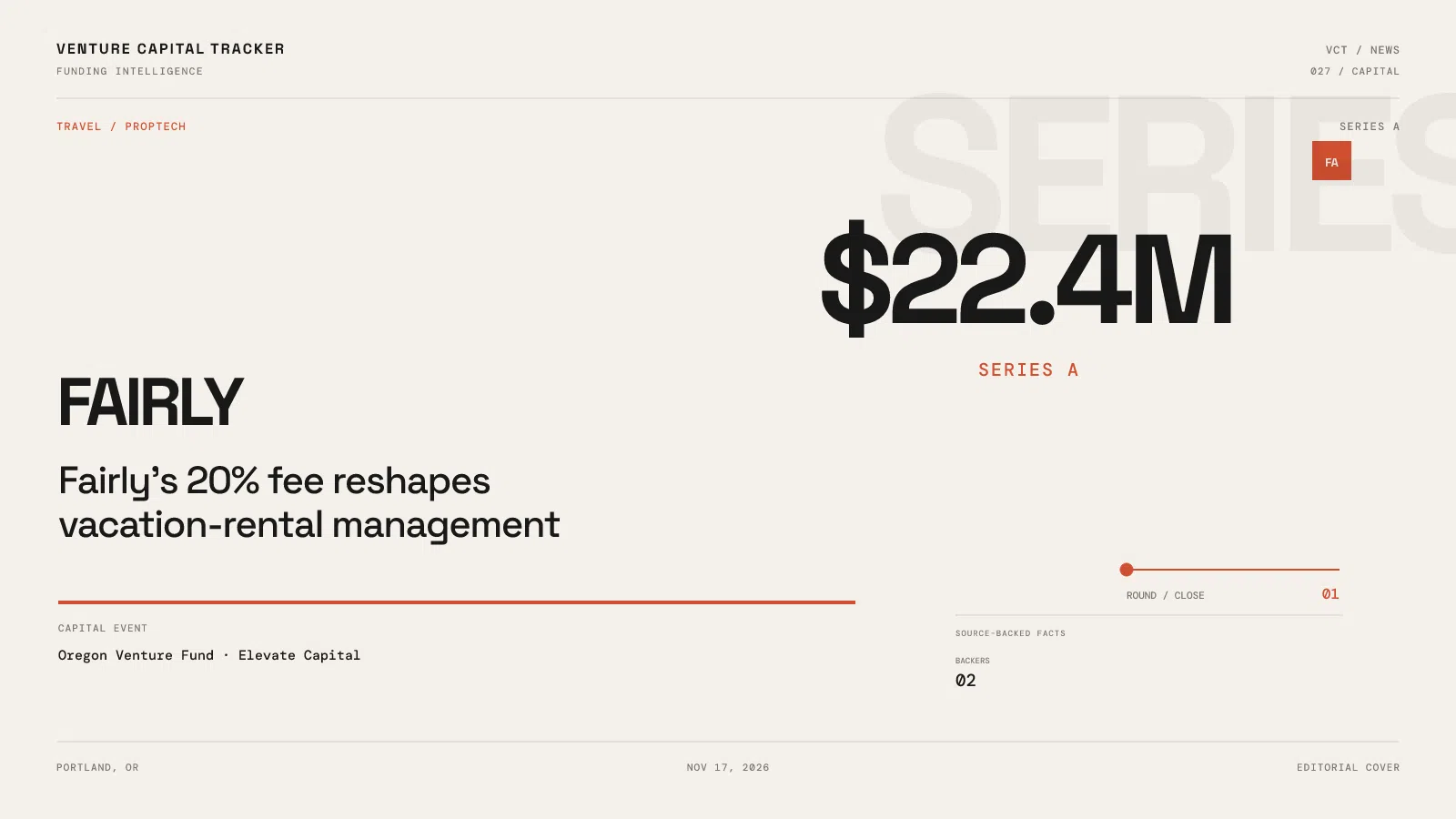
Fairly Raises $22.4M Series A: What Its 20% Vacation-Rental Fee Really Covers
Vacasa's founder is trying a local-caretaker model instead of centrally dispatched teams. Its published owner terms reveal the true fee base, optional insurance, the restrictions on a revenue guarantee and the difference between guest bookings and company revenue.

Editorial team
Fairly is betting that a vacation home works better with one accountable local operator than with a centrally dispatched crew. It supplies the booking technology, owner dashboard and pricing guidance, while the homeowner chooses an independent caretaker who knows the property. This is a different proposition from simply buying software to list an Airbnb: the day-to-day operational work is supposed to happen locally.
Deal details & investors
Funding event
Fairly
Led by Oregon Venture Fund
The important buyer question is not whether 20% sounds cheaper than a competitor's headline commission. It is what that percentage applies to, which services it buys, who remains liable when something goes wrong, and what the homeowner actually keeps. Fairly's owner contract, updated November 5, 2026, provides unusually useful answers — and some restrictions that its marketing headline cannot convey.
How a Fairly vacation rental actually runs
The following is an illustrative owner journey reconstructed from Fairly's published product pages, help center and terms, not a hands-on test or verified customer outcome.
- Model the property. An owner enters the home's location and details to request an income projection, then assesses the demand assumptions rather than treating the projected yield as guaranteed.
- Choose the person on the ground. Fairly introduces prospective local caretakers; the owner evaluates one and agrees on cleaning services and fees. The contract for these services is between the owner and caretaker, not with Fairly.
- Connect listings and operations. Property information, house rules, photos and availability go into the Fairly platform. Distribution can include Airbnb, Vrbo, Fairly's direct channel and other sources; the Fairly calendar is the contractual system of record for availability.
- Set and adjust prices. Fairly provides nightly pricing guidance, but owners ordinarily retain control of rates. There is an important exception when trying to qualify for its revenue guarantee: that requires following the platform's pricing rules.
- Run each stay. Fairly coordinates guest messages and booking information; the caretaker handles cleaning, turnovers and local issues. The owner can see calendar, guest communications and financial records.
- Review payouts and performance. Fairly initiates owner payouts after checkout for shorter stays, subject to funds arriving from the booking channel. Caretakers receive cleaning payments separately; the percentage share is settled on a monthly schedule.
This arrangement may appeal to an owner who wants local attention without paying a traditional full-service management quote. It also carries dependency risk: if the chosen caretaker is unavailable or underperforms, the platform alone cannot clean or repair a home.
What the 20% fee buys — and what the guest still pays
The November 2026 Owner Terms define a 20% Fairly Platform Fee on “Qualified Rent”. That is net rental revenue through the platform after excluding refunds, channel fees, payment-processing pass-throughs, cleaning fees and taxes. It is not 20% of the entire checkout bill.
Fairly's caretaker recruitment page advertises a 5% share of completed rental reservations plus the cleaning fee the caretaker sets; the firm retains the remainder of the platform fee before any other payouts and operating expenses. Its fee help page notes that certain direct-booking processing fees, ordinarily around 3% of the relevant reservation charges, are passed to guests. On third-party channels, channel fees can affect what the traveler sees and the owner's eventual settlement.
Here is a deliberately simplified annual illustration using $60,000 of Qualified Rent — not $60,000 of total guest spending, gross bookings or a forecast for any specific home:
| Illustrative allocation | Annual amount | Interpretation |
|---|---|---|
| Qualified Rent | $60,000 | Defined contractual fee base |
| Fairly Platform Fee, 20% | $12,000 | Charged to owner |
| Of that fee, caretaker share, 5 percentage points | $3,000 | Paid to caretaker, not an additional 5% owner charge |
| Remaining platform-fee share, before other arrangements/costs | $9,000 | Not audited company revenue or profit |
| Owner's balance after platform fee | $48,000 | Before property expenses, optional coverage, financing, taxes and other applicable costs |
This example does not assume a number of booked nights or uniform nightly rates. Cleaning fees, taxes and channel costs have been excluded from the fee base rather than silently treated as Fairly's revenue.
The optional protection programs are separate. Under Fairly's Safely coverage guide, the guest can opt to pay $10 per occupied night for damage coverage up to $25,000 per eligible stay; the owner can opt for liability coverage of $5 per occupied night, deducted from earnings, with a stated limit up to $1 million per eligible stay. At 200 eligible occupied nights, that owner-paid liability product alone would cost $1,000. Limits, exclusions and eligibility still matter. Neither coverage should be advertised as automatic or included in the 20% fee.
The $5,000 guarantee is conditional, not a minimum return
Fairly advertises a first-year revenue improvement guarantee, but the current agreement's Section 8 sets a significantly narrower test than “every owner earns $5,000 more.” An eligible owner must submit a full previous-year reservation history before the first Fairly booking so that Fairly can confirm a net-rental-revenue baseline. The target is that baseline plus $5,000, but any payout is capped at the Fairly platform fees paid during the guarantee year.
Owners must follow pricing guidance, maintain qualifying availability and remain active for the full term. Blocked or personal-use nights may be counted as imputed rental income, reducing a potential shortfall. Violations of price settings, owner cancellations, early termination or extended unavailability can void the guarantee. Therefore, an owner who wants complete independent pricing control should not presume they will also qualify for the guarantee. This nuance is more important to a purchase decision than simply repeating its headline.
Does Fairly beat Evolve, Vacasa or self-management?
A like-for-like comparison needs a local service inventory, not just percentages.
| Option | Published management/listing price | Operational distinction |
|---|---|---|
| Fairly | 20% of Qualified Rent | Dedicated independent local caretaker plus central software and guest operations; separately chosen protection |
| Evolve Core / Plus | 10% / 15% management fee | Listing, pricing and guest support; owners need to check local services and protection details for the selected tier |
| Evolve Pro | Custom fee | Portfolio services and quote-dependent scope |
| Vacasa / Casago network | Property-specific quote | More conventional locally delivered full-service arrangement; compare contracts and actual staffing |
| Houfy | No booking commission on its listing plans; optional paid software | Mostly a direct-booking/listing tool, not a substitute for locally managed turnovers or guest emergencies |
Evolve's published plans include different protections, including specified damage and liability limits; Houfy's November 2026 pricing advertises a free plan subject to a host verification cost and paid optional tiers. Houfy also identifies a guest-paid API fee on certain integrations. A 10% fee for a different service bundle is not proof that Evolve is cheaper on an equivalent fully outsourced operating basis, just as Fairly's 20% does not prove that it undercuts every conventional manager. Obtain a net-owner statement and verify who responds to guests at 2 a.m.
Two further lock-ins matter. Fairly's owner terms make its calendar the system of record and restrict simultaneous instant-bookable off-platform calendars for the same property. Its caretaker agreement contains a 24-month non-solicitation/non-circumvention clause concerning owners introduced through Fairly. Those are real implementation and switching considerations even if the owner avoids a long fixed management contract.
What the Series A finances — and what it does not prove
Fairly's November 17 announcement identifies Oregon Venture Fund as lead, with Elevate Capital and founder Eric Breon participating. The company previously disclosed $10.1 million pre-seed financing when it emerged publicly in December 2024, making $32.5 million disclosed across the two financings. It has not released a round valuation, dilution, investor ownership percentages or an audited profit figure.
Breon's connection matters operationally: he founded vacation-rental operator Vacasa, which went public in 2021 and was later acquired by Casago. Fairly replaces part of that centralized staffing approach with independent local businesses, while using software and AI to coordinate price suggestions, messaging and maintenance flags. That is a plausible scale hypothesis, not yet measured proof that service quality or company-level unit economics are better.
The company reports roughly 2,000 homes, nearly 900 caretakers and coverage across 47 US states, plus more than $66 million in guest reservations during the past year, compared with approximately $5 million the year before. Those figures describe booking value and reach, not recognized management-fee revenue. As a purely illustrative ceiling if every dollar of reported reservations were Qualified Rent subject to a uniform 20% fee, 20% of $66 million would be $13.2 million in fees before caretaker shares, discounts, exclusions and expenses. Because actual Qualified Rent and take rate are not disclosed, this is not an ARR estimate. Dividing the reported bookings by roughly 2,000 listed homes would also conceal when each home joined the network, occupancy differences and seasonal markets.
For investors, the next questions are owner retention, active-booked-home cohorts, caretaker availability, net take rate after sharing, customer acquisition cost, claims experience and the cost of supporting more markets. For a prospective owner, the questions are much nearer term: can you meet your actual caretaker, view comparable local payout statements, review the guarantee rules, and test the cost with and without optional coverage?
The structured Fairly company and financing profile and VCT's Oregon Venture Fund and Elevate Capital profiles preserve investor relationships without confusing guest reservations, management fees and venture capital proceeds.
Follow Venture Capital Tracker on Google
Add VCT as a preferred source to see more of our venture-capital reporting in Google Search.
Editorial note: AI tools assisted with research, structure, or drafting. Venture Capital Tracker retains human editorial responsibility for factual accuracy, relevance, and source quality before publication.