· Venture Capital · 15 sources · Updated · Verified
AI Drug Discovery Companies in 2026: Funding, Investors and Clinical Progress
Compare AI drug-discovery startups and public companies by new financing, backers, pharma partnerships, software-vs-drug business model and clinical progress.

Editorial team
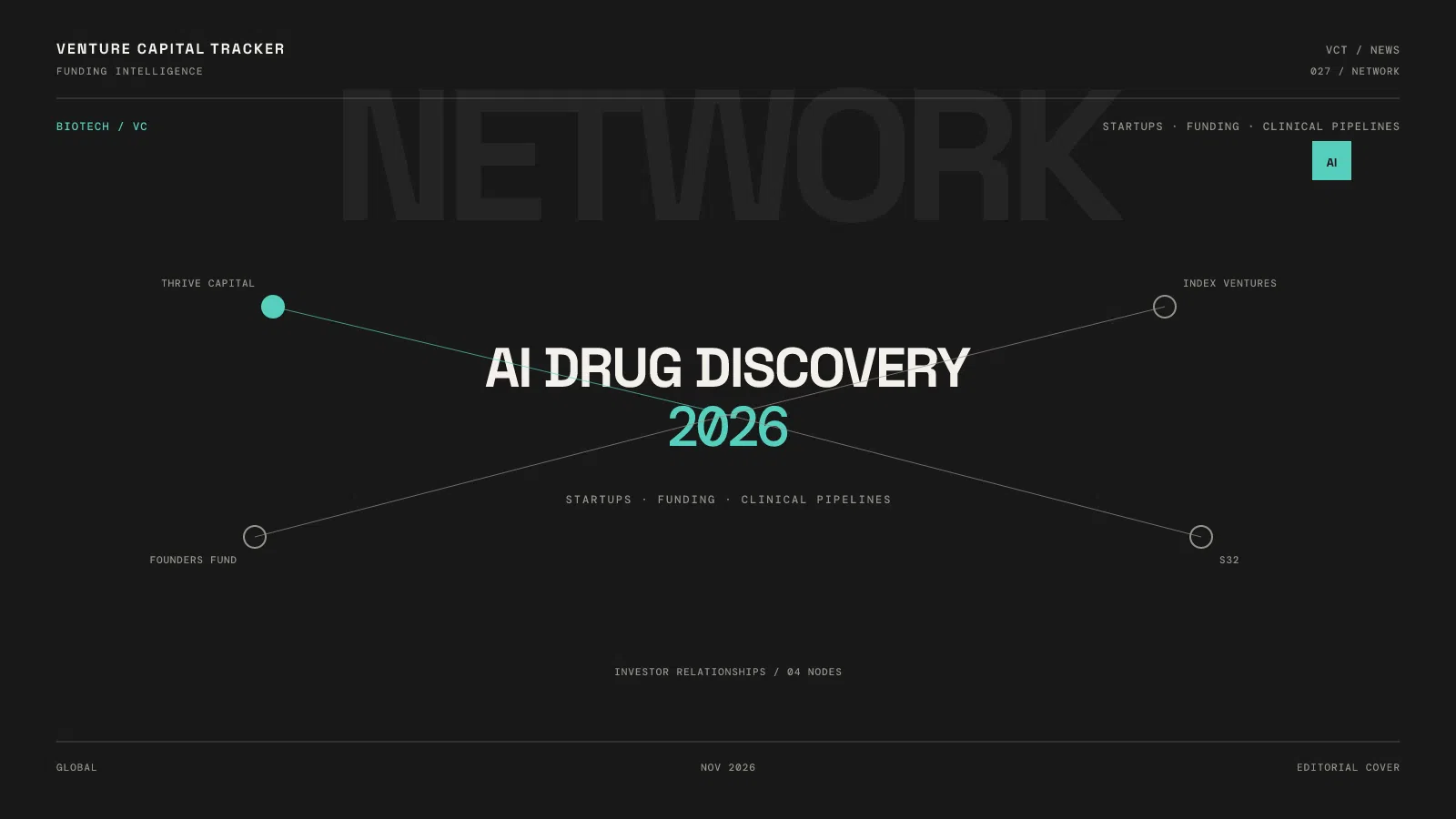
AI drug discovery is not one market. Some companies sell molecular-design tools; others build the experimental data those tools need; some hold the rights to medicines and finance clinical trials. Comparing all of them by the amount of venture capital raised can therefore be misleading.
For readers looking for actual companies rather than a general explanation of artificial intelligence in pharmaceuticals, this guide separates funding, business model, pharma customers and clinical evidence. Figures are dated to November 13, 2026.
The biggest disclosed 2026 startup financing rounds
These are selected new company financing rounds, not a complete global ranking. They are ordered by disclosed transaction size; a larger round is not evidence of better science or greater revenue.
| Company | 2026 financing | Named lead / major backers | What the capital is intended to support |
|---|---|---|---|
| Isomorphic Labs | $2.1B Series B, May 12 | Thrive Capital; Alphabet, GV, MGX, Temasek and others | Scale AI drug design and move an internal pipeline toward the clinic |
| NewLimit | $435M Series C, June 2 | Founders Fund; Thrive, Greenoaks and others | Epigenetic reprogramming medicines for diseases of aging |
| Chai Discovery | $400M Series C, July 14 | Index Ventures and other growth investors | Molecular and antibody-design models and pharmaceutical deployments |
| Enveda | $311M Series E, September 23 | Catalio Capital Management and other new/returning investors | Progress natural-chemistry-derived clinical assets |
| Pathos AI | $237M Series E, October 23 | Bristol Myers Squibb; existing investors | Advance a four-asset clinical oncology portfolio |
| Basecamp Research | $140M Series C, September 23 | S32; NVIDIA, Menlo Ventures' Anthology Fund and others | Develop biological AI models and move therapies toward human testing |
| BigHat Biosciences | $75M Series C, September 24 | DFJ Growth and Premji Invest | Expand automated protein-design research and clinical programs |
| Boltz | $28M seed, January 8 | Amplify, a16z and Zetta | Open molecular models, enterprise agents and Boltz Lab |
Chai disclosed a $3.8 billion valuation in its July 14 company announcement. The announcement does not specify whether that figure is pre- or post-money. This valuation is not an additional $3.8 billion of new funding.
NewLimit is included as an adjacent computationally enabled biotech, not characterized as a pure molecular-model vendor. Funding amounts above are individual 2026 rounds; they are not total capital raised. Isomorphic, Chai and others may also receive research, development or licensing payments, but those are different transaction types.
Two important historical and public-market comparisons
Xaira Therapeutics launched in April 2024 with more than $1 billion of committed capital, led by ARCH Venture Partners and Foresite Capital. That is a 2024 financing milestone, not a fresh 2026 round.
Two AI-associated clinical drug developers also accessed public markets in 2026. Generate Biomedicines priced an IPO with $400 million expected gross proceeds in February; Iambic Therapeutics priced an IPO with $150 million expected gross proceeds in October. Those are IPO proceeds, not venture rounds.
Company map: who sells software and who develops drugs?
A useful way to understand the sector is to follow the end customer and the asset being financed.
1. Molecular-design models and research software
| Company | Main business | Commercial or investment signal |
|---|---|---|
| Chai Discovery | Models for designing antibodies and other molecules | $400M Series C; disclosed collaborations with Pfizer, Lilly, Novartis, BMS and Roche |
| Boltz | Open biomolecular models, agents and drug-discovery software | $28M seed; multiyear Pfizer partnership |
| Schrödinger | Physics-based molecular modeling and drug-development software | Established software business and drug-development collaborations; a public company, not a new startup |
| Genesis Molecular AI | AI-assisted small-molecule drug design | Development collaborations, including Gilead and Incyte |
| Absci | Generative antibody discovery coupled to laboratory testing | Publicly traded, with proprietary therapeutics and partner programs |
| Profluent | AI protein and gene-editing design | Platform-and-partnership business; assess delivered tools separately from clinical outcomes |
| Nabla Bio | Antibody discovery and design | Model-driven biologics collaboration strategy |
| XtalPi | AI, simulation and laboratory automation for molecular discovery | Listed company; commercial research and development services |
A signed pharma partnership is a meaningful customer signal, but a headline potential milestone total should never be presented as revenue already earned. Investors should ask which agreements include actual upfront cash, research funding, exclusivity, customer renewal or ownership of later drug economics.
2. Companies developing proprietary therapeutic assets
| Company | Focus | What to verify next |
|---|---|---|
| Isomorphic Labs | AI-designed medicines; partnerships and internal pipeline | Named clinical assets and human trial progress |
| Enveda | Drugs discovered from naturally occurring chemistry | Larger trials following its 2026 early clinical readouts |
| Pathos AI | AI-informed oncology asset selection and development | Trial execution, individual asset economics and data |
| Basecamp Research | New therapeutic designs informed by large biological datasets | Transition from preclinical findings to human studies |
| BigHat Biosciences | AI-engineered protein therapeutics and automated experiments | Clinical safety and proof of efficacy |
| Xaira Therapeutics | End-to-end AI-enabled therapeutic development | Independently validated drug candidates relative to capital committed |
| insitro | Machine learning, human genetics and proprietary disease data | Target validity, partner economics and pipeline maturation |
| Recursion | Data-intensive biology, automation and clinical-stage drug programs | Clinical readouts and operating cash requirements |
| Insilico Medicine | AI-driven target and molecule discovery plus drug development | Results from rentosertib's Phase III trials |
| Iambic Therapeutics | AI and automated experimentation for small-molecule oncology medicines | Clinical outcomes after its October 2026 IPO |
| Generate Biomedicines | Computationally designed biologic medicines | Pivotal clinical outcomes following its February IPO |
| Relay Therapeutics | Computational and experimental precision medicines | Clinical differentiation and commercial partnerships |
| NewLimit | Cell reprogramming and rejuvenation-oriented therapeutics | Whether preclinical cellular findings translate into human benefit |
This is not a ranking of medical effectiveness. Companies have different modalities, diseases, maturity levels and regulatory obligations. Several are publicly traded; others are private; some are platform providers as well as asset owners.
Insilico's September 2026 announcement of the first patient dosed in a Phase III rentosertib trial is one unusually concrete point on that progression. Phase III entry demonstrates development maturity, not treatment approval or demonstrated efficacy in the pivotal trial.
3. Data platforms and clinical-development systems
| Company | What it is trying to improve | Principal diligence question |
|---|---|---|
| Formation Bio | Clinical asset selection and execution with shared AI tools | Can the shared operating model consistently reduce trial cost and time? |
| Owkin | Patient and multimodal biological data for precision medicine | Are models externally validated across hospitals and patient populations? |
| Immunai | Immune-cell mapping and disease modeling | Does better immune profiling improve development decisions? |
| Noetik | AI models trained on tumor biology and patient data | Do predictions generalize to new clinical cohorts? |
| Unlearn | Digital-twin approaches to trial analytics | Will methods satisfy prespecified statistical and regulatory requirements? |
| Medra | Robotics and laboratory automation | What measurable laboratory throughput and reliability can it deliver? |
| Octant Bio | Cellular measurement and engineered therapeutic discovery | Can cell-level platform outputs become viable clinical programs? |
These businesses are often grouped with AI drug discovery, but the buyer, contract and moat may be completely different from those of a company owning a drug candidate. For example, clinical development software could become commercially useful long before the drug it helps test earns approval.
Which companies actually have pharma partnerships?
A partnership can mean a software license, joint experimentation, a target-discovery research program, a drug-license transaction, or strategic investment. Those should not be merged into a single partnership count.
- Chai Discovery announced agreements in 2026 involving Lilly, Pfizer, Novartis, Bristol Myers Squibb, GSK and Roche. Terms vary and not every payment is disclosed.
- Boltz announced a multiyear Pfizer relationship alongside its January launch.
- Isomorphic Labs has disclosed collaborations with major pharmaceutical companies while also developing its own research pipeline.
- Pathos's October financing was led by Bristol Myers Squibb. An equity investment is not interchangeable with the future revenue from a licensed drug.
- BigHat disclosed investment and commercial relationships with drugmakers including Lilly and Merck. Strategic backing does not prove that any particular experimental medicine will be approved.
The critical financial separation is upfront licensing income vs. potential milestones vs. venture equity vs. future royalties. A $1 billion maximum deal announcement does not mean a startup has $1 billion in the bank.
How to evaluate an AI drug-discovery startup
For founders, prospective employees, venture funds and pharmaceutical partners, seven questions are more useful than a model benchmark alone.
- What is the customer actually buying? Model access, a tested molecule, an exclusive license, laboratory data or a drug asset?
- What is already proven? Structure prediction, laboratory binding, animal data, human safety, meaningful human efficacy or regulatory approval?
- What is proprietary? Unique experimental data, repeatable workflows, patents, human genetics, regulated operating infrastructure or merely model weights?
- How much cash is available? A completed financing round is different from committed fund capital or a potential milestone package.
- What does the next value-creating milestone cost? A model release is far cheaper than a multicenter pivotal trial.
- Who captures drug economics? The model supplier, the therapeutic company, an acquiring drugmaker or an asset-level investment vehicle?
- What could invalidate the thesis? Incorrect biological target, unexpected toxicity, delayed enrollment, competitor data, patent limits or lack of reimbursement.
The biological validation question is fundamental. Models can accelerate molecule design without improving the probability that a drug's underlying disease target is correct.
An important financing exception: Formation Bio's $600M fund
Formation announced a $600 million Drug Development Accelerator Fund in October 2026, to acquire or license roughly 10–15 clinical-stage programs over three to five years. The capital is held in a separate investment structure that backs individual drug programs. It is not Formation's new equity round or company valuation.
This model matters because it addresses clinical-development capacity rather than simply manufacturing more molecular candidates. VCT has a separate analysis of the fund, its NewCo structure and reported economics.
What is missing from most company rankings?
The leading Google results frequently emphasize company counts or cumulative capital raised. Dealroom's November 2026 list presents 50 companies with a combined $23 billion in reported funding, but the population mixes early startups, mature private biotechs and companies that have gone public. That number is useful for understanding the breadth of the field; it is not a measure of capital raised in 2026 or the size of the addressable drug-discovery market.
A company profile becomes decision-useful only when it ties financing to clinical stages, named drug assets, the ownership of revenue streams, partnership cash and verified milestones.
For the bigger market forces and why drugmakers need startups, read the $2 trillion pharma investment analysis. For dated financings across AI and non-AI biotechs, see Biotech Funding 2026.
Frequently asked questions
What is the largest disclosed AI drug-discovery startup financing of 2026?
Among the selected, verified company rounds in this article, Isomorphic Labs' $2.1 billion Series B announced May 12 is the largest. It is a new round, not its total lifetime funding.
Does an AI-designed drug have FDA approval?
Not every AI-associated drug is developed or marketed in the same way; there is no universal category of "AI-approved medicines." A model's role in discovery must be distinguished from the evidence for an individual medicine. Regulatory approval and human trial outcomes should always be checked at the drug-and-indication level.
Are these all venture-backed startups?
No. This guide deliberately includes publicly traded comparisons and mature technology providers so readers can compare company strategies without treating an IPO as a venture financing round.
Is a pharmaceutical licensing headline the same as funding?
No. Deal announcements may include small upfront payments and much larger contingent clinical, regulatory or commercial milestones. A funding round usually sells company ownership; a license sells or shares rights to an asset.
Methodology: Curated, not exhaustive. Transaction amounts and dates come from cited issuer announcements and official offering documents; business-model descriptions use company disclosures and sector reporting. The 2026 funding table excludes IPOs, asset-level funds, M&A and milestone ceilings. “Clinical-stage” means a program has entered human testing, not that efficacy or approval has been established.
- biotech
- biotech-life-sciences
- biopharma
- +2 more
Last updated:
Editorial note: AI tools assisted with research, structure, or drafting. Venture Capital Tracker retains human editorial responsibility for factual accuracy, relevance, and source quality before publication.