Thunder Compute Raises $13M Series A — YC & Matrix Virtualize Idle GPUs
Thunder Compute’s $13M Series A (Matrix lead; YC, CEAS) funds “VMware for GPUs” — virtualize underused enterprise GPUs after 10k+ users on its self-serve cloud.
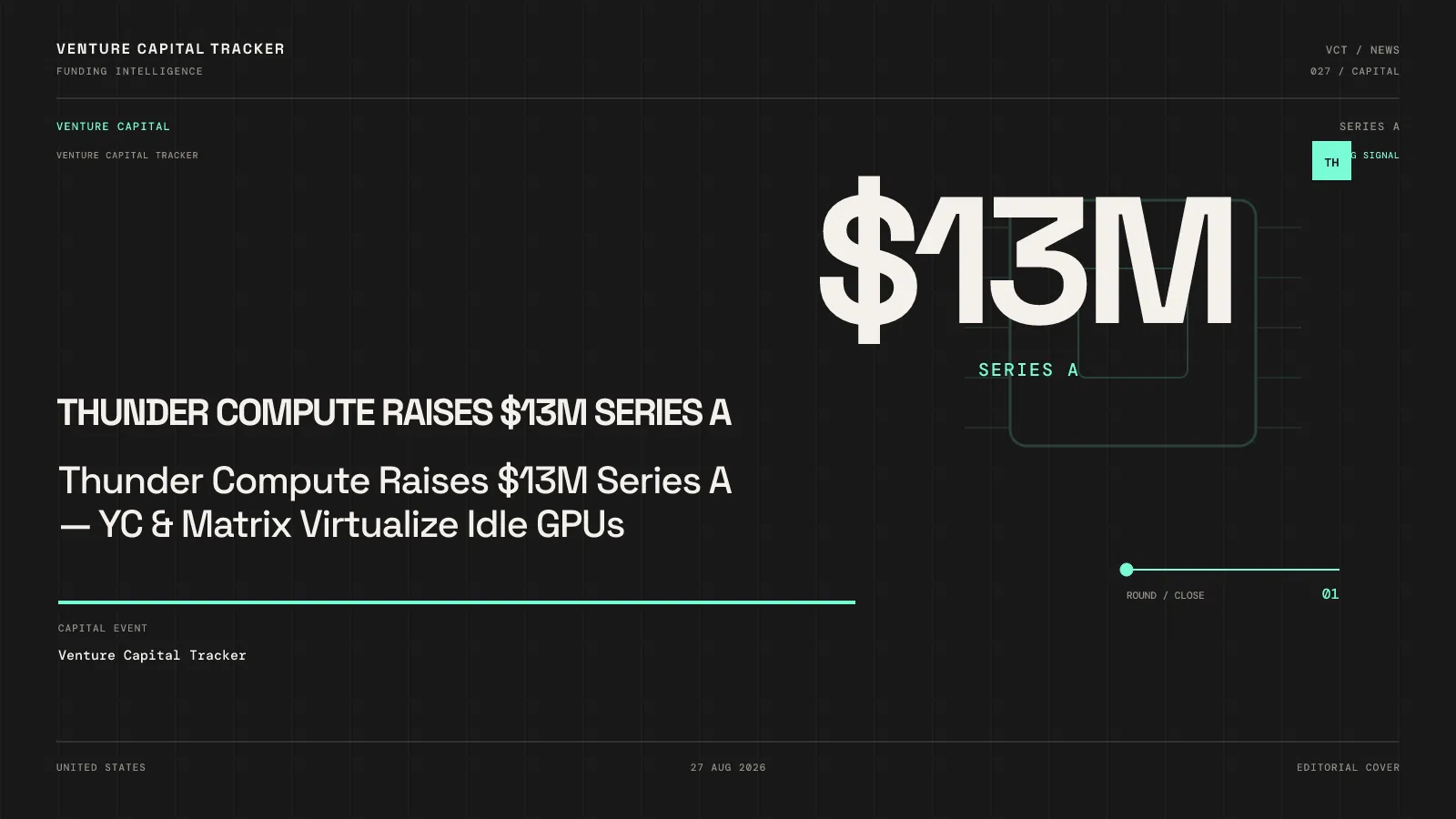
Thunder Compute raised a $13 million Series A announced August 19, 2026, led by Matrix Partners (also seed lead), with Y Combinator and CEAS Investments.
Key facts
| Field | Detail |
|---|---|
| Company | Thunder Compute — GPU virtualization (“VMware for GPUs”) |
| Round | $13M Series A (Matrix lead; YC, CEAS) |
| Date | August 19, 2026 |
| Traction | 10,000+ users on self-serve virtualized GPU cloud (company) |
| Problem framing | GPUs ~5% avg utilization (Cast AI 2026 K8s report cited); company cites ~$200B idle data-center capacity narrative |
| Use of proceeds | Enterprise/GPU-cloud partnerships; systems research; sales; scale virtualization |
Who uses the product — and for what job
Users today: developers and teams on Thunder’s self-serve cloud. Buyers next: enterprises and GPU cloud providers sitting on fleets that look “full” on paper but idle between jobs.
Job: get more useful FLOPs from cards you already bought — virtualize GPUs so they behave like shared network resources without rewriting ML code.
Why now
- GPU scarcity and price keep CFOs hunting utilization before CapEx.
- Four years of product hardening on self-serve (per co-founder) makes enterprise the logical Series A motion.
- Matrix doubling down (seed → A) is a continuity signal that the category timing finally matches the tech.
- Power constraints (Emerald) raise the cost of idle silicon further — wasted watts hurt twice.
Why Y Combinator — portfolio fit
Y Combinator participates again beside Matrix. GPU infra that drops into existing workloads without developer rewrite matches YC’s bias for leverage on scarce resources.
Likely founder rationale: keep Matrix as lead for Series A enterprise push; keep YC for talent and AI-native customer intros.
| Investor type | What they bring |
|---|---|
| Matrix Partners | Lead + seed continuity |
| Y Combinator | Brand, talent, AI GTM |
| CEAS | Additional early-stage capital |
Competitive map
| Player | Lane |
|---|---|
| Cloud GPU schedulers / MIG / time-slicing | Partial sharing; often workload-specific |
| Fireworks-class inference platforms | Model serving optimization |
| Buy more NVIDIA capacity | CapEx answer; doesn’t fix idle |
| Other GPU virt / pooling startups | Same category; diligence on transparency and perf isolation |
Market signal
$13M to move from self-serve proof to enterprise fleet virtualization says investors will fund utilization software even while mega-rounds buy more GPUs — efficiency and CapEx run in parallel.
When not to use this as a template
- Wrong if virtualization breaks training performance SLAs you cannot measure.
- Wrong if “10k users” are free-tier curiosity without paid enterprise path.
- Wrong if you promise $200B savings without scoped customer baselines.
Practical takeaway
- Founders (AI infra): Prove invisible virt on real training/inference mixes before enterprise logos.
- Investors: Diligence isolation, overhead %, and who pays (cloud vs enterprise IT).
- Operators: Instrument idle GPU hours; virt only wins if accounting shows reclaimable capacity.
Sources
- Thunder Compute (Aug 19, 2026): https://www.thundercompute.com/blog/thunder-compute-series-a
- SiliconANGLE: https://siliconangle.com/2026/08/19/thunder-compute-raises-13m-squeeze-work-idle-gpus/
- Related: /fund/y-combinator · /2026-august-vc-news
Editorial note: AI tools assisted with research, structure, or drafting. Venture Capital Tracker retains human editorial responsibility for factual accuracy, relevance, and source quality before publication.