· Venture Capital · 7 sources · Updated · Verified
Melius AI Explained: Product, Pricing & $20M Series A Funding
What Melius AI does, live creative-agent features, pricing and competitors, plus its $20M CRV-led Series A and $5M seed. Funding and product facts verified.

By Venture Capital Tracker
What is Melius AI? Melius is a New York creative-production platform where designers, agencies and marketing teams use a shared visual canvas and AI agents to produce images, video, audio and campaign variations. It connects third-party generative models and editable workflows; Melius is not itself the developer of those foundation models.
Deal details & investors
Funding event
Melius
Led by CRV
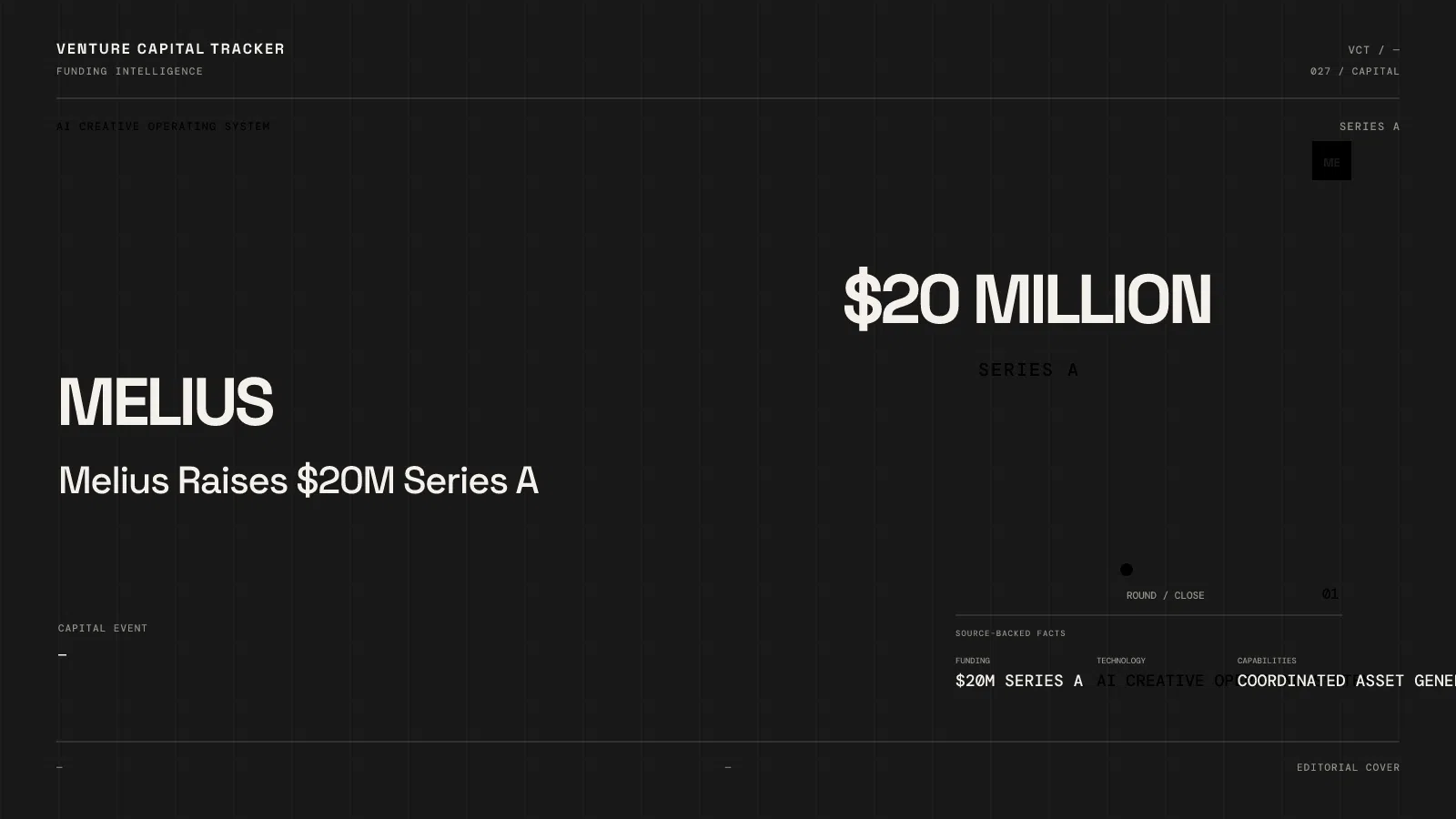
Funding: On October 6, 2026, Melius disclosed a $20 million Series A led by CRV and a previously raised $5 million seed led by General Catalyst: $25 million in disclosed funding, not a $25 million Series A. The company did not announce a valuation. Co-founders Joowon Kim, Young Kim and Arnav Ramu rebuilt the product after an initial performance-marketing concept failed to gain traction.
Read the VCT Melius company profile for its structured funding record. This guide answers what the product does, how its announced agent features work, what the financing actually means and how to evaluate its competitive position. Product and financing details rechecked November 13, 2026.
The financing at a glance
| Round | Amount | Lead investor | Status |
|---|---|---|---|
| Seed | $5 million | General Catalyst | Previously completed; disclosed October 6 |
| Series A | $20 million | CRV | Newly announced October 6 |
| Total disclosed | $25 million | — | Across both rounds |
Melius named Genius Ventures, Vine Ventures and Anti Fund as participating investors across the financing disclosure. Angels included Vercel CEO Guillermo Rauch and Natural CEO Kahlil Lalji. The announcement did not allocate those investors to a specific round, so they should not be assigned to the seed or Series A without further confirmation.
The company said the money will support hiring, go-to-market expansion and continued development of its “agents lab” for creative work.
A Series A built on a complete product reset
The most consequential part of the Melius story is not the size of the round. It is how quickly the company changed direction.
CEO Joowon Kim, CTO Young Kim and COO Arnav Ramu initially built an AI product for performance marketing. Kim and Young had previously worked at Ramp; Young was also a co-founder of Venue, which Ramp acquired in 2023.
After roughly six months, the founders concluded that the original product lacked sufficient potential. Kim told TechCrunch that the team discarded the codebase and rebuilt around a larger problem: producing the creative assets and campaigns themselves.
That pivot moved Melius from optimizing ad spend to orchestrating creative work. The company emerged from stealth in July 2026 and now describes the product as a shared operating system in which AI agents handle the production steps between an idea and a finished asset.
For investors, the reset offers both evidence of speed and a caution. Rebuilding quickly can demonstrate founder adaptability, but the new category remains crowded and the company has only a short operating history in its current form.
What does Melius AI actually do?
Instead of prompting separate image, video, voice and editing tools, a team uses Melius' node-based canvas to describe a campaign, generate assets, compare variations, make revisions and reuse earlier work. A practical example: a footwear brand supplies a brief, produces product photographs and short videos, swaps models for different shots, adjusts lighting and creates localized variations without manually rebuilding the whole workflow.
Features verified against Melius' October 6 product announcement:
| Feature | Status at the announcement | What a buyer gets |
|---|---|---|
| Playground | Live | Generate and test image, video and audio models |
| Cast | Live | Assemble a script into scenes, voices and AI actors |
| Agentic Asset Manager | Live | Locate and reuse creative assets in projects |
| Agentic Creative Canvas | Live | Guide AI agents through editable, multi-step creative workflows |
| MCP, API and CLI | Live | Integrate Melius into existing agent and developer workflows |
| Agentic Timeline Editor | Announced as coming soon | Agent-guided timeline editing; do not count as generally available yet |
| Elements | Announced as coming soon | Reusable brand and product references; availability requires a new check |
Melius' terms of service say the platform calls third-party models rather than developing, training or operating the underlying models itself. That creates useful model choice for creators, but also a dependency: model-provider costs, capabilities, licensing and policies can change. Claims about commercial usage should be checked against both Melius terms and the selected model provider's terms.
Is Melius free? How much does it cost?
The official pricing page lists sign-up or trial access, with paid generation generally based on credits. As viewed on November 13, examples include Creator at about $17 per month on annual billing (20,000 credits monthly) and Team at about $56 per seat per month on annual billing with a two-seat minimum. Month-to-month pricing, regional taxes, credit consumption and models differ; use the live pricing page before committing. Free sign-up is not unlimited free AI generation.
A useful purchase test: Compare (1) output quality using your actual brand brief, (2) cost per accepted final asset rather than cost per generated asset, (3) whether another teammate can reproducibly edit a workflow, and (4) the review and licensing process for commercial creative work.
Melius versus alternatives
| Option | Primary strength | Trade-off worth testing |
|---|---|---|
| Melius | Multi-model canvas with agentic production and team workflow | Depends on third-party models and credit pricing |
| Single-model image/video applications | Simpler specialized generation from one provider | Less freedom to swap a model inside the same workflow |
| Krea / Flora-style visual creative tools | Specialized creative exploration and visual iteration | Compare workflow reuse, collaborative review, model access and pricing directly |
| Agency-built workflow across tools | Maximum custom control and existing vendor contracts | More integration overhead and repetitive handoffs |
This is a workflow comparison, not a verified ranking of output quality. Model capabilities and plan inclusions change quickly.
Why the workflow layer could matter
Creative AI is moving through a predictable transition. Generation quality improves rapidly, but access to those models becomes less differentiated. As model capabilities converge, value can migrate toward the software layer that holds brand context, coordinates steps, manages assets and captures approval history.
Melius is betting that this workflow layer will be more durable than any single generation feature.
The bull case has three parts:
- Switching costs can grow with workflow depth. A team that stores assets, brand context and campaign processes in one system may be less likely to switch than a user of a standalone generator.
- Model choice can become an advantage. A model-agnostic platform can route different tasks to the strongest or most economical model without forcing customers to rebuild their process.
- Collaboration creates more surface area. Asset management, approvals and reuse can expand a product from individual creation into an organization-wide system of record.
The bear case is equally clear. Adobe and Canva already own important parts of the creative workflow, while AI-native platforms including Higgsfield, Krea and Flora compete for the same users. If incumbents bundle comparable agentic features, or if model providers make orchestration trivial, Melius could face rapid feature compression.
Early traction is promising but still company-reported
Melius said it crossed a seven-figure annualized run rate less than three months after leaving stealth and that thousands of teams use the platform. Those figures were supplied by the company and have not been independently verified.
A seven-figure run rate is encouraging for a recently relaunched product, but it leaves several unanswered questions:
- How much usage comes from paid customers versus free users?
- Are teams adopting one generation feature or embedding Melius across their workflow?
- What gross margins remain after paying model and inference providers?
- Does revenue persist after a campaign or experimental budget ends?
- Can the company sell into larger organizations that require permissions, auditability and brand controls?
The next financing milestone should be judged less by raw generation volume and more by retained team usage, expansion within accounts and unit economics after model costs.
What the investors are underwriting
CRV’s Series A appears to underwrite Melius as the coordination layer for creative agents, not merely another AI image application. General Catalyst backed the company at seed and remained part of the announced investor group after the pivot.
That is a high-upside position. Creative production is a large, recurring expense for brands and agencies, and multimodal models can reduce both time and marginal production cost. But the category’s low technical barriers make distribution and workflow ownership more important than demo quality.
Melius now has enough capital to test whether a fast product reset can become a durable company. The decisive question is whether customers treat its agentic workspace as core production infrastructure—or as a convenient interface they can replace when the next model or bundled feature arrives.
What investors should test after the $20M Series A
Melius' financing buys time for hiring and distribution, but $25 million of disclosed capital is not proof of recurring revenue, product-market fit or a sustainable gross margin. The company has reported a seven-figure annualized run rate after launching the new product; that is a company assertion, not independently audited ARR.
Three questions matter more than the funding headline: (1) How many creative teams repeatedly pay rather than try a generation? (2) Does revenue grow faster than inference costs and customer support? (3) Can shared workflows, review history and team integrations create retention when underlying AI models become broadly available? Ex-Ramp founders' product reset is an execution signal, but it does not settle any of those questions.
Bottom line
Melius’s financing is best understood as a $20 million Series A plus a previously completed $5 million seed, not a single $25 million round. The company has paired an unusually fast pivot with early, company-reported commercial momentum and a credible investor group.
Its opportunity is to own the workflow connecting ideas, generative models, assets and approvals. Its risk is that the same workflow is becoming a strategic battleground for well-funded AI startups and incumbent creative-software vendors alike.
- startup-funding
- ai-agents
- generative-ai
- +1 more
Last updated:
Editorial note: AI tools assisted with research, structure, or drafting. Venture Capital Tracker retains human editorial responsibility for factual accuracy, relevance, and source quality before publication.