· Venture Capital Tracker · venture-capital
Nvidia Explores Reflection AI Deal After Beam’s Open-Weight Debut
Nvidia is reportedly considering a full acquisition, acqui-hire, new investment or deeper compute partnership with Reflection AI. No deal or price has been announced.
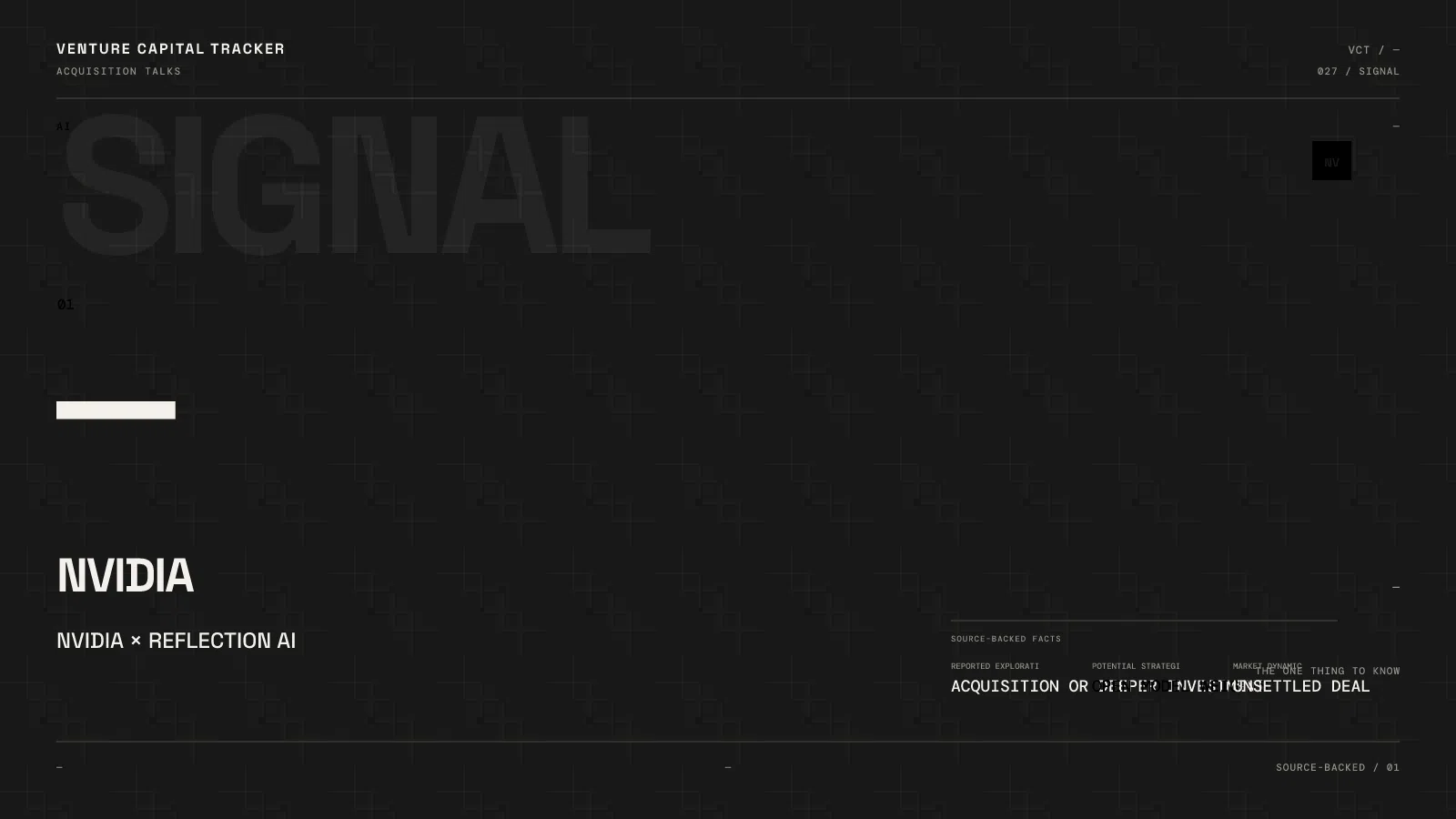
Nvidia is in early talks that could reshape the ownership of one of the most heavily financed open-weight AI labs in the United States.
The Financial Times reported on October 10 that Nvidia is discussing several possible transactions with Reflection AI: a full acquisition, an acqui-hire combined with technology licensing, another equity investment, or deeper support through chips and computing capacity. The report says a deal could emerge within weeks, but also warns that discussions may collapse.
That distinction matters. Nvidia has not announced an acquisition, Reflection has not confirmed a sale, and no transaction price has been disclosed. Reflection remains an independent private company at the time of publication.
What is actually on the table?
| Possible structure | What it would mean | What is known |
|---|---|---|
| Full acquisition | Nvidia would buy Reflection and control its models, staff and commercial strategy | Reported as one option; no price or agreement |
| Acqui-hire plus licensing | Nvidia could hire key employees and license Reflection technology without buying the company outright | Reported as another possible structure |
| Additional equity investment | Nvidia could increase an already substantial minority position | No amount or valuation has been reported |
| Compute partnership | Nvidia could provide more chips or infrastructure while Reflection remains independent | Discussed as a possible deepening of the existing relationship |
These are alternatives, not four announced components of one transaction. Treating the story as a completed $25 billion acquisition would be inaccurate.
Why Reflection matters to Nvidia
Reflection was founded in 2024 by former Google DeepMind researchers Misha Laskin and Ioannis Antonoglou. The company began with autonomous coding systems and later broadened its ambition toward “frontier open intelligence”: models whose weights can be downloaded, customized and deployed under a customer’s control.
That strategy gives Nvidia several forms of strategic leverage.
First, open-weight models can expand demand for Nvidia hardware without forcing customers into a closed-model API. Governments, regulated industries and large enterprises can run their own versions while still purchasing the accelerators and networking equipment needed for training and inference.
Second, Reflection’s proposed “AI factory” model fits Nvidia’s long-running argument that institutions will operate localized AI infrastructure in the same way they operate data centers. Owning or more tightly controlling Reflection could connect model development, compute infrastructure and go-to-market activity.
Third, the company gives Nvidia a U.S.-based answer to Chinese open-model developers such as DeepSeek, Z.ai and Alibaba’s Qwen. That has commercial value, but also a geopolitical dimension as governments seek domestic or allied alternatives.
Beam changes the timing
Reflection introduced Beam on October 5, five days before the reported talks became public. The company describes Beam as a 501-billion-parameter mixture-of-experts model with 23 billion parameters active for each token, designed for coding, reasoning and agent workflows.
Reflection says its base model matches or exceeds comparable accessible open models and plans to release weights, a technical report and developer tools after completing safety work. Those are company claims and still require broader independent testing.
The timing creates a straightforward strategic question: does Nvidia want to remain Reflection’s supplier and shareholder, or does it want direct control just as Beam begins to move from a research result into a commercial platform?
Reflection AI funding and valuation history
Reflection’s capital history explains why even preliminary talks are financially significant.
| Date | Financing | Valuation | Selected investors |
|---|---|---|---|
| March 2025 | Approximately $130 million of early funding | About $545 million, according to later reporting | Sequoia Capital and CRV |
| October 2025 | $2 billion funding round | $8 billion | Nvidia led; Disruptive, DST, Citi, 1789 Capital, B Capital, Lightspeed, Sequoia and others participated |
| March 2026 | Financing referenced by the Financial Times; complete terms were not established in accessible disclosures | $25 billion, according to the FT | Full syndicate and final amount not clearly disclosed |
Wilson Sonsini’s transaction announcement confirms the October 2025 $2 billion round and identifies Nvidia as lead investor. Separate reporting has placed Nvidia’s contribution at roughly $800 million.
The $25 billion figure is Reflection’s latest reported private-market valuation. It is not a reported acquisition price. A buyer could negotiate a premium, a discount, a stock-heavy structure or a narrower transaction that never transfers the entire company.
The circular economics behind the relationship
Nvidia’s position is unusual because it is simultaneously an investor, critical supplier and potential acquirer.
A portion of the capital Nvidia and other investors provide to model labs is ultimately spent on GPUs, networking and related infrastructure. That does not invalidate the investment thesis, but it does mean reported funding, hardware demand and strategic dependence can reinforce one another.
For Reflection, close alignment with Nvidia can accelerate access to scarce compute and enterprise customers. The trade-off is concentration: a model company that depends heavily on one hardware platform may have less bargaining power on cost, deployment architecture and future strategic direction.
A full acquisition would resolve that tension through ownership. A fresh minority investment would preserve Reflection’s independence while increasing Nvidia’s influence. An acqui-hire and licensing arrangement could transfer much of the talent and technology without paying for every shareholder’s stake.
Competitive implications
Reflection does not compete in a single market.
- Open-weight foundation models: Meta’s Llama ecosystem, Mistral AI, DeepSeek, Z.ai and Qwen compete on capability, licensing, efficiency and developer adoption.
- Enterprise AI platforms: OpenAI, Anthropic and Google compete for many of the same corporate and government workloads, even with primarily closed models.
- Sovereign AI infrastructure: Cloud providers, national computing programs and model companies compete to supply governments seeking localized control.
- Coding and agent systems: Reflection’s original focus overlaps with model labs and application companies building autonomous software-development tools.
If Nvidia acquired Reflection, rivals could reasonably ask whether an important open-model developer would continue receiving neutral infrastructure support and whether its roadmap would prioritize Nvidia-specific optimization. If Nvidia remains a minority investor, Reflection must show that it can build an independent business rather than operate mainly as a demand channel for its largest strategic backer.
Regulatory and governance questions
A full acquisition could draw scrutiny because Nvidia already dominates advanced AI accelerators and has invested across the model, cloud and infrastructure stack. Regulators would likely examine whether ownership of a prominent open-weight lab strengthens Nvidia’s control over adjacent layers of the AI market.
An acqui-hire or licensing agreement may be faster to execute, but deal labels do not automatically remove competition or national-security questions. Authorities can assess substance as well as legal form, particularly when talent, intellectual property and commercial control move together.
Other Reflection shareholders also matter. The company’s investor base includes major venture firms and politically connected capital, while its products have relevance to government and allied-country AI programs. Any transaction would need to reconcile economic returns, control rights, model-access commitments and public-sector obligations.
What to watch next
The most important confirmation points are:
- Whether either company acknowledges formal negotiations.
- Whether Nvidia seeks full ownership or another minority investment.
- Any disclosed transaction price relative to the reported $25 billion valuation.
- Treatment of Reflection’s existing shareholders and employee equity.
- Whether Beam weights are released on the timetable Reflection announced.
- Commitments on open access, licensing and support for non-Nvidia hardware.
- Regulatory filings or government review in the United States and other markets.
Until those details emerge, the correct classification is reported acquisition or investment talks, not a completed acquisition and not a new confirmed funding round.
The bottom line
Reflection gives Nvidia something strategically different from a conventional software investment: a well-capitalized U.S. open-weight model company whose products can drive demand for Nvidia infrastructure while competing with both Chinese open models and closed American labs.
That makes deeper integration logical. It also makes the structure consequential. A full purchase would turn an ecosystem investment into vertical ownership; a minority investment would preserve the appearance and some substance of independence; an acqui-hire could transfer the most valuable human and technical assets without buying the whole cap table.
For now, the talks are real enough to monitor but too preliminary to price as a deal.
Follow Venture Capital Tracker in Google
Add VCT as a preferred source to make our venture-capital coverage easier to find in Google Search.
Editorial note: AI tools assisted with research, structure, or drafting. Venture Capital Tracker retains human editorial responsibility for factual accuracy, relevance, and source quality before publication.