· Venture Capital Tracker Research · venture-capital
DailyObjects Raises ₹332 Crore in Mixed Primary-Secondary Series C
DailyObjects announced a ₹332 crore Series C led by Xponentia, Anicut and Axiom Asia, but the total includes an undisclosed mix of primary capital and secondary share sales.
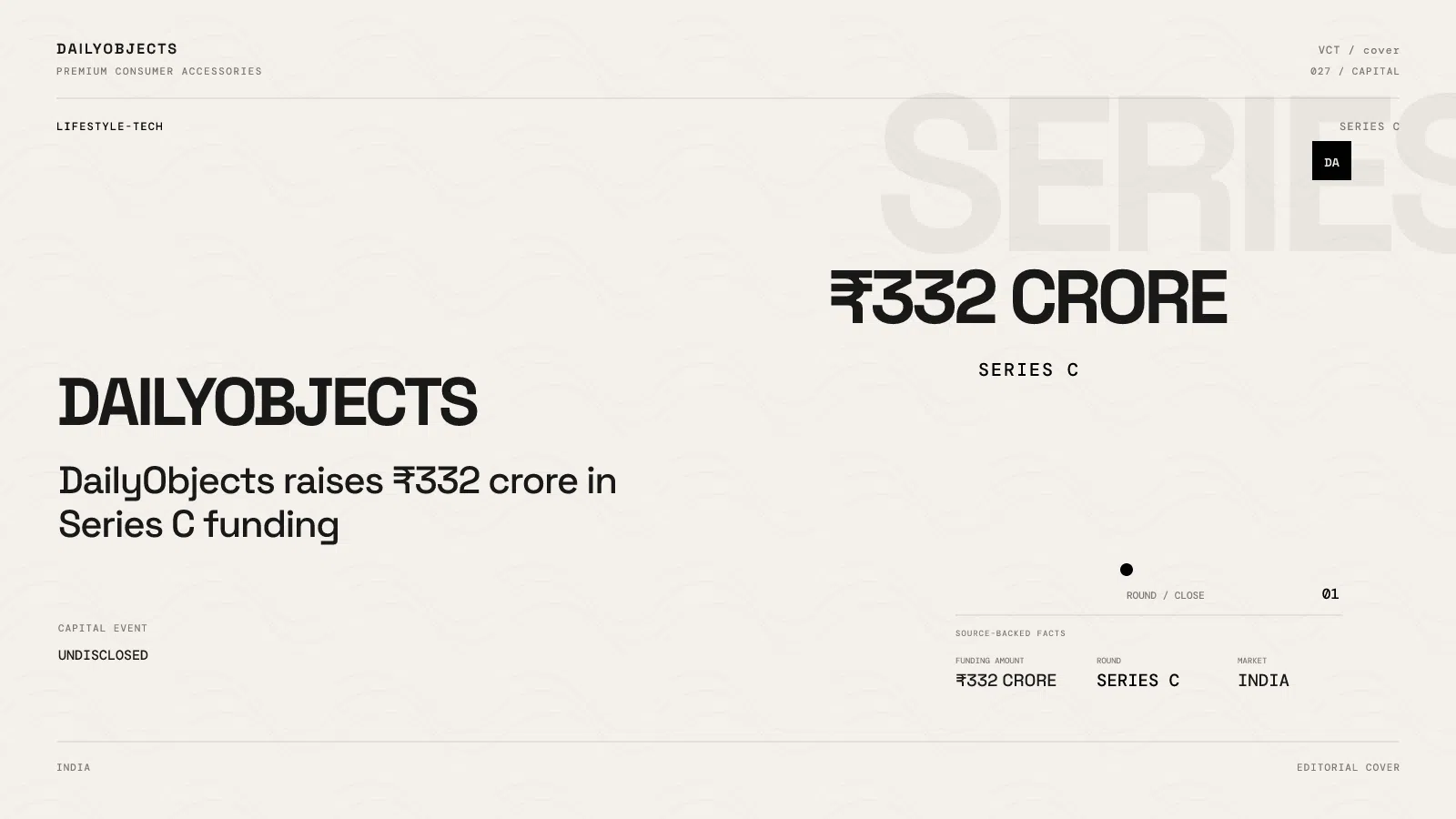
DailyObjects has announced a ₹332 crore Series C, approximately $34–35 million, led by Xponentia Capital Partners, Anicut Capital and Axiom Asia Private Capital.
The transaction values the Indian lifestyle-technology brand at about ₹1,050 crore. Crucially, the headline amount combines primary capital and secondary share sales. DailyObjects did not disclose the split, so ₹332 crore should not be treated as new cash entering the company.
The transaction at a glance
| Item | Detail |
|---|---|
| Company | DailyObjects |
| Transaction size | ₹332 crore |
| Stage | Series C |
| Structure | Mixed primary and secondary |
| Lead investors | Xponentia Capital Partners, Anicut Capital and Axiom Asia Private Capital |
| Seller | Roots Ventures made a partial exit |
| Valuation | Approximately ₹1,050 crore |
| Primary proceeds | Not disclosed |
Roots Ventures sold part of its holding and said it generated an 18-times return while remaining one of DailyObjects' largest shareholders. Existing investors 360 One Asset and Trifecta Capital are also staying on the cap table.
Why the primary-secondary split matters
A primary investment finances the company. A secondary transaction transfers existing shares and provides liquidity to founders, employees or earlier investors. Both can be part of the same Series C, but they have different economic meanings.
DailyObjects says the fresh capital will support retail expansion, product development, research and development, brand building and evaluation of overseas markets. Without a disclosed split, however, readers cannot calculate how much of the ₹332 crore is available for those plans.
That distinction is especially important because the round is being widely summarized as “funding.” The correct interpretation is a ₹332 crore transaction with an undisclosed primary component, not ₹332 crore of new balance-sheet cash.
From phone cases to an omnichannel brand
Founded in 2012 by Pankaj Garg and Saurav Adlakha, DailyObjects started with phone cases and expanded into charging products, bags, carry accessories and workspace goods.
The company now sells through its own digital channel, marketplaces and close to 350 physical touchpoints, including exclusive stores and Apple Premium Reseller locations. It plans to establish 150 exclusive brand outlets over five years.
That strategy shifts the investment case. DailyObjects is no longer only a direct-to-consumer accessories brand. It is becoming an omnichannel retail business with inventory, store economics and working-capital requirements that look very different from a pure online model.
What the investors are underwriting
Xponentia brings Indian mid-market private-equity experience. Anicut operates across seed, private credit and growth equity. Axiom Asia is primarily an Asia-Pacific private-equity allocator and direct co-investor.
The syndicate suggests a growth and operating-efficiency thesis more than a conventional venture bet. The investors are underwriting DailyObjects' ability to repeat a branded retail format, expand product categories without diluting the brand and improve scale economics.
The target of building a ₹1,000 crore business is ambitious. To reach it, DailyObjects must prove that store-level revenue and contribution margin justify the capital required for leases, inventory and staffing.
Competitive landscape
DailyObjects competes with generic marketplace sellers, retailer-owned accessory ranges and Indian consumer brands such as boAt. In bags and carry products, it also overlaps with design-led brands including Mokobara.
Its advantage is a coherent design language across categories and a growing distribution footprint. Its risks include rapid product obsolescence, dependence on smartphone and device cycles, low-priced imitation products and the complexity of managing a broad assortment across online and offline channels.
International expansion adds another layer of uncertainty. Brand recognition built in India may not transfer automatically, and overseas markets often require new distribution partners, compliance work and localized merchandising.
What competitors covered
Current search results are led by company-profile databases and short news reports from Indian Retailer, YourStory and Economic Times. Those stories correctly identify the Series C, valuation and retail plan, but many headlines do not foreground the secondary component.
VCT's central analytical point is the transaction structure: the gross ₹332 crore figure measures shares financed or transferred, while only the undisclosed primary portion funds growth.
What to watch next
The most useful operating disclosures would be:
- the primary-versus-secondary split;
- store count and mature-store payback period;
- revenue, gross margin and inventory turns;
- share of sales from owned retail versus marketplaces;
- repeat purchase and cross-category buying; and
- the timing and capital requirements of international expansion.
Bottom line
DailyObjects' Series C is a confirmed financing transaction, not a rumor. It is also not a pure primary venture round. The strongest headline is therefore the ₹332 crore mixed primary-secondary Series C at an approximately ₹1,050 crore valuation.
The round gives DailyObjects institutional backing for an ambitious retail push. Whether it creates durable value will depend less on opening 150 stores than on proving those stores can produce attractive unit economics across a widening consumer-product portfolio.
Editorial note: AI tools assisted with research, structure, or drafting. Venture Capital Tracker retains human editorial responsibility for factual accuracy, relevance, and source quality before publication.