· Updated · Venture Capital Tracker · investment-strategies
What Is Lovable’s Valuation in 2026? $13.3B After a $400M Series C
Lovable’s current valuation is $13.3 billion as of the August 12, 2026 $400M Series C led by Menlo Ventures. That supersedes the December $6.6B mark and earlier $12B–$13.2B “in talks” headlines.
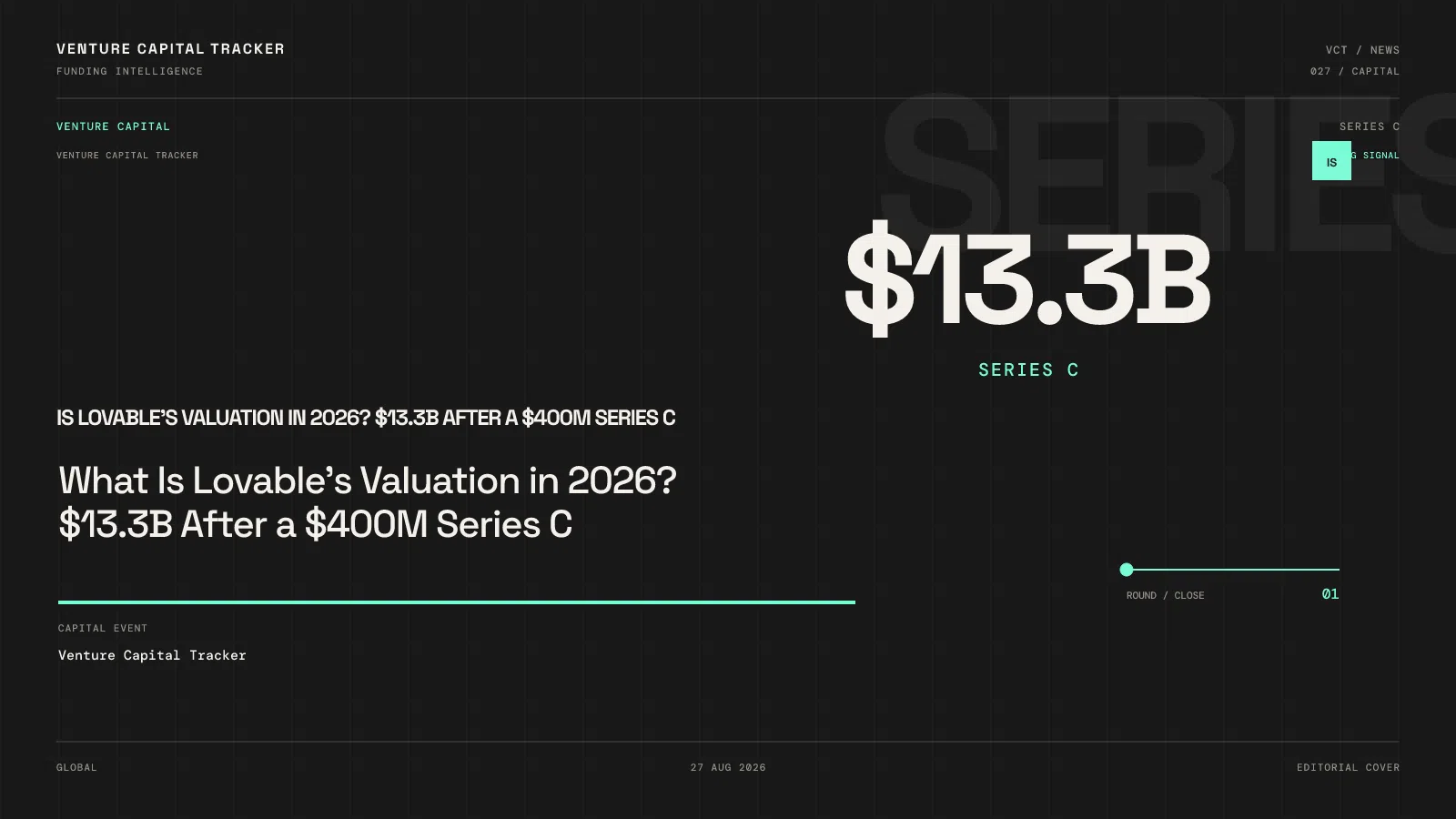
Lovable’s current valuation is $13.3 billion as of August 12, 2026, after a $400 million Series C led by Menlo Ventures and the Scaleup Europe Fund. That supersedes the December $6.6 billion mark and earlier press that Lovable was in talks around $12B–$13.2B.
Last verified August 18, 2026. Profile: Lovable.
Lovable valuation — $6.6B vs $13.3B
| Date | What it was | Mark | Amount |
|---|---|---|---|
| Aug 12, 2026 | Closed Series C (use this) | $13.3B | $400M |
| Jul 2026 | TechCrunch: in talks | ~$13.2B | Not a close |
| Jun 2026 | Forbes: in talks | ~$12B | Not a close |
| Dec 2025 | Prior round | $6.6B | $330M |
Key facts
| Field | Detail |
|---|---|
| Company | Lovable — Stockholm “vibe-coding” AI builder |
| Round | $400M Series C @ $13.3B |
| Date | August 12, 2026 |
| Leads | Menlo Ventures, Scaleup Europe Fund |
| Prior | $330M (Dec) @ $6.6B — Menlo lead, CapitalG co-lead |
| Traction (company) | $500M ARR (Jun 2026); ~60M projects; ~900M monthly visitors |
| Infra | Multiyear Google Cloud deal; in-house + frontier models |
| Note | Regent (TechCrunch’s owner) is among new Series C investors — disclosure |
Who uses the product — and for what job
Users: founders, PMs, designers, and non-traditional builders who want a working app without a full eng team — plus developers who use AI as the primary authoring surface.
Job: turn a plain-language product idea into a hosted application fast, then iterate. Lovable is the generation layer of the AI software stack; review/CI tools (CodeRabbit, Blacksmith) sit downstream.
Why now
- Codegen volume exploded; platforms with distribution + ARR can raise at software multiples again.
- Doubling valuation in ~8 months tracks the disclosed ARR step-up — investors are underwriting usage economics, not a demo video.
- Europe wants onshore AI champions; Scaleup Europe Fund co-leading is that policy + capital stack.
- Owning models + cloud capacity (Google Cloud) is the infra tax of staying at this scale.
Why Menlo Ventures — portfolio fit
Menlo Ventures already led Lovable once. Returning as lead says the firm sees Lovable as a category-defining AI application with developer-tool adjacency — aligned with Menlo’s enterprise/AI book and Anthology-era AI mandate.
Likely founder rationale: keep the lead who priced the last round (continuity, pro-rata, board chemistry) and add a Europe-scale public-policy fund for geographic legitimacy and LP narrative.
| Investor type | What they bring |
|---|---|
| Menlo Ventures | Repeat lead; AI app + devtools pattern recognition |
| Scaleup Europe Fund | European scale capital + champion narrative |
| CapitalG (prior) | Google ecosystem adjacency (cloud already expanding) |
Competitive map
| Player | Lane |
|---|---|
| Cursor / Windsurf / Claude Code | Pro-developer IDE agents |
| v0 / Bolt / other builders | Adjacent vibe-coding / UI generators |
| CodeRabbit | Post-generation review & change control |
| Blacksmith | CI / validation infra for the code flood |
Market signal
~$0.8M ARR per $1M of new equity at announce (illustrative: $500M ARR vs $400M raise) is late-stage software math — the surprise is that a Europe-based builder cleared a $13B print this fast.
When not to use this as a template
- Wrong if ARR is mostly credits, one enterprise, or non-recurring services.
- Wrong if you equate vibe-coding with enterprise SDLC control (different buyer).
- Wrong if valuation comps ignore gross margin on inference.
Practical takeaway
- Founders (AI apps): Show usage → revenue → infra leverage; Menlo-style leads re-up when the curve is undeniable.
- Investors: Separate creation platforms (Lovable) from validation platforms (CodeRabbit/Blacksmith) — both can win.
- Operators: If agents write the app, budget for review, CI, and security in the same quarter.
Sources
- TechCrunch (Aug 12, 2026): https://techcrunch.com/2026/08/12/lovable-confirms-new-13-3b-valuation-raises-another-400m/
- Related: /startup/lovable · /fund/menlo-ventures · /2026-august-vc-news
Follow Venture Capital Tracker in Google
Add VCT as a preferred source to make our venture-capital coverage easier to find in Google Search.
Last updated:
Editorial note: AI tools assisted with research, structure, or drafting. Venture Capital Tracker retains human editorial responsibility for factual accuracy, relevance, and source quality before publication.