· Venture Capital Tracker · venture-capital
Solcoa Industries Secures $75M: $45M Equity, $30M Debt
Solcoa Industries secured $75M to build a Nevada rare-earth metal plant: $45M of equity led by Bain Capital Ventures and $30M of debt and equipment financing anchored by J.P. Morgan.
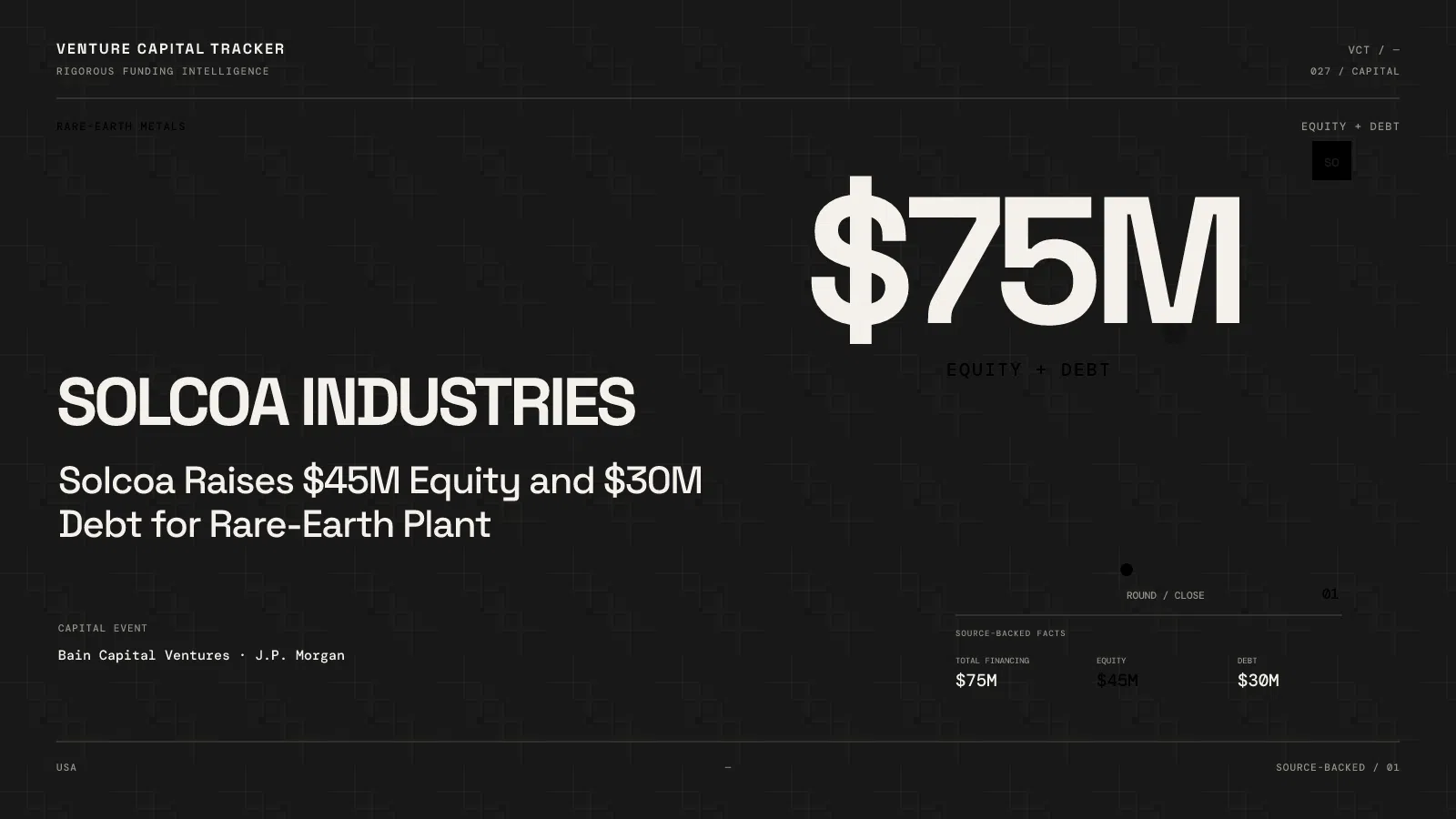
Solcoa Industries has announced $75 million of financing to build Solcoa One, its first commercial rare-earth metal plant in Nevada. The headline total is not a single venture round: $45 million is equity led by Bain Capital Ventures, while $30 million is debt and equipment financing anchored by J.P. Morgan.
That distinction matters. Solcoa is funding both a technology company and a capital-intensive production facility. Calling the full package a "$75 million seed round" would overstate the equity raised and blur the industrial financing behind the project.
The financing at a glance
- Total package: $75 million
- Equity: $45 million
- Debt and equipment financing: $30 million
- Equity lead: Bain Capital Ventures
- Other equity participants: Gigascale Capital, Long Journey Ventures, Felicis, Dylan Field, and other unnamed defense and technology executives
- Debt anchor: J.P. Morgan
- Valuation: Not disclosed
- Announced: September 24, 2026
- Primary use: Construction and commissioning of Solcoa One in Nevada, additional reactor manufacturing in Alameda, and team expansion
Axios described the transaction as seed equity and debt. Solcoa's official announcement provides the instrument split and investor names.
Solcoa is targeting the step between oxide and magnets
Rare-earth supply chains are usually discussed in terms of mining, separation, or finished magnets. Solcoa is focused on an intermediate step: turning separated rare-earth oxide into metal that can then be alloyed and manufactured into permanent magnets.
The company currently says it produces neodymium-praseodymium and samarium metal at a 10-tonne annualized rate in Alameda, California. Its planned Nevada facility is designed for 500 tonnes of annual capacity beginning in mid-2027, according to Solcoa's website.
If delivered, that would be a fiftyfold increase from the company's stated present rate. It would also test whether Solcoa's modular reactor design can move from a small production setting to a commercially dependable operation.
Why the capital stack is notable
The financing structure is as important as the amount. Venture equity can support engineering, hiring, and technology development, while debt and equipment financing can fund physical assets whose cost and repayment profile differ from software-style growth spending.
J.P. Morgan's participation does not eliminate scale-up risk, but the debt component suggests that at least part of the project has been underwritten as equipment and plant infrastructure rather than only as a venture experiment. The announcement does not disclose interest rates, maturities, collateral, covenants, or whether the full $30 million is available immediately.
The equity syndicate also spans conventional venture capital and climate-focused capital. Bain Capital Ventures led, with Gigascale, Long Journey, Felicis and Figma co-founder Dylan Field participating. No post-money valuation or ownership terms were disclosed.
The 500-tonne plant is the real test
Solcoa says its process uses halide-free chemistry and reactors designed and manufactured in-house. It claims lower energy use, lower costs, and fewer harmful emissions than conventional molten-salt routes.
Those remain company claims. The commercial test will be whether the process can maintain purity, yield, uptime, energy efficiency, and consistent output while expanding roughly fiftyfold. Customer qualification is another hurdle: magnet and defense supply chains demand material consistency and extensive validation, not simply nominal production capacity.
A detailed Rare Earth Exchanges analysis identifies metallization as a thin link in the U.S. mine-to-magnet chain, while also warning that the company's operating advantages still need independent validation at commercial scale.
Strategic demand does not remove execution risk
The timing is favorable. Automakers, energy companies, and defense suppliers want more rare-earth processing capacity outside China, and U.S. procurement rules are tightening for certain magnets and upstream inputs.
But strategic importance should not be confused with proof of economics. Solcoa must commission a new plant, increase production sharply, secure qualified customers, and compete with established Asian supply chains. Construction schedules and the mid-2027 production target are forward-looking.
For investors, the central question is therefore not whether rare-earth metals matter. It is whether Solcoa can turn a promising electrochemical process into repeatable industrial output on the announced schedule and budget.
Bottom line
Solcoa's financing is a meaningful bet on U.S. rare-earth metallization, but the accurate number is $45 million of equity plus $30 million of debt and equipment financing. The Nevada plant's planned 500-tonne capacity provides a concrete milestone. Until it is commissioned and qualified by customers, cost and performance advantages should remain attributed to the company.
Follow Venture Capital Tracker in Google
Add VCT as a preferred source to make our venture-capital coverage easier to find in Google Search.
Last updated:
Editorial note: AI tools assisted with research, structure, or drafting. Venture Capital Tracker retains human editorial responsibility for factual accuracy, relevance, and source quality before publication.