· Investment Strategies · 3 sources
Blacksmith Raises $45M Series B at $550M — Peak XV Bets on AI-Era CI
Peak XV led Blacksmith’s $45M Series B (closed March, announced Aug 12) with YC and GV tripling down — purpose-built CI compute as AI codegen floods test queues.

Editorial team
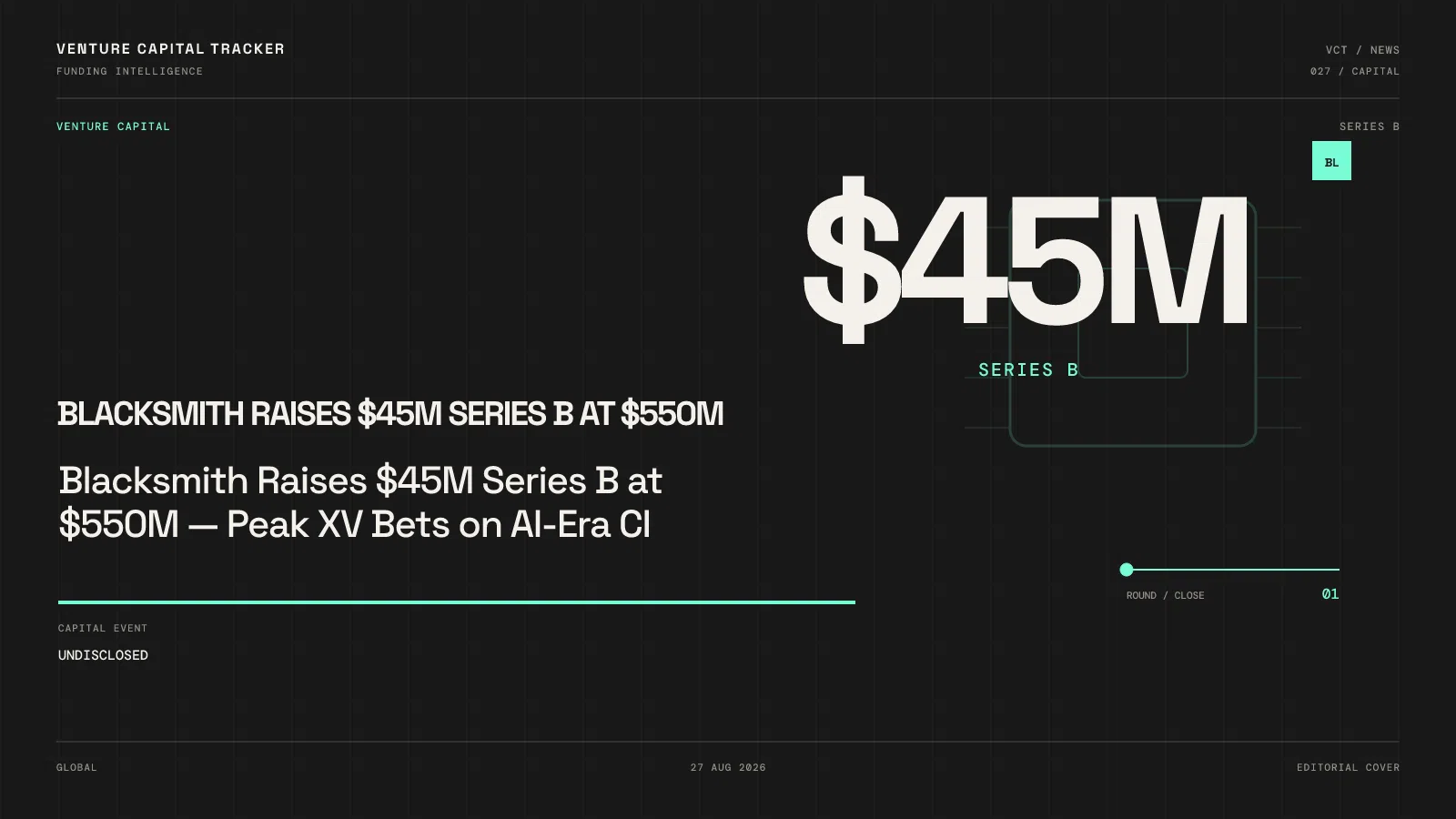
Blacksmith raised a $45 million Series B at a $550 million valuation. Peak XV Partners led; Y Combinator and GV tripled down. The round closed March 2026 and was announced August 12, 2026. Total funding: $58.5M.
Deal details & investors
Funding event
Blacksmith
Led by Peak XV Partners
Reported valuation $550M
Key facts
- Company
- Blacksmith — CI cloud + [code]smith agent
- Round
- $45M Series B @ $550M (closed Mar 2026; announced Aug 12)
- Lead
- Peak XV Partners
- Returning
- Y Combinator, GV
- Prior
- Seed $3.5M (May 2025, GV/YC); Series A $10M (Sep 2025, GV)
- Traction (company)
- 6,000+ companies; customers incl. Supabase, Clerk, Ashby, Mercury; CI jobs +5–10% WoW in 2026
- Use of proceeds
- Expand compute footprint (hundreds of thousands of cores → ~10×)
- HQ / hiring
- NYC and SF
Who uses the product — and for what job
Users: platform/DevEx teams whose developers adopted Claude Code / Cursor-class tools and watched PR volume and CI minutes explode.
Job: run tests faster on purpose-built infra and autofix red builds so merge queues do not become the weekly incident.
Customer quote pattern in the announce: 4× PR volume → CI cannot keep up → merge-blocking incidents.
Why now
- Codegen made writing cheap; validating is the new capacity constraint.
- Blacksmith’s valuation jumped ~9× from the ~$60M Series A print in under a year (press) — pricing CI as AI infra, not a cost-center tool.
- Peak XV’s developer-tools book (Supabase, PostHog) maps to Blacksmith’s ICP; Supabase is also a named customer.
- Compute is the bill — this raise is explicitly for cores, not brand ads.
Why Peak XV / YC — portfolio fit
Peak XV (ex–Sequoia India/SEA) underwrites product-led developer platforms and already knows Supabase-scale usage curves. Y Combinator returning hard is the classic W24 follow-on when usage is compounding weekly.
Likely founder rationale: pick a lead that understands PLG developer GTM and will fund the infra CapEx race without forcing an enterprise-only pivot too early.
| Investor type | What they bring |
|---|---|
| Peak XV | Devtools pattern recognition; board for PLG scale |
| YC | Talent + company-building network |
| GV | Cloud/Google ecosystem adjacency from prior leads |
Competitive map
| Player | Lane |
|---|---|
| GitHub-hosted runners / Buildkite / CircleCI | General CI; less AI-codegen-native autofix |
| CodeRabbit | PR judgment & security; not CI compute |
| Lovable | App generation; upstream of CI |
| In-house runner fleets | CapEx and ops heavy |
Market signal
Announcing a March close in August with $550M attached says the company preferred shipping through the Claude Code wave over a flashy fundraise day — then used the tape to brand the category.
When not to use this as a template
- Wrong if CI spend is still tiny relative to headcount (no pain).
- Wrong if autofix agents merge without human policy.
- Wrong if you only optimize list price/minute without cache/hit-rate economics.
Practical takeaway
- Founders (infra): When agents write code, sell minutes and green builds, not another chat UI.
- Investors: Model gross margin on compute carefully — this is closer to cloud than SaaS seats.
- Operators: Track CI queue time vs PR volume after codegen adoption; that ratio is the buying trigger.
Follow Venture Capital Tracker on Google
Add VCT as a preferred source to see more of our venture-capital reporting in Google Search.
Editorial note: AI tools assisted with research, structure, or drafting. Venture Capital Tracker retains human editorial responsibility for factual accuracy, relevance, and source quality before publication.