· Investment Strategies · 8 sources · Updated · Verified
Who Owns Claude AI? Anthropic Investors, Voting Control & IPO (2026)
Claude is owned by Anthropic, not Amazon. November 10 S-1/A reveals proposed $70–$78 IPO range, 825M Class A shares, a conditional $26B Class N deal and founder voting rights.

Editorial team
Who owns Claude AI? Anthropic develops and operates Claude. Amazon is a significant minority investor and AWS infrastructure partner; Amazon does not own or operate Claude. Google and other strategic partners also hold or plan to acquire securities, but that is not the same as acquiring the company.
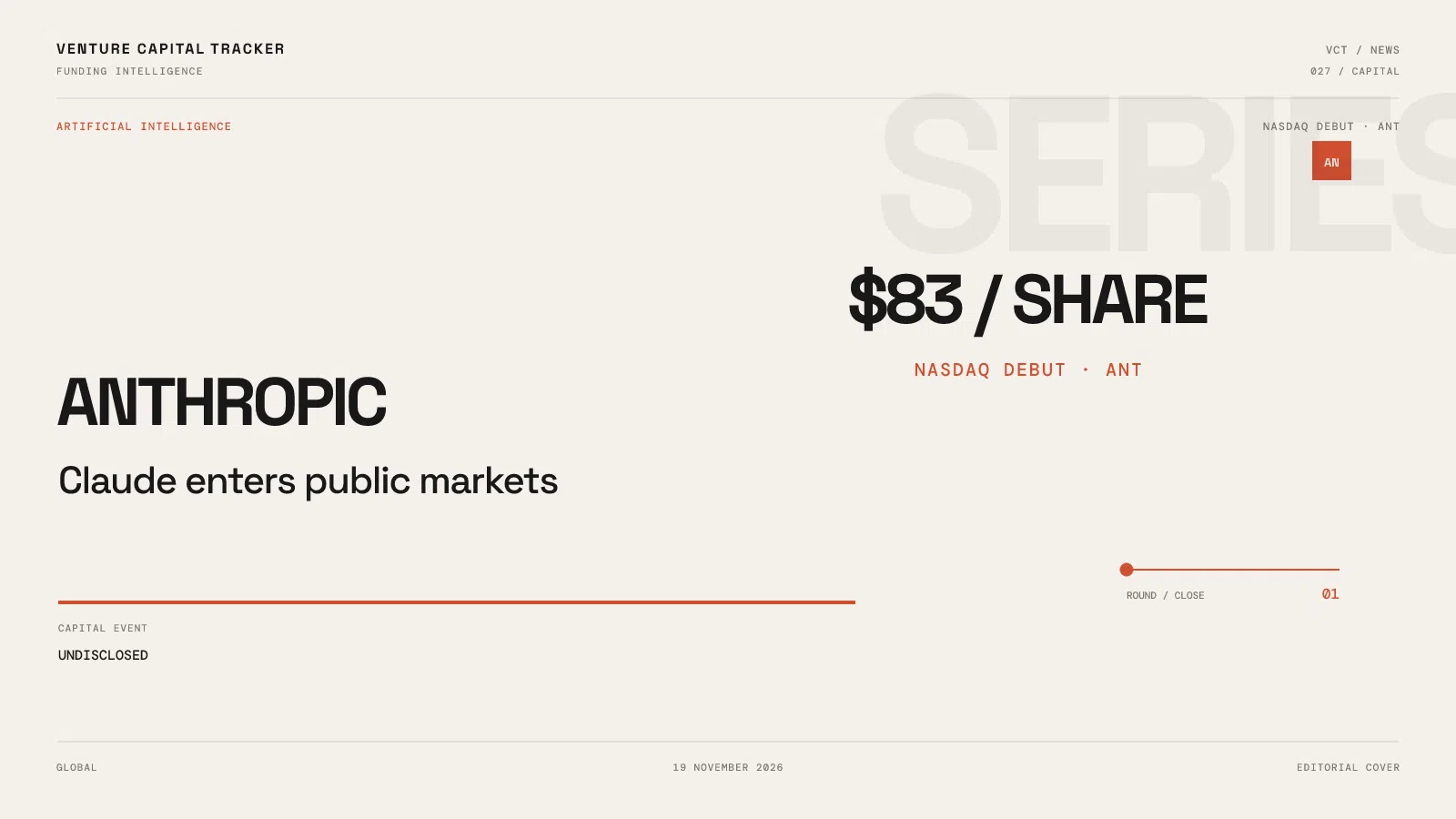
New on November 10, 2026: Anthropic filed its second amended IPO registration statement with an indicative $70–$78 per-share price range, a proposed 825 million Class A shares in the offering and the planned Nasdaq symbol ANT. The document is a preliminary prospectus, not proof the IPO has priced or the shares are trading. The proposed concurrent $26 billion Class N placement is also contingent on closing.
To understand ownership, separate who builds the product, who owns economic shares, and who controls votes and board appointments. Those are different answers in Anthropic's unusually structured capitalization. Facts below were verified November 13, 2026.
Claude ownership at a glance
| Question | What the latest filing actually says |
|---|---|
| Who makes Claude? | Anthropic, PBC, not Amazon or Google |
| Is Anthropic public yet? | No completed IPO established by the Nov 10 preliminary S-1/A; ANT listing is proposed |
| Proposed IPO range | $70–$78 per Class A share; not the final offer price |
| Shares proposed for the public offering | 825M Class A: roughly 801.35M newly issued by Anthropic and 23.65M sold by existing holders |
| Concurrent strategic investment | $26B proposed Class N private placement, conditional on the IPO; Class N is generally nonvoting while held |
| Founder voting control | Founder LLC Class F vote equals 50.1% of general stockholder votes following the proposed structure; no corresponding economic rights |
| Long-Term Benefit Trust | Class T right generally to select a board majority; different from ownership of most economic shares |
| Latest private financing reference | $965B post-money Series H mark in May 2026; a historical financing mark, not the IPO price or completed public market cap |
What investors should not infer: A price range is not a completed offering, a strategic investment is not a takeover, and founder voting control is not the same thing as founder ownership of 50.1% of the economic equity.
Why Amazon is not the same as “owner”
Amazon has two relationships with Anthropic:
- Investor: Amazon has invested in Anthropic and its 2026 disclosures describe additional preferred-stock investment and a further financing facility tied to future milestones.
- Infrastructure partner: Anthropic uses AWS technologies and has committed to large-scale compute capacity. That makes AWS strategically important, but it does not turn Claude into an Amazon product.
Anthropic’s own Series H announcement lists Amazon among previously committed hyperscaler investments and names the financial investors leading or co-leading the round. Amazon’s company announcement describes its position as a minority investment. The distinction matters: a minority investor can have important economic and commercial rights without owning the operating company.
Who are the major Anthropic investors?
Anthropic’s May 2026 Series H announcement named the following lead or co-lead groups:
| Role in the Series H announcement | Investors named |
|---|---|
| Lead | Altimeter Capital, Dragoneer, Greenoaks, Sequoia Capital |
| Co-lead | Capital Group, Coatue, D1 Capital Partners, GIC, ICONIQ, XN |
| Significant investors | Blackstone, Fidelity Management & Research Company, General Catalyst, Insight Partners, Jane Street, Lightspeed Venture Partners, MGX, Temasek, and others |
| Strategic / hyperscaler context | Amazon and other infrastructure partners; Anthropic said $15B of previously committed hyperscaler investments were included |
This is an investor list for a financing announcement, not a ranked list of owners. It tells you who participated in the round; it does not tell you each party’s final percentage, voting power, liquidation preference, or board rights.
The November 10 amended S-1/A includes a detailed Principal and Selling Stockholders table. It models shares after the proposed offering and concurrent placement under stated assumptions, but those are not a final traded cap table. Do not equate a strategic partner's Class N position with its voting control, or a cofounder's Class A percentage with overall control.
For a founder or investor mapping the category, start with the structured Anthropic profile, then read the Series H valuation analysis. The profile is the better place for company facts; this article is the ownership explainer.
What the November 10 IPO filing reveals about the owners
The proposed 825 million-share public offering consists of roughly 801.35 million new Anthropic shares and 23.65 million existing shares sold by holders. Anthropic receives proceeds from the newly issued shares, not from stockholders' secondary sales. Underwriters also have a separately disclosed option for additional shares, so final terms can change.
The same amended prospectus says Google, NVIDIA, AMD, Broadcom, Micron, Microsoft and TSMC agreed to purchase $26 billion in aggregate Class N shares in a concurrent private placement, subject to IPO completion and other conditions. This is not $26 billion of IPO public demand or proof the payment has already been made. The prospectus estimates approximately $10 billion each for Google and NVIDIA at the $74 illustrative midpoint; the other counterparties account for the balance. Class N is generally nonvoting until a qualifying transfer/conversion.
The stockholder table uses specific denominators. For example, Dario Amodei is listed at roughly 3.2% of pro forma Class A shares after the modeled transaction (excluding proxy-share nuance), not 3.2% of general voting control. Daniela Amodei is also shown at roughly 3.2% of pro forma Class A. Meanwhile the Founder LLC's single Class F share carries 50.1% of general voting power. The Long-Term Benefit Trust's Class T rights affect board selection rather than ordinary equity percentage.
The lesson for comparing AI companies: model share class, economic ownership, voting control, new proceeds, secondary proceeds and conditional strategic purchases as separate columns. An "investor list" without these distinctions is not an ownership table.
Anthropic’s latest funding and valuation
The latest company-announced private financing mark cited here (before the proposed public offering) is:
- Round: Series H
- Announcement: May 28, 2026
- Capital: $65B
- Post-money valuation: $965B, as reported in Anthropic’s financing announcement
- Lead investors: Altimeter Capital, Dragoneer, Greenoaks, and Sequoia Capital
That valuation is a historical private financing mark, not a completed public-market capitalization. The November 10 proposed IPO price range provides new price-discovery information but is not a final transaction price. It also does not mean every investor bought at the same economic terms or owns the same security. Preferred-stock rights, conversion terms, and prior investments can make a financing more complicated than the headline number.
Do not merge the $965B mark with later secondary-market talk, a revenue run-rate, or the value of Amazon’s stake. Those answer different questions.
Anthropic’s governance is part of the ownership answer
Anthropic is a Public Benefit Corporation. Its public governance description describes a board elected by stockholders and the Long-Term Benefit Trust.
The November 10 amended S-1/A explains the proposed structure in more detail. A company organized by Anthropic’s seven co-founders, the Founder LLC, is to hold a single Class F share carrying 50.1% of total voting power on matters submitted to stockholders generally. This is voting control, not a 50.1% economic ownership stake: that Class F share has no economic rights. The Long-Term Benefit Trust generally has the right to elect and remove the Class T directors, who together form a majority of the authorized board.
That does not erase investor economics. Stockholders still have economic interests, and preferred financing still has contractual rights. It does mean that “who owns Claude?” cannot be answered accurately by naming the largest strategic investor alone. Economic ownership, operational control, and mission governance are separate layers.
What founders and investors should take from the structure
If you are comparing frontier-AI companies or preparing a diligence memo, record four fields separately:
- Operating company: who employs the team and ships the product?
- Latest priced round: what was raised, when, and at what post-money valuation?
- Strategic dependencies: which investors, clouds, chips, or distribution partners matter?
- Governance: who sits on the board, and are there trust, nonprofit, or public-benefit features?
This prevents a common error: treating a large commercial agreement as an acquisition, or treating a named financing participant as the controlling owner. The same discipline applies to OpenAI, Character.AI, and any private company whose headlines mix funding with strategic partnerships.
Practical takeaway
Claude belongs to Anthropic. Amazon and Google are investors and infrastructure partners, not the product's owners. Anthropic's November 10 preliminary S-1/A proposes a Nasdaq listing as ANT, a $70–$78 price range, a 825M-share Class A offering, and a conditional $26B Class N strategic placement. These proposals are not confirmation of a completed IPO.
If you want to know who controls the company, look beyond the financing roster: Founder LLC is designed to hold 50.1% of general votes through Class F, while the Long-Term Benefit Trust has majority board-selection rights through Class T. Neither figure represents a claim that either entity owns the same percentage of ordinary economic equity.
Follow the Anthropic profile, Anthropic IPO analysis, and explanation of VC fund returns for the broader investor context.
- ai-ml
- startup-funding
- venture-capital
- +2 more
Last updated:
Editorial note: AI tools assisted with research, structure, or drafting. Venture Capital Tracker retains human editorial responsibility for factual accuracy, relevance, and source quality before publication.