· Updated · Venture Capital Tracker · investment-strategies
IRR vs MOIC vs DPI vs TVPI: The 4 VC Return Metrics Every LP Asks About
Understanding IRR, MOIC, DPI, and TVPI is essential for anyone working with VC funds. Here's what each actually measures and why DPI dominates LP conversations in 2026.
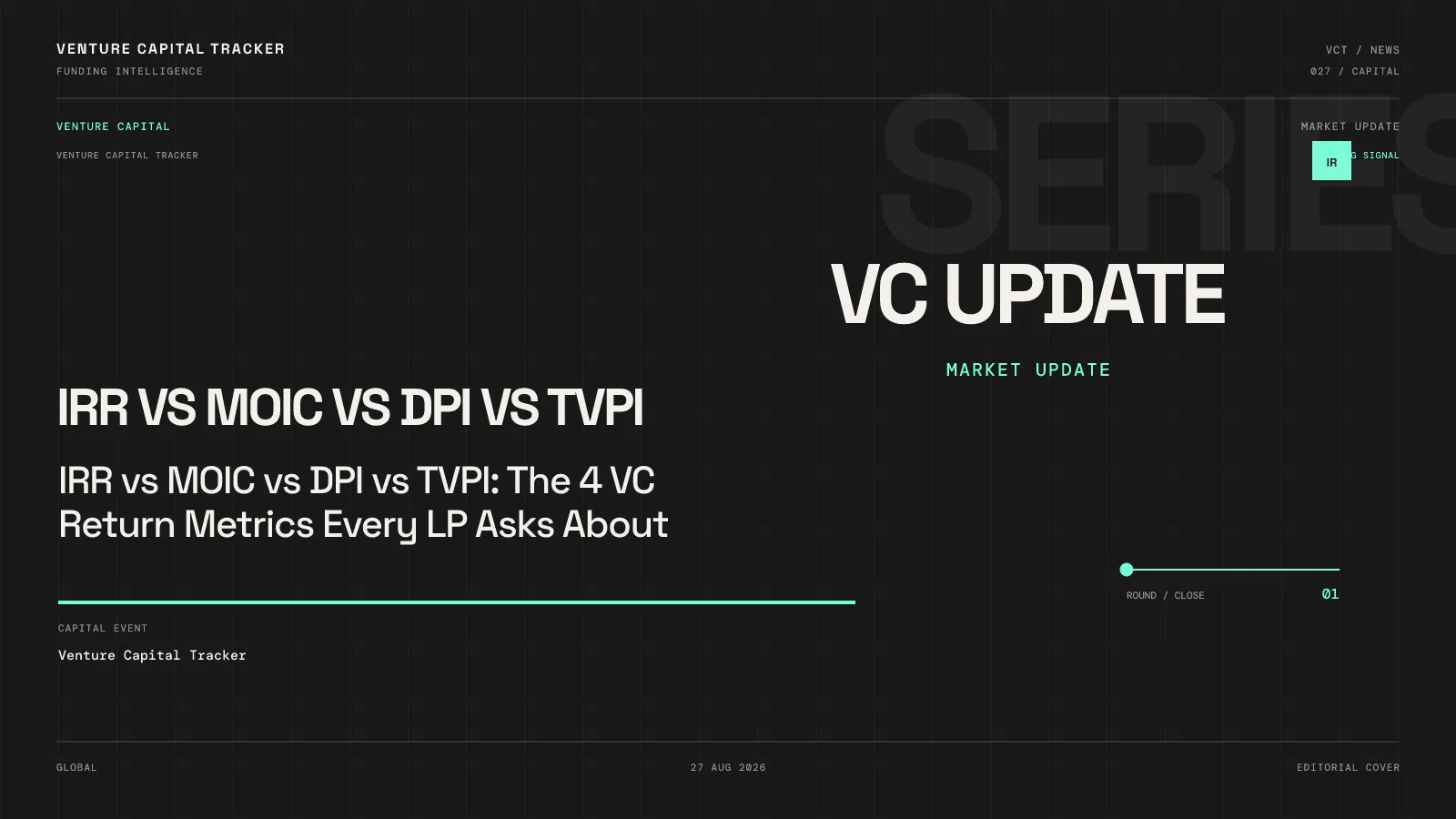
IRR vs MOIC vs DPI vs TVPI: four acronyms that define how VC funds are measured — IRR is time-weighted return, MOIC is a time-agnostic multiple, TVPI includes unrealized NAV, and DPI is cash actually returned. Mastering them is mandatory for GPs, LPs, and founders who want to understand what's really going on inside a fund.
1. IRR — Internal Rate of Return
What it measures: Time-weighted annualized return.
Why it matters: Compares apples to apples across different durations and asset classes. A 3x in 3 years beats a 3x in 10 years dramatically in IRR terms.
How it's calculated: The discount rate that makes the net present value of all cash flows equal to zero.
Limitation: IRR is highly sensitive to the timing of early distributions — a fund with one early hit can post a large IRR even if aggregate outcomes are mediocre.
2. MOIC — Multiple on Invested Capital
What it measures: Total value (realized + unrealized) divided by invested capital.
Why it matters: Simple, time-agnostic measure of efficiency.
Limitation: Ignores the holding period. A 3x in 3 years and a 3x in 15 years look identical in MOIC.
3. TVPI — Total Value to Paid-In
What it measures: (Distributions + Remaining NAV) / Paid-In Capital.
Why it matters: Captures everything the fund has returned or claims to be worth.
Limitation: NAV is a markup, not cash. Funds can carry inflated NAVs from boom-era markups.
4. DPI — Distributions to Paid-In
What it measures: Cash (+ stock distributions marked-to-market) actually returned to LPs divided by capital called.
Why it matters: This is the only metric that can't be inflated by subjective markups. It's real cash in the LP's account.
In 2026: LPs treat DPI as the most important fund metric, especially for 2018–2022 vintages.
Worked example
- A $100M fund has:
- Called $80M.
- Distributed $120M.
- Remaining NAV: $60M.
- Paid-in (net of recycling): $80M.
Metrics:
- DPI = $120M / $80M = 1.5x.
- TVPI = ($120M + $60M) / $80M = 2.25x.
- MOIC = similar to TVPI but typically calculated on invested rather than called (context-dependent).
- IRR = depends on the timing of the flows; might be 18–25% for a fund this far along.
How these metrics evolve over a fund's life
- Year 1–3: TVPI and MOIC slightly below 1x (the "J-curve"). DPI near 0.
- Year 4–6: Markups drive TVPI above 1x. DPI still modest.
- Year 7–10: Exits convert markups to DPI. TVPI and DPI converge.
- Year 10+: Residual positions remain until extended. Mature DPI reveals actual fund quality.
What LPs actually benchmark
- Top-quartile VC funds historically: ~3x net TVPI, 25%+ IRR.
- Top-decile: 5x+ net TVPI.
- Median: 1.5–2x net TVPI — often only 1.1–1.3x net DPI at maturity.
Common traps
- Unrealized TVPI inflation: Many 2020–2021 funds carry 3x TVPI and under 0.5x DPI.
- IRR gaming: Early small distributions can artificially boost IRR.
- Fee-gross vs net reporting: Always ask for net-to-LP metrics.
Practical takeaway
- GPs: Transparency on DPI trajectories builds LP trust faster than any markup narrative.
- LPs: Track DPI milestones by vintage year; use them to gauge realistic re-up pacing.
- Founders: Your investor's fund vintage and DPI situation influence how patient they can be with your timeline.
Further reading
- NVCA 2026 Yearbook: https://nvca.org/press_releases/nvca-releases-2026-yearbook-charts-a-venture-industry-in-transition/
- vc-explainers
- fund-economics
- lp-relations
- +1 more
Last updated:
Editorial note: AI tools assisted with research, structure, or drafting. Venture Capital Tracker retains human editorial responsibility for factual accuracy, relevance, and source quality before publication.