· Investment Strategies · 11 sources · Updated · Verified
Anthropic IPO: What the $83 Offer Price Means After ANT's Debut
Claude's maker has reached Nasdaq. The filing separates company capital from selling shareholders' proceeds—and leaves important questions about costs and control.

By Venture Capital Tracker
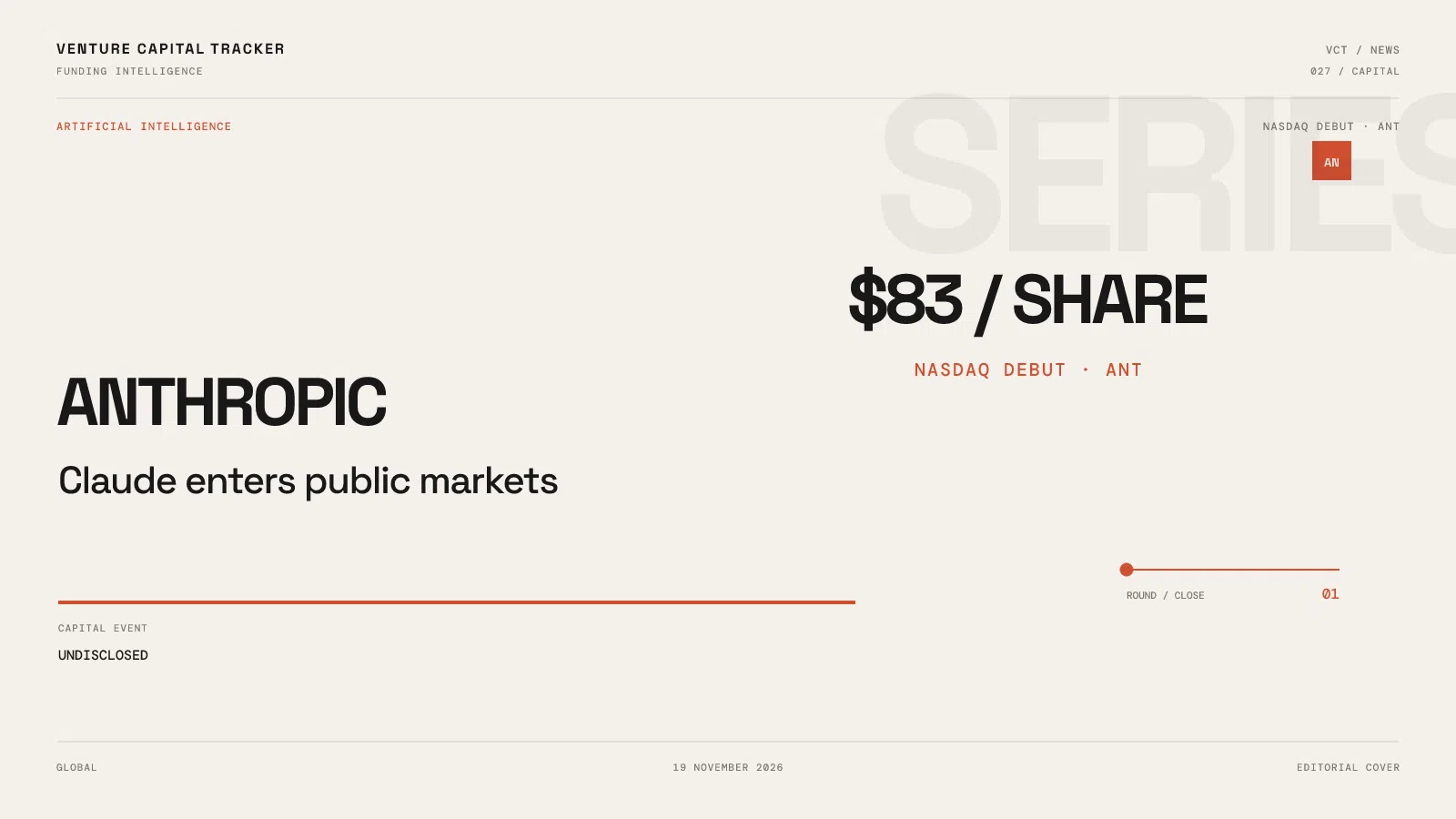
Anthropic began trading on Nasdaq on November 19, giving public investors a direct stake in the company behind Claude. Its shares opened at $111.50, according to Nasdaq's account of the debut.
Deal details & investors
IPO
Anthropic
For investors, the immediate task is to understand what they are buying and where the offering money goes. The headline deal size combines money for Anthropic with money for selling stockholders. A separate private placement and a possible additional share sale make the financing larger—and easier to misread.
Where the offering money goes
The November 18 pricing document filed with the SEC sets out a base offering of 980 million Class A shares at $83 each. Multiplying those figures gives $81.34 billion gross.
Most of those shares are newly sold by Anthropic. A smaller portion belongs to existing stockholders, whose sale proceeds go to them.
| Component | Disclosed shares | Gross value at the offer price |
|---|---|---|
| Company shares | 956,351,354 | About $79.38 billion |
| Selling-stockholder shares | 23,648,646 | About $1.96 billion |
| Base public offering | 980,000,000 | $81.34 billion |
The dollar values in this table are VCT calculations from the filed share counts and offer price. They precede underwriting discounts and other expenses; they are not net cash received. The company's announcement explicitly says it receives no proceeds from selling stockholders' shares.
The filing separately identifies a $26 billion concurrent private placement of Class N shares. It also provides for an underwriters' option covering up to 147 million additional Class A shares. Neither belongs in the base-offering total above. The document specifies that the option shares would all be newly issued company shares. Exercise has not been verified here.
Anthropic expected the offering to settle on November 20, subject to customary conditions. Trading has begun, but this article has not verified completed settlement or final net proceeds.
The offer price and the market price
The offer price was agreed before public trading. It is the price attached to the IPO allocation, rather than a price guaranteed to someone submitting a later brokerage order.
The difference was visible immediately: Nasdaq recorded the first trade above the offer price. That opening print is a historical transaction, not a current quote or an indication of what a future order will receive.
Reuters' pricing report put Anthropic's fully diluted valuation at about $1.5 trillion, including potential shares such as options and restricted stock; it reported about $1.1 trillion on a non-diluted basis. In plain language, two people can multiply the same share price by different share counts and produce different company valuations. Comparisons with earlier private-round valuations need consistent share counts, dates and treatment of convertible securities.
For the history behind the listing, the Anthropic company profile keeps the private rounds separate. Our Claude ownership analysis explains why economic ownership and voting control also need separate examination.
What public investors are buying
Anthropic develops the Claude family of AI models and the applications built around them. Its current product overview describes work such as synthesizing information, drafting documents and creating software or financial models.
An illustrative workplace use is a product manager asking Claude to collect meeting action items, identify owners and prepare a follow-up for review. Anthropic's website demonstrates connected workflows involving transcripts, Slack and calendars. These are vendor-described capabilities, not a workflow VCT tested or evidence of a particular customer's savings.
The business competes with other commercial model providers and with software built around open-weight models. For an enterprise buyer, a useful comparison includes output quality on its own tasks, integration effort, data handling, human review and total usage cost. A public listing establishes neither a product's accuracy nor its advantage on those measures.
That is also the bridge to the investment case. The economic question is how effectively paying usage turns into durable cash generation after serving customers, developing models and securing computing capacity.
Growth needs to be read alongside computing costs
Reuters reported third-quarter 2026 revenue of $16.96 billion and about $5 billion of additional computing costs during that quarter. Those figures describe a fast-growing business with substantial infrastructure demands. They should not be subtracted to manufacture a profit margin: computing expense is not a complete measure of operating costs.
Future supplier commitments add another distinction. Contracted capacity, expenses recognized in a quarter and cash paid during that quarter are different measures. A financing headline alone cannot establish that future infrastructure obligations are comfortably funded.
Reuters also reported that investor Baillie Gifford's case rested on Anthropic remaining among the leading model developers. That is an investor thesis, not a demonstrated guarantee of future returns. Competition, customer retention, pricing and the availability of computing infrastructure remain practical tests of it.
Earlier private backers include Altimeter Capital, one of the leaders of Anthropic's May Series H. In the company's announcement, Altimeter's Brad Gerstner tied his case to adoption by demanding customers. That historical financing and thesis are separate from the banks underwriting the IPO.
What a brokerage purchase actually involves
Consider an illustrative reader who uses Claude and wants to own its shares. A subscription account is not a securities account, and familiarity with the product does not establish an appropriate purchase price.
The SEC's IPO investor bulletin distinguishes receiving an IPO allocation from buying shares after trading starts. Access to an allocation depends on the intermediary; requesting shares does not establish that an allocation has been made.
For a public-market order, the reader would check the security and ticker, available order types, currency-conversion costs and trading charges. This example describes the mechanics, rather than recommending a purchase. The SEC's order-types guide explains that a market order does not guarantee a price, while a limit order sets a price boundary without guaranteeing execution.
The next company disclosures should make final proceeds and settlement clearer. Subsequent financial reports will provide the more demanding evidence: whether growth, computing expenditure and cash generation support the expectations built into the shares.
Updated November 20, 2026. Offering terms, exchange confirmation, attributed reporting and VCT calculations are identified separately. Share prices above are dated observations, not live quotes.
- ipo
- private-markets
- valuation
- +1 more
Last updated:
Editorial note: AI tools assisted with research, structure, or drafting. Venture Capital Tracker retains human editorial responsibility for factual accuracy, relevance, and source quality before publication.