· 8 sources · Updated · Verified
UFORCE Raises $700M Series A at $6B: UK Investment, Drone Platforms and Valuation Explained
UFORCE raised $700M at a company-stated $6B valuation. Why the UK's $150M sovereign equity ticket is inside—not on top of—the deal, what its drones actually do, and the procurement and valuation risks.

Editorial team
Funding event
UFORCE
Led by Valor Equity Partners , UK National Wealth Fund
Reported valuation $6B
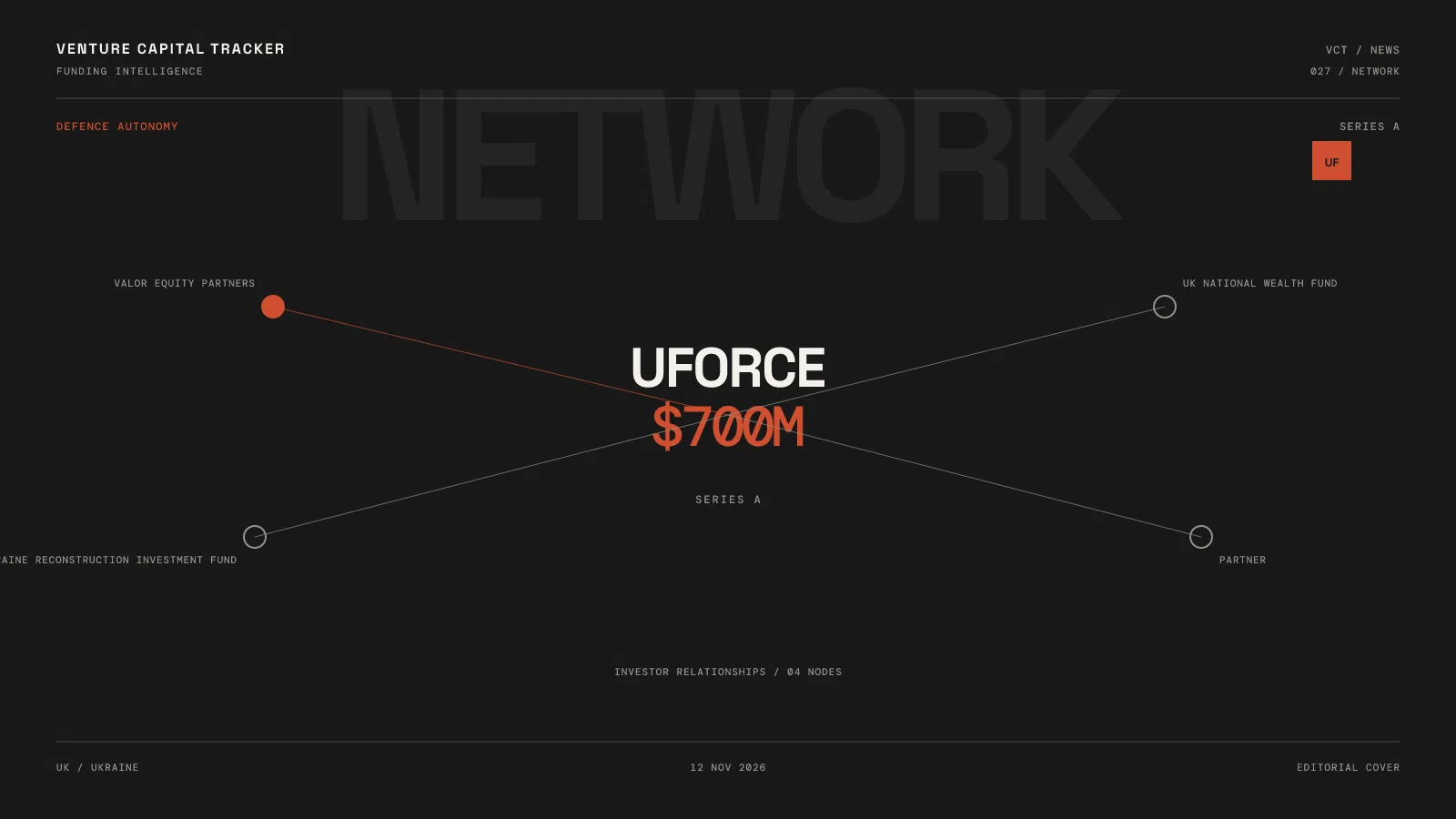
UFORCE announced a $700 million Series A at a company-stated $6 billion valuation on November 12, 2026, co-led by Valor Equity Partners and the UK's National Wealth Fund (NWF). The London-headquartered, Ukrainian-founded defence technology group develops unmanned systems for maritime, aerial and ground operations, along with software connecting those platforms. NWF separately confirmed its own $150 million equity investment is part of—not additional to—the $700 million round. The deal finances production expansion for Ukraine and allied countries, but the company has not disclosed the exact legal closing date, whether $6 billion is pre- or post-money, or audited commercial revenue.
The news is important for more than its valuation: a British public investor is putting capital directly behind technology refined during Ukraine's war, with an explicit plan to localize more production in the UK. For investors, the unresolved question is how battlefield evidence converts into repeatable, export-compliant procurement and attractive manufacturing economics.
The transaction, at a glance
| Item | What is verified |
|---|---|
| Financing announced | $700 million Series A, November 12, 2026 |
| Company-reported valuation | $6 billion; pre- versus post-money basis not identified |
| Co-leads | Valor Equity Partners and UK National Wealth Fund |
| NWF's own check | $150 million in equity, included in the $700 million total |
| Other named participants | U.S.–Ukraine Reconstruction Investment Fund, Menlo Ventures, Xantium, Hiro Capital; returning Shield Capital, Ballistic Ventures, Lakestar and Squadra |
| Prior reported funding | $50 million seed, reported March 5, 2026, at a valuation above $1 billion |
| Not disclosed | Ownership stakes, share price, audited sales, customer contract economics and precise deal completion date |
These numbers come from UFORCE's company-issued funding announcement and the NWF's own investment statement. The funding total is not $850 million: adding the NWF commitment again would double-count part of the round. Dividing its $150 million contribution by $700 million gives about 21.4% of the round's announced financing, not 21.4% ownership of UFORCE. Equity ownership requires a pre-/post-money basis, capitalization and deal terms that have not been published.
What does UFORCE actually build?
UFORCE describes an integrated defence offering across three physical domains and the software used to coordinate them. Its MAGURA family covers uncrewed maritime vessels; NEMESIS is associated with aerial unmanned systems; LIUT with ground robotics; and PREDATOR with remotely operated protection systems. Command-and-control software is intended to help operate and integrate the hardware. These are different products and capabilities—not a single consumer drone or a downloadable software subscription.
The company says its platforms have amassed extensive combat experience. Such field use may be commercially meaningful because a buyer can evaluate performance against real-world constraints rather than demonstrations alone. But published mission totals, performance claims and generalized cost advantages remain company claims; a mission count is neither a count of platforms sold nor evidence of annual revenue, gross margin, successful export certification or independent testing.
Importantly, a defence-technology product announcement should not be read as evidence that every government buyer has qualified every variant. A system deployed by one military may still require separate safety, electromagnetic, security, data-governance, integration and local regulatory approvals elsewhere.
The five-step buyer journey: how a defence ministry might procure it
The following is an illustrative procurement scenario based on the public product categories, not a claim that VCT conducted hands-on tests or witnessed a particular customer's tender.
- Define the mission and requirements. A government acquisition team specifies whether it needs maritime surveillance, aerial reconnaissance, ground logistics, integration software or some combination. Range, communications security, endurance, maintenance and data handling become acceptance criteria.
- Shortlist systems and suppliers. The team examines UFORCE's relevant platform family, existing military-user experience, support model, documentation and credible alternatives. A maritime MAGURA evaluation has different constraints from an aerial NEMESIS one.
- Run controlled trials. Technical staff request demonstrations and independently assessed evidence under the buyer's environmental, safety, reliability and interoperability conditions. Military field reports may inform testing, not replace it.
- Check the supply chain and permissions. Procurement officials examine export approvals, sovereign component content, cybersecurity, national procurement rules, spare parts, training, repair access and possible local assembly.
- Negotiate capability and lifecycle costs. An eventual contract would typically need to define quantities, deliverables, software support, sustainment and adaptation. UFORCE does not publish verified list prices, unit margins or customer-specific total cost of ownership, so VCT cannot supply a meaningful per-vessel or per-mission quote.
For a founder, this is a fundamentally different go-to-market motion from SaaS: the commercial risk is not just whether a prototype works, but whether procurement, localization and long-term sustainment can scale without eroding margins.
Why the British government is investing—and what $150 million buys
The UK's National Wealth Fund independently described its $150 million equity commitment as part of the financing. The rationale is not limited to financial return: the UK wants industrial capacity and a supply chain capable of manufacturing selected systems domestically while supporting allied defence needs.
NWF and British government statements describe an ambition for more than 70% British-sourced content in each UK-built MAGURA vessel, encompassing components and fit-out. That percentage refers to a prospective sourcing target for UK-built boats, not an independently verified share of UFORCE's current global bill of materials or evidence that a factory is already delivering contracted volume. The company's earlier announcement of its first UK-developed autonomous sea drone is a development milestone, not a disclosed mass-production tally.
This makes the round unusual: a public investor is simultaneously targeting investment return, defence readiness, jobs and local industrial participation. Those objectives can reinforce one another but can also impose higher manufacturing, supplier-qualification and compliance costs. Neither NWF nor the company has published a detailed unit-cost comparison that would settle that trade-off.
UFORCE's funding history: do not turn September talks into another round
A March 5, 2026 report, citing Bloomberg, described a separate $50 million seed financing at a valuation above $1 billion, naming Lakestar and Shield Capital as co-leads and Ballistic Ventures as a participant. That earlier valuation is a reported lower bound, not an exact price.
In September, Dealroom reported that UFORCE was **in talks** to raise roughly $500 million at about a $5 billion valuation. That was a proposed transaction, not an independently completed financing. November's confirmed announcement is $700 million at $6 billion. Recording September's proposal as a closed $500 million round and then adding November's proceeds would overstate the company's financing history.
The two separately identified completed/announced financings total $750 million in disclosed rounds, subject to the limitations of historical reporting; this is not proof that no other financing or secondary transactions exist. The reported funding and the stated valuation are also different quantities: a $6 billion valuation is not $6 billion received by UFORCE.
Investor thesis: battlefield iteration plus sovereign capacity
Valor Equity Partners and NWF co-led the round. The company frames the investment around accelerating scaled, adaptable autonomous systems. NWF's own rationale specifically emphasizes British production capability and the transfer of battle-developed technology into an allied industrial base. These are documented investor and issuer positions, not independently demonstrated returns.
For private-capital investors, the thesis is that repeated real-world iteration may shorten product-learning cycles, and that sovereign demand for autonomous, lower-personnel-risk systems can create durable procurement programs. Yet defence procurement has long sales cycles, political oversight, changing demand and strict export compliance. Strong battlefield adoption does not automatically deliver repeat international contracts, high software-like margins or customer diversification.
How does the valuation compare with other defence financings?
| Company and transaction | Reported investment | Valuation reference | Useful comparison |
|---|---|---|---|
| UFORCE — November 2026 Series A | $700M | $6B company-stated | Air, maritime and ground unmanned defence systems; valuation basis undisclosed |
| Quantum Systems — July 2026 Series D | $1.2B | About $8B | European autonomous defence platforms; later stage and different commercial mix |
| Onodrim Industries — November 2026 Series A | $300M | $1.3B | European defence industrial supplier acquisitions, not the same product-sales model |
The Quantum Systems announcement provides a relevant European autonomy financing reference. VCT's Onodrim analysis helps distinguish a defence manufacturing roll-up from an autonomy equipment company. Round sizes alone cannot establish relative value, because stage, revenue, supply chain, gross margins, contractual backlog and valuation terms differ or remain unavailable.
For competitive procurement, Kraken Technology Group is relevant to maritime autonomy; Anduril Industries has broader US defence hardware/software integration; Helsing focuses on European defence autonomy and software; and Quantum Systems spans multiple unmanned-platform categories. None should be treated as interchangeable without platform-level acceptance criteria. A buyer comparing vessel endurance, integration rights and sustainment coverage needs data unavailable from headline funding announcements.
What investors and buyers still cannot verify
Three material diligence gaps stand out. First, the valuation disclosure lacks a pre-/post-money label and a capitalization breakdown, preventing credible dilution estimates. Second, the announcement does not publish independently audited revenue, unit production economics, signed contract values or verified backlog conversion; a claimed mission history or bookings trend is not the same thing as recognized sales. Third, UK manufacturing plans need to be measured against qualified local suppliers, actual deliveries and enduring government contracts—not just a promising percentage target.
The strongest near-term milestones to watch are verifiable UK manufacturing capacity and component localization, independent acceptance of named systems by additional allied buyers, and disclosed evidence of recurring orders and sustainment economics. None is guaranteed by the financing itself.
VCT maintains the UFORCE company and funding profile alongside its canonical investment-event feed. This account separates the November funding announcement, the earlier March financing and September's uncompleted talks so readers can follow the transaction without accidental double counting.
Follow Venture Capital Tracker on Google
Add VCT as a preferred source to see more of our venture-capital reporting in Google Search.
Last updated:
Editorial note: AI tools assisted with research, structure, or drafting. Venture Capital Tracker retains human editorial responsibility for factual accuracy, relevance, and source quality before publication.