· 4 sources · Verified
Switchpoint Bio Raises $5.3M Pre-Seed: Blood Epigenomics, Lupus Research and Clinical Validation
Switchpoint Bio disclosed $5.3M of pre-seed financing, including $5M from Treehouse Delmar. How its blood-based DNA-methylation assay works, what lupus research could prove, and key clinical risks.

Editorial team
Funding event
Switchpoint Bio
Led by Treehouse Delmar Investments
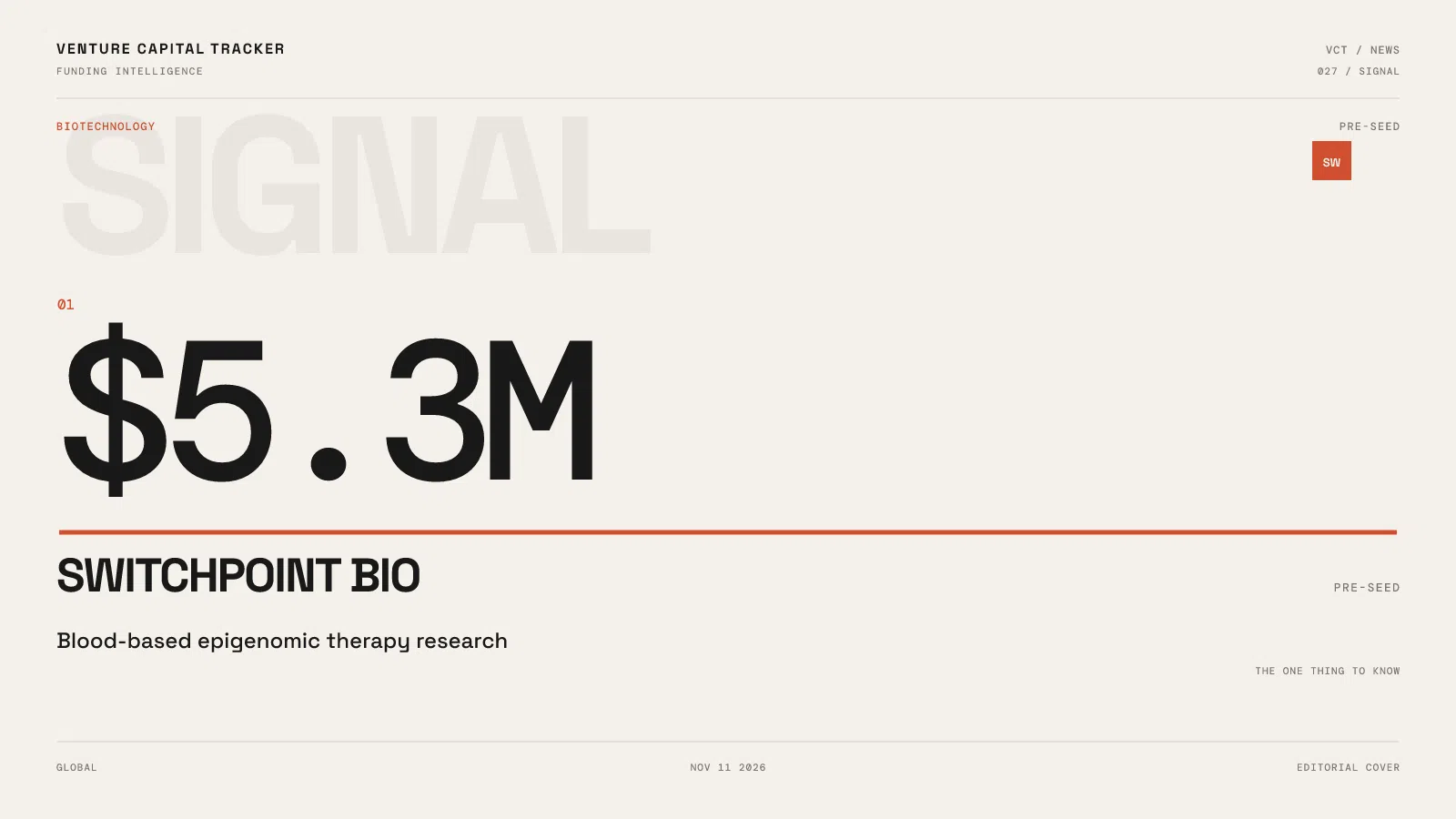
Switchpoint Bio disclosed $5.3 million in pre-seed funding on November 11, 2026, including $5 million from Treehouse Delmar Investments. The Treehouse investment is included in—not additional to—the total. The Helsinki- and Cambridge, Massachusetts-based company is developing a blood-based platform to measure DNA-methylation patterns and infer changes in disease biology and drug response. It is a research-stage platform, not an approved diagnostic.
The original company-issued Finnish announcement was published on November 11 and carries a November 10 company dateline. A legal financing close date and valuation were not provided.
Financing and company facts
| Item | Verified status |
|---|---|
| Financing | $5.3M pre-seed |
| Identified investor contribution | $5M Treehouse Delmar, part of the total |
| Other investor allocation | Not individually disclosed |
| Announcement | November 11, 2026 |
| Founders | Samuel Myllykangas and Jason Buenrostro |
| Operations | Helsinki, Finland; Cambridge, Massachusetts |
| Product stage | Clinical and industry validation |
| Commercial diagnostic approval | Not established |
The funding supports the company's scientific platform, clinical and biobank datasets and team development. Neither the investor's $5 million contribution nor the aggregate raise demonstrates product-market fit or a particular clinical result.
What is the product supposed to do?
The idea is to use changes in the epigenome—especially DNA methylation, a chemical modification associated with gene regulation—as a window into immune-cell states. In principle, those measurements could reveal biological changes that are not evident from conventional blood counts or a patient's reported symptoms.
A representative, prospective research workflow would be:
- A clinical or pharmaceutical research team defines a disease cohort, treatment and sampling schedule.
- Researchers collect blood samples before and during treatment, with appropriate ethics approval and consent.
- Switchpoint's targeted assay measures methylation patterns in relevant cells or DNA material.
- Computational analysis compares signatures with reference datasets to infer shifts in immune-cell populations or states.
- The research team tests whether those shifts correlate with validated disease activity or treatment response, ideally in independent cohorts.
This is a proposed research and validation sequence; VCT did not perform the assay or verify its analytical sensitivity, clinical specificity or ability to predict outcomes.
Why lupus is an interesting but difficult test case
Systemic lupus erythematosus can involve fluctuating immune activity and variable responses to therapy. A longitudinal blood test could be useful if it measured underlying biological changes earlier or more reliably than existing clinical indicators. Tech.eu's coverage reports that Switchpoint is using autoimmune disease, including lupus, to validate this approach.
The real hurdle is separating signal from noise. Changes in cell composition, infections, medicines, age, sampling technique and batch effects can alter epigenomic measurements. A credible validation programme needs technical reproducibility, independent cohorts, comparison against established markers and evidence that findings change a meaningful clinical or drug-development decision.
Buyer, business model and alternatives
The initial potential buyers are pharmaceutical developers, translational research teams and biomarker programmes, rather than patients buying a consumer health test. The company says it is engaging pharmaceutical and biotechnology partners to define early validation projects. Public pricing, per-sample costs, platform licensing terms, signed customer revenue and deployment volumes have not been disclosed.
Practical alternatives include conventional immune phenotyping such as flow cytometry, RNA-expression profiling, cell-free DNA tests for appropriate indications, broader epigenomic sequencing and longitudinal clinical biomarkers. None is a perfect equivalent. Switchpoint's proposed advantage would need to be demonstrated as either lower operational burden, improved measurement of relevant biology, better decision-making or a compelling cost/reproducibility tradeoff.
The company was founded by scientists with experience in targeted sequencing technologies. Founder expertise is relevant but does not replace independent platform validation. EU-Startups identifies the founders and confirms the investor structure.
What must be proved before this becomes clinical infrastructure?
The remaining gates include analytical repeatability between laboratories and batches; sensitivity to the immune-cell states of interest; generalization outside initial discovery cohorts; demonstration that a signal meaningfully tracks patient response; data privacy, consent and regulated diagnostic pathways where clinical claims are made; and sustainable cost per sample.
Bottom line: This is a promising attempt to create more informative longitudinal biological readouts from blood. Its $5.3 million pre-seed is verified, but claims of clinical usefulness, regulatory clearance and commercial traction remain prospective. See the Switchpoint Bio startup and financing profile for canonical transaction information.
Follow Venture Capital Tracker on Google
Add VCT as a preferred source to see more of our venture-capital reporting in Google Search.
Editorial note: AI tools assisted with research, structure, or drafting. Venture Capital Tracker retains human editorial responsibility for factual accuracy, relevance, and source quality before publication.