· 7 sources · Verified
Onodrim Raises $300M at $1.3B to Buy Europe's Defence Suppliers
Onodrim's Nov. 9 Lux-led Series A funds an acquisition-led industrial strategy. Reconcile its €40M seed, unclosed September talks, supplier economics and risks.

By Venture Capital Tracker Editorial
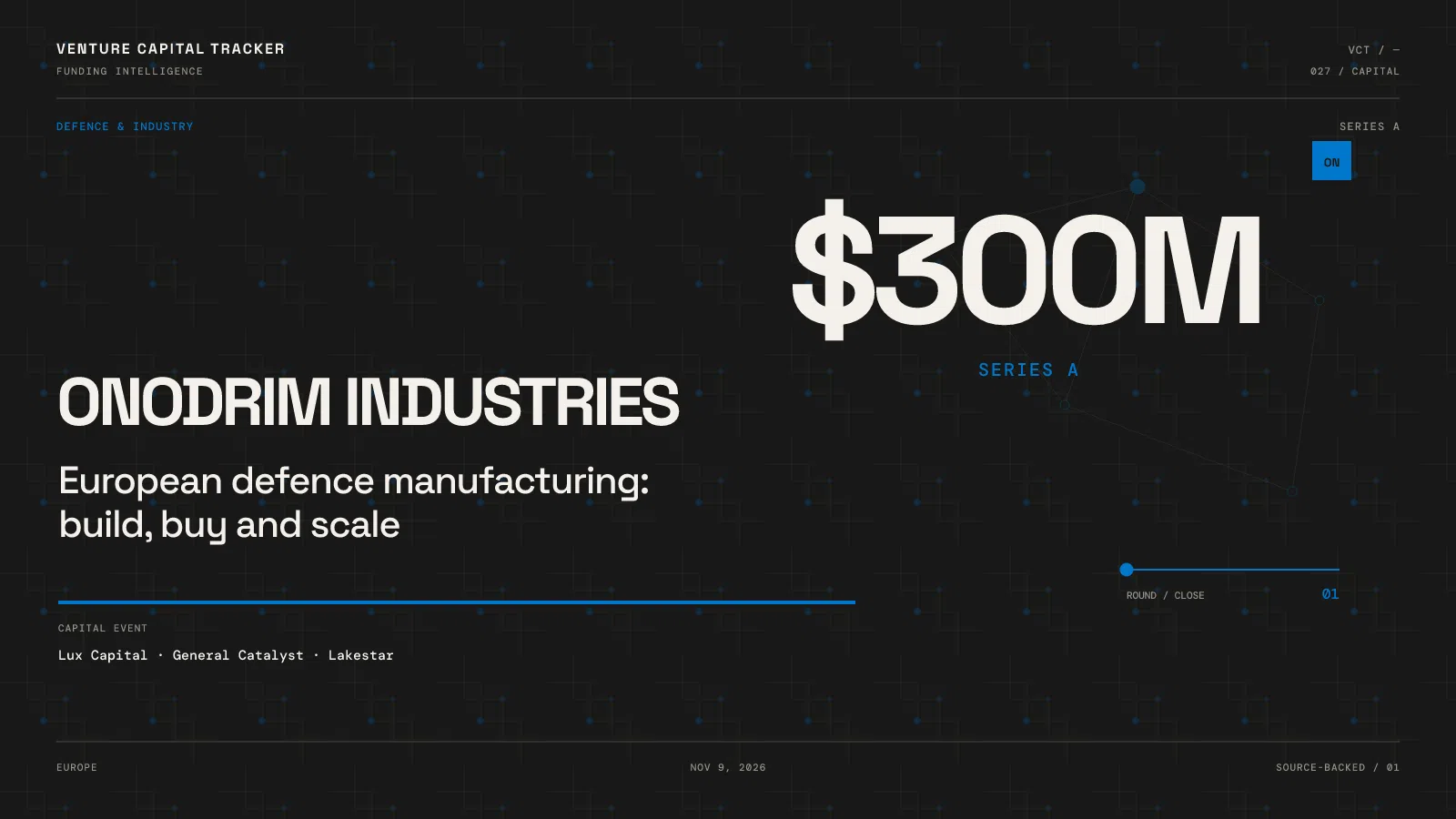
Funding event
Onodrim Industries
Led by Lux Capital
Reported valuation $1.3B
On November 9, 2026, Amsterdam-based Onodrim Industries announced a $300 million Series A led by Lux Capital, with General Catalyst, Lakestar, Altimeter, Strike Capital, 137 Ventures, 8090 and Expeditions participating. The company says the transaction values it at $1.3 billion, but it has not disclosed whether that valuation is pre- or post-money. The round follows an entirely separate €40 million seed announced in February 2026.
Onodrim is unusual for a venture-backed defence company: it is not primarily trying to sell a new drone, missile or command-and-control product. It wants to buy controlling stakes in established European manufacturers, keep them for the long term and provide capital, engineers and commercial expertise to help them manufacture more. The difference matters for founders, suppliers and investors: this is an acquisition-led industrial operating strategy, not a $300 million defence contract or a fund close. As of the announcement, no completed acquisition or named acquired company had been disclosed.
| November 9 financing | Verified position |
|---|---|
| New Series A | $300 million, company-announced |
| Lead investor | Lux Capital |
| Other named backers | General Catalyst, Lakestar, Altimeter, Strike Capital, 137 Ventures, 8090 and Expeditions |
| Valuation | $1.3 billion, company-stated; pre/post-money basis not specified |
| Earlier seed | €40 million, announced February 13, 2026 |
| Intended use | Acquiring control of suppliers; manufacturing, engineering and commercial investment |
| Completed acquisitions | None named or verified publicly as of November 9 |
| Revenue, EBITDA, acquisition multiples | Not disclosed |
What Onodrim is actually building
The company calls itself a European defence and industrial scale-up platform. The key asset it seeks is an already operating business—for example, a manufacturer with specialized expertise and customers whose output is constrained by equipment, hiring, working capital or sales reach.
Instead of competing directly with a specialist aircraft maker such as TEKEVER, Onodrim aims to own businesses further along the industrial supply chain. Its target areas include aerospace and defence components, sensing, industrial manufacturing, and civilian-military dual-use suppliers. The company says it intends to hold controlling interests using permanent capital, rather than run a conventional private-equity fund with a predefined exit date.
That claim should be read carefully. Permanent-capital intent does not disclose the actual shareholder rights, leverage, acquisition prices, ownership structure or legal constraints of future deals. Those terms will matter once transactions are announced.
A practical supplier-owner journey—not a deployed product demo
Consider an illustrative, already-profitable European component maker whose production line is at capacity. This is a hypothetical workflow based on Onodrim's announced model, not an account of an acquisition it has completed.
- The owner assesses a sale of control. The manufacturer has existing products and customers but needs capital or expertise to expand. It can evaluate Onodrim against a trade buyer, private-equity sponsor, bank loan or remaining independent.
- Onodrim conducts acquisition and operational diligence. A credible buyer would need to review financials, customer concentration, quality systems, production bottlenecks, export-control requirements and supplier certifications. The company has not disclosed its own formal diligence checklist.
- Capital and governance are agreed. Onodrim's proposed model is a controlling stake and long-term ownership, not simply a loan or grant to the factory. The price, minority protections and management incentives are negotiated and currently undisclosed.
- The manufacturer would be upgraded after closing. The intended support includes engineering teams, technology modernization, new equipment, operations and business-development capabilities. None is proof of a realized productivity improvement yet.
- The supplier tries to win and deliver larger programmes. Actual return depends on verified customer orders, factory utilization, defects, working capital, capital expenditure and eventual cash flows—not how much Onodrim raised.
Who pays? Onodrim's prospective acquired suppliers would earn money by selling parts, systems or services to industrial customers and defence prime contractors. Onodrim would economically participate as an owner. There is no disclosed subscription fee or product price for an Onodrim software platform, nor published consolidated revenue or margins.
How the $300 million relates to the February seed
There are two announced financings, not three:
| Announcement date | Financing | What the source actually says |
|---|---|---|
| February 13, 2026 | €40 million seed | Led by Founders Fund, Lakestar and General Catalyst. The euro-denominated issuer release is the original source. |
| September 29, 2026 | Talks only | Bloomberg reported discussions of approximately €200 million with Lux Capital at a suggested unicorn valuation. A negotiation was not an additional completed round. |
| November 9, 2026 | $300 million Series A | Lux-led company-announced financing with a $1.3 billion valuation. |
The November release describes the February seed as about $45 million, a rounded conversion of the earlier €40 million announcement—not a new $45 million investment and not a second seed. Likewise, the September proposed €200 million cannot be added to the final November Series A. The sources do not give exact legal completion dates for either financing apart from the announcement dates.
It is tempting to subtract the $300 million round from the $1.3 billion valuation to calculate ownership dilution. That would not be reliable: the issuer does not say whether $1.3 billion is pre- or post-money, and it has not released the full security terms.
Why Lux Capital, General Catalyst and Lakestar are backing it
In its November 9 announcement, Lux partner Brandon Reeves frames the opportunity as expanding the manufacturing capacity required for European resilience, not just financing novel technologies. Jeannette zu Fürstenberg of General Catalyst makes a related point: established manufacturers already possess product know-how and customer trust, but may lack the technology and resources to take on larger programmes.
The investor argument is that buying a capable existing factory may be faster than creating a new supplier and earning all the necessary quality approvals from scratch. That is a plausible thesis, not demonstrated execution. The company is still to name its first acquisitions.
Onodrim's leadership is CEO and co-founder Aistis Šimaitis, a former Lithuanian government adviser and Palantir technology leader; CTO and co-founder Alexander Blessing, a former Palantir forward-deployed engineer; and co-founder Christian Garrett, a partner at 137 Ventures. Onodrim lists Amsterdam, London and Vilnius operations and announced plans for additional offices in Munich and Turin.
The acquisition economics investors should scrutinize
A $300 million financing does not mean Onodrim has $300 million in annual revenue, has purchased $300 million of factories, or manages a $300 million LP fund. It is corporate financing intended to support investment in operating businesses.
An illustrative capital-allocation calculation shows why this matters. Assume—not predict—that a controlling stake in one supplier costs $50 million, and upgrading its equipment, staffing and systems requires another $20 million. That is $70 million deployed per supplier before integration fees, working capital and central overhead. On those assumptions, three such projects would use $210 million, leaving $90 million from a $300 million raise before other uses of cash. If acquisition prices, debt financing or capex requirements differ, the result changes substantially. Onodrim has published none of those acquisition prices, target counts or leverage assumptions.
The better measure of progress will be whether acquired factories increase qualified output, meet customer deadlines, sustain quality, convert orders into cash and generate incremental operating profit relative to purchase price and additional investment. A future announcement of a large signed order is not the same thing as delivered revenue.
Alternatives—and why this is not another defence hardware startup
| Model | How it differs from Onodrim |
|---|---|
| Traditional industrial private equity | Can acquire and modernize factories too, but many vehicles work within fixed fund lifetimes and planned realization periods. Onodrim advertises permanent capital. |
| UFORCE and other supplier consolidators | Also seek more capable defence-industrial production, with differing geography, supply-chain relationships and operating models; their financial results are not interchangeable. |
| Hadrian-style new automated manufacturing | Builds modernized industrial production capacity using a different mix of new facilities and software, rather than starting with controlling stakes in existing independent suppliers. |
| TEKEVER, Skydio and other product developers | Design and sell systems such as aircraft, sensors and related technologies. Their funding supports product and manufacturing execution; Onodrim would chiefly acquire and operate suppliers. |
This distinction also changes the relevant comparison set. A business with existing products and customers might reduce some invention risk but introduce integration, maintenance-capex, working-capital and procurement concentration risks. A holding company can become more complicated as the number of operating subsidiaries grows.
What remains unproven
The central open questions are more meaningful than a unicorn label. Which companies will Onodrim acquire, at what prices and with what debt? Will their existing managers and customers remain? Can a central engineering team modernize different factories without interrupting production? How much qualification or regulatory work is necessary before expanded capacity turns into defensible orders?
European defence supply chains are subject to national security reviews, export controls, customer-specific quality requirements and procurement cycles. Even if orders exist at the prime-contractor level, a supplier cannot automatically convert them into new revenue. Higher throughput can also consume working capital before buyers pay.
Specialist defence reporting has likewise found no independently verifiable Onodrim product catalogue, consolidated revenue or publicly announced acquisitions as of November 9. That is not proof the company has no commercial activity—it means the measurable operating evidence is not public. An investor should not mistake statements about future acquisitions for completed deals.
For related capital structures, see VCT's defence-tech investor landscape and the Onodrim company funding profile, where the original seed and Series A are recorded as separate events.
The next evidence milestone is an actual acquired company, including ownership percentage, capital committed, revenue scale, purchase terms where disclosed and verifiable production expansion. Until then, the $300 million round establishes financing and ambition—not a completed European manufacturing roll-up.
Follow Venture Capital Tracker on Google
Add VCT as a preferred source to see more of our venture-capital reporting in Google Search.
Editorial note: AI tools assisted with research, structure, or drafting. Venture Capital Tracker retains human editorial responsibility for factual accuracy, relevance, and source quality before publication.