· 4 sources · Verified
Tano Raises $4M Seed: How AI Creator Marketing Works, Pricing and Agency Alternatives
Tano reportedly raised $4M led by Cherry Ventures. Its managed AI creator programme, per-post and affiliate fees, attribution economics, alternatives and conflicting creator reach claims explained.

Editorial team
Funding event
Tano
Led by Cherry Ventures
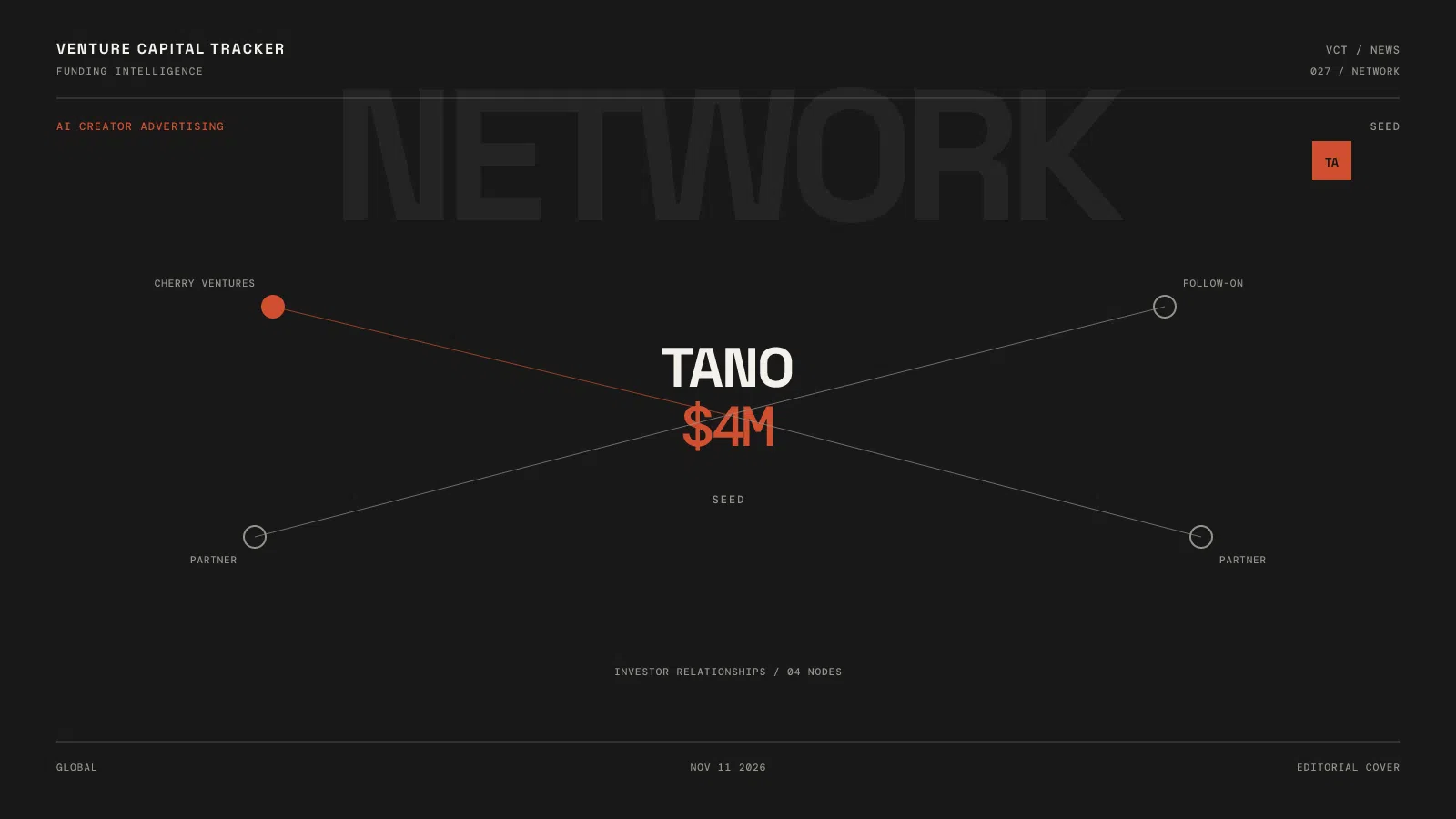
London-based Tano raised a reported $4 million seed round led by Cherry Ventures, according to Business Insider's original November 11, 2026 founder interview. The company reports approximately $5 million raised cumulatively. The difference does not establish a distinct $1 million financing round, and VCT has not found a separate company-issued funding announcement. Its valuation and legal close date remain undisclosed.
Tano sells something materially different from a self-service influencer-search database: AI-assisted, human-supervised management of creator advertising campaigns, including outreach, product gifts, follow-ups and performance tracking.
Tano financing: the verified distinctions
| Question | Answer |
|---|---|
| New funding reported | $4M seed |
| Lead investor | Cherry Ventures |
| Reported cumulative funding | Approximately $5M, not a second round |
| Disclosed valuation | None |
| Evidence | Founder interview reported by Business Insider |
| Commercial model | Managed creator programme; customized fees |
The company says the proceeds will support engineering, compute and creator-strategy staffing. Prior backing has been associated with Seedcamp and The Players Fund, but the precise earlier instruments and amounts are not independently reconstructed.
What would a consumer brand actually buy?
Consider an illustrative online beauty brand that wants more first-time orders without hiring staff to negotiate with hundreds of small creators.
- The brand specifies its product, campaign budget, target customer acquisition cost, permitted claims, creator exclusions and required advertising disclosures.
- Tano connects to relevant commerce data—its site describes a Shopify app and API integrations—and scores creators against the brief.
- Its agents contact shortlisted creators with personalized messages, negotiate or coordinate suitable gifts and follow up with human strategist oversight.
- The company records posts, discount codes, tracked links and product shipments. Contractual content usage rights must be confirmed before boosting a creator's work as an advertisement.
- The brand reviews attributable orders and campaign costs, then changes the creator mix, offers and creative tests.
These steps reflect the vendor's published workflow, not a hands-on VCT evaluation. It is explicitly positioned as managed execution, not simply a licence to use discovery software.
Pricing and unit economics: what the seed announcement leaves out
Tano describes contracts based on a fee per live creator post, a share of affiliate sales or negotiated commercial arrangements. It does not disclose a universal fee schedule.
A useful acquisition-cost calculation must include the platform/management charge, creator commissions, free products, shipping, paid media, content usage rights and returns—not just the campaign's apparent link-click cost.
Illustrative example, not Tano's actual price: assume a campaign costs $6,000 in management fees, $3,000 in gifts and delivery and $3,000 in commissions for 300 incremental new buyers. Fully loaded customer acquisition cost is $40 per buyer. If only 150 buyers were genuinely incremental after accounting for organic purchases, the cost rises to $80. The difference is why brands need holdout tests or other incremental-lift evidence rather than relying solely on last-click discount codes.
Tano's own case-study page makes performance claims including click-through-rate improvements and creator engagement. These are seller-selected examples, not independent causal studies.
Where Tano fits against alternatives
| Alternative | What the buyer mainly gets | Tradeoff relative to Tano |
|---|---|---|
| CreatorIQ | Enterprise creator relationship management | Internal operators or agency services still needed |
| Aspire | Creator discovery and campaign-management software | Different balance of self-serve control and managed execution |
| GRIN | DTC influencer-management workflows | Requires the brand to run more day-to-day activity |
| Impact.com | Affiliate attribution and partnerships | Stronger network/attribution focus; different creator gifting operations |
| Traditional agency | Human-led campaigns and brand expertise | More labor-intensive; economics vary widely |
Tano's differentiator is operational scale: it claims agents can run large numbers of personalized conversations while human strategists handle brand decisions and exceptions. Its effectiveness depends on creator quality, disclosure compliance, audience overlap, fraud prevention and actual incremental sales.
An unresolved creator-database discrepancy
The company's own materials and the Business Insider interview have described different creator-universe sizes, around 230 million versus 280 million. The difference may reflect definitions or snapshot timing, but no reconciled methodology was published. Neither number should be presented as independently verified active creators or monetizable advertising inventory.
For a buyer, the useful measure is not total discovered accounts. It is the number of qualified, reachable creators in a relevant market, post acceptance rate, delivered content quality and incremental revenue per total campaign cost.
Bottom line: Tano's $4 million reported seed supports a plausible product category: managed creator advertising with AI agents and human oversight. The case for the buyer depends on complete campaign economics and verified incremental orders, not headline database size or vendor-reported CTR. See the Tano startup and investor profile for structured deal details.
Follow Venture Capital Tracker on Google
Add VCT as a preferred source to see more of our venture-capital reporting in Google Search.
Editorial note: AI tools assisted with research, structure, or drafting. Venture Capital Tracker retains human editorial responsibility for factual accuracy, relevance, and source quality before publication.