Shield AI Valuation 2026: $12.7B Series G and $2B Financing
Shield AI's latest mark is $12.7B after a $1.5B Series G and $500M preferred financing. See what it means for funding, stock, and IPO questions.
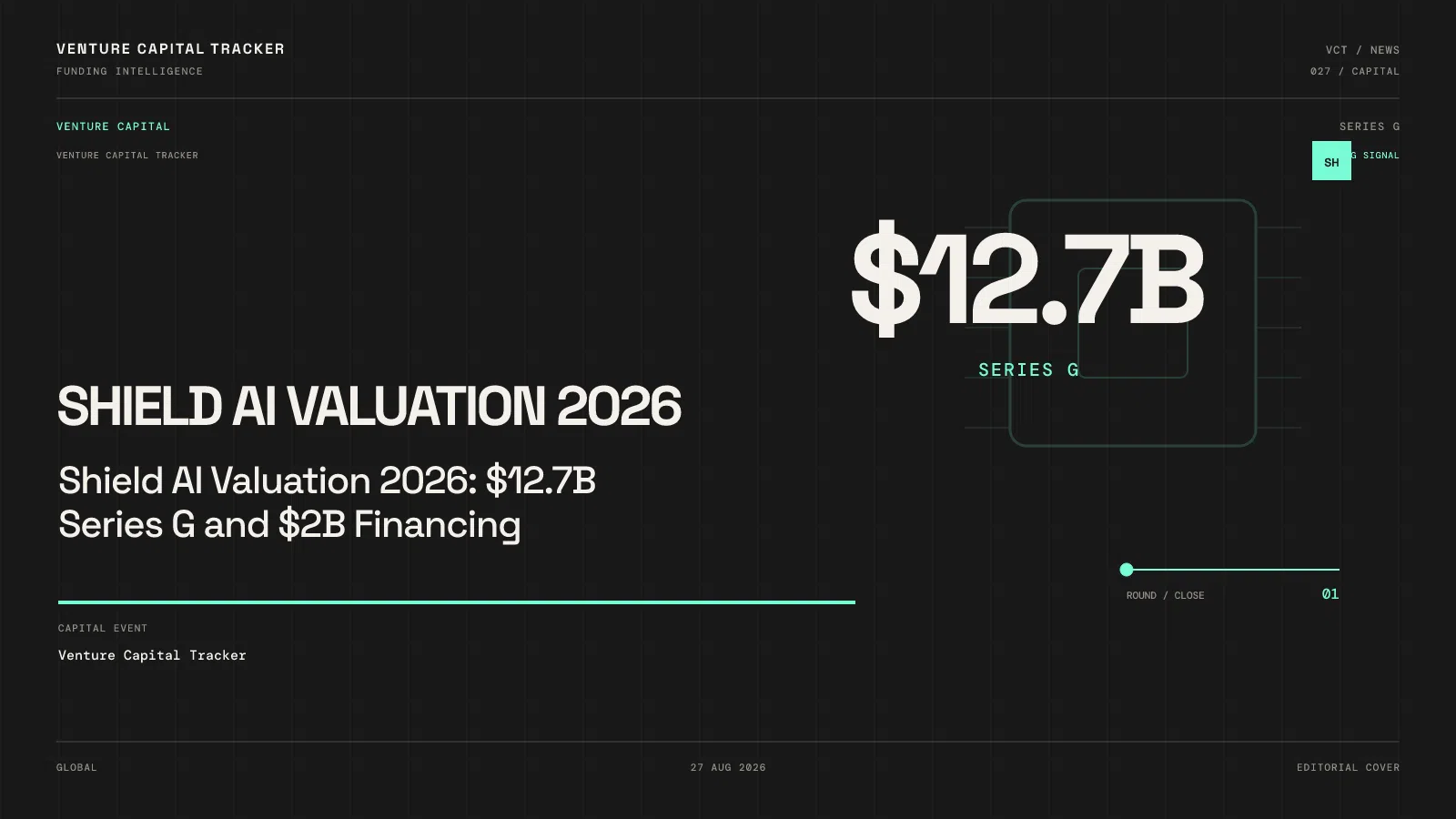
Shield AI's latest disclosed valuation is $12.7 billion post-money, announced on March 26, 2026 with a $1.5 billion Series G. The company also announced $500 million of fixed-return preferred equity, so the headline financing package is $2 billion but the priced equity round is $1.5 billion. That distinction matters when someone searches for Shield AI's “stock price” or market cap.
The company is still private. There is no public-exchange ticker in the sources reviewed, and a secondary-market estimate—if one is available through an intermediary—is not the same thing as a public quote.
Shield AI valuation and funding history
| Date | Financing | Amount | Valuation / status | Lead or named investors |
|---|---|---|---|---|
| Mar. 26, 2026 | Series G equity | $1.5B | $12.7B post-money | Advent International; JPMorganChase Strategic Investment Group |
| Mar. 26, 2026 | Fixed-return preferred equity | $500M | Separate from Series G | Blackstone-managed funds |
| Mar. 6, 2025 | F-1 strategic funding | $240M | $5.3B | L3Harris, Hanwha Asset Management, Andreessen Horowitz, U.S. Innovative Technology, Washington Harbour |
| Jun. 2022 | Series E | $165M | Earlier private mark | Snowpoint Ventures |
The March 2026 announcement is the number to use for the latest official valuation. The $5.3B figure is a prior 2025 mark, not a competing current valuation.
What the 2026 financing funds
Shield AI said part of the proceeds would support its planned acquisition of Aechelon Technology, a company focused on high-fidelity simulation and synthetic-reality systems used in military training. The rest of the financing supports Hivemind Enterprise, defense-aircraft development, and the company's broader autonomy platform.
That use of capital is more revealing than the round size alone. Shield AI is combining software, aircraft, simulation, and government-facing deployment. It is no longer a single-product drone story; the financing is aimed at a defense autonomy stack.
Why the valuation moved so quickly
Shield AI's mark rose from $5.3B in March 2025 to $12.7B in March 2026. TechCrunch tied the financing to the company's Hivemind software being selected for the U.S. Air Force's Collaborative Combat Aircraft prototype program and to work alongside Anduril's Fury aircraft.
For investors, that is a classic defense-tech re-rating signal: a government program can validate a platform's relevance, but it does not remove execution risk. Production throughput, procurement timing, program concentration, and integration with prime contractors still matter.
Who invested and why the mix matters
- Advent International brings large-scale growth and defense-investment capacity.
- JPMorganChase's Strategic Investment Group adds a financial institution and security/resiliency lens.
- Snowpoint Ventures, InnovationX, Riot Ventures, Disruptive, and Apandion provide continuity across defense, autonomy, and technology investing.
- Blackstone-managed funds supplied preferred equity rather than the Series G common-equity round.
The capital stack shows how defense companies can finance growth: venture and strategic investors support the operating platform, growth capital scales it, and preferred or credit-like instruments can fund acquisitions without being mislabeled as ordinary venture equity.
Does Shield AI have stock?
No public stock ticker is identified for Shield AI in the sources reviewed. The company is private, so search results that use “stock,” “share price,” or “market cap” may refer to one of three different things:
- the latest priced funding valuation;
- a private secondary-market estimate or transaction; or
- a hypothetical future IPO.
Only the first is directly established here by the company's financing announcement. Do not treat a private estimate as a live public-market price, and do not treat the $12.7B post-money mark as a promise that an IPO is imminent.
What founders and investors should take from the round
Founders: Defense customers can create unusually strong validation, but the financing bar includes compliance, manufacturing, deployment, and program execution—not only a working autonomy demo.
Investors: Separate the $1.5B Series G from the $500M preferred financing. The structure tells you about dilution, seniority, and the uses of capital; those are different underwriting questions.
Researchers: The most useful comparison set is not “AI stocks.” It is defense-autonomy companies such as Anduril, Saronic, and the other companies in the venture capital directory, compared by contracts, production, and software-platform reach.
Bottom line
Use $12.7B as Shield AI's latest disclosed private valuation, $1.5B as the Series G equity amount, and $500M as separate preferred equity. The round is evidence of growing institutional demand for defense autonomy; it is not a public stock listing or an IPO date.
Read the Shield AI company profile, compare the Anduril financing, or browse the investment feed for newer defense and AI rounds.
Last updated:
Editorial note: AI tools assisted with research, structure, or drafting. Venture Capital Tracker retains human editorial responsibility for factual accuracy, relevance, and source quality before publication.