Astribot Discloses RMB1B Financing at RMB15B Valuation
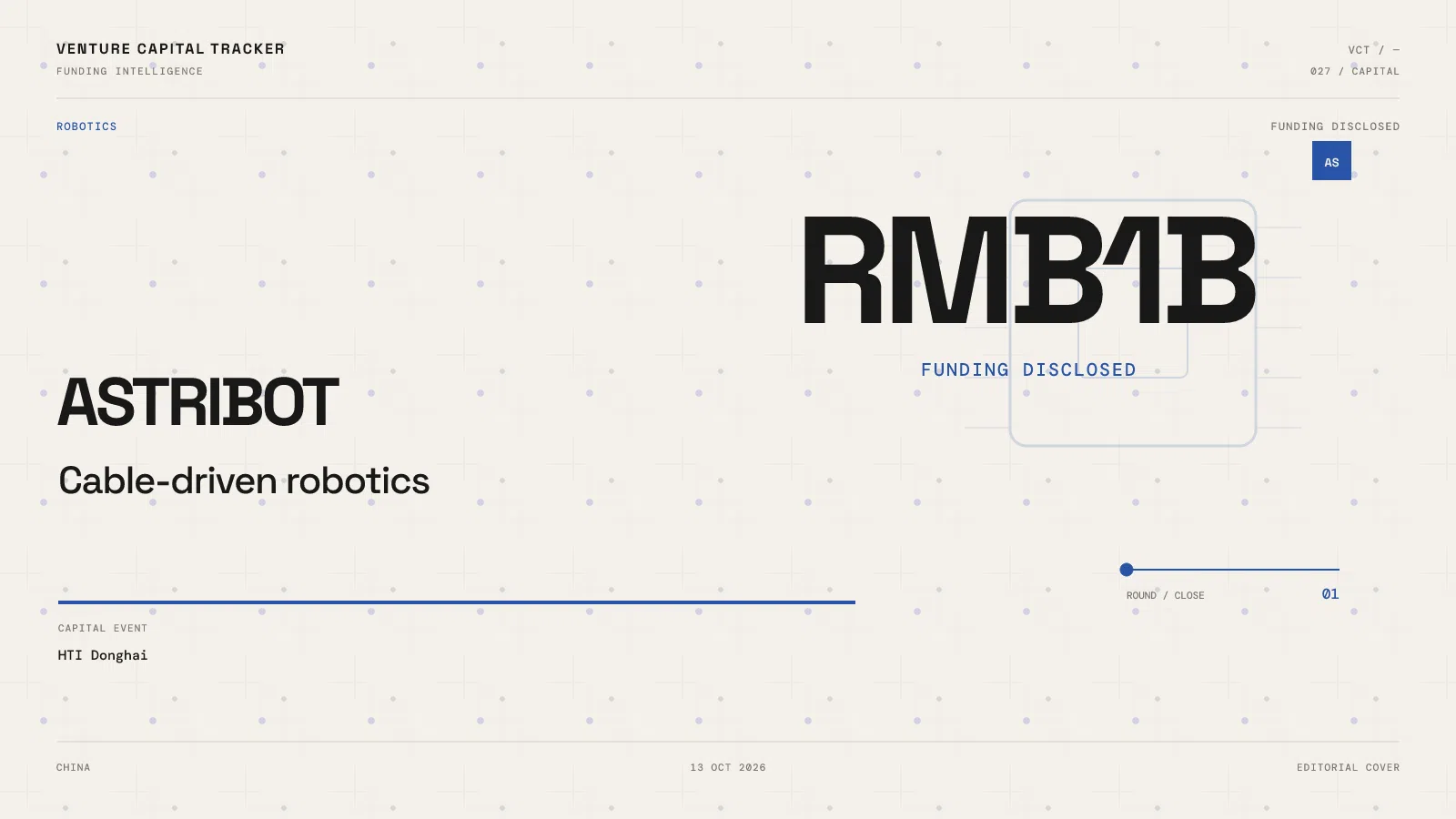
Astribot disclosed RMB1B of financing led by HTI Donghai at a reported RMB15B valuation. Announced October 13, the round reportedly closed in September.
Astribot Discloses RMB1B Financing at RMB15B Valuation
Astribot announced a completed RMB1 billion financing on October 13, 2026, at a reported RMB15 billion valuation. The round was led by HTI Donghai (投控东海), with Hongtai Fund, the Ninghai Xingtaihe Fund managed by Guanghua Sunshine, Shanheng Capital and returning investor Xianmu participating.
There is an important timing qualification. Economic Observer's October 14 interview reporting, syndicated by Phoenix Finance, says the financing had already completed in September. This is newly disclosed financing news, not evidence that RMB1 billion closed during the October 9–15 week.
The terms that are public
| Field | Disclosed position |
|---|---|
| Amount | RMB1B |
| Formal financing stage | Undisclosed |
| Reported valuation | RMB15B; pre/post-money basis unspecified |
| Lead | HTI Donghai |
| Public announcement | October 13, 2026 |
| Closing timing | September 2026, according to Economic Observer |
The latest amount is separate from earlier B-series financing discussed in June. VCT does not add the two headlines together and label the result one new round.
Beijing Business Daily's announcement coverage corroborates the amount, valuation and investor names.
A hardware architecture with an economic hypothesis
Astribot's official description presents a tightly integrated robot-hardware and AI-software approach. Its funding coverage highlights cable-driven actuation alongside proprietary models and an embodied operating system.
The attraction is not simply that the mechanism differs from competing designs. A different transmission architecture matters commercially if it improves useful task performance, component cost, serviceability or safe operation.
Those outcomes require evidence in deployed systems. A convincing demonstration does not establish lifetime maintenance costs, uptime or performance after months of repeated work.
For investors, the hardware question is inseparable from operations: how often does a unit require intervention, who performs the repair and how much revenue is lost while it is unavailable?
Capacity and orders are not the same as realized sales
Astribot has described substantial production capacity and commercial partnerships. Such statements indicate ambition and potential demand; they do not establish the number of units delivered, accepted and paid for.
A large framework order can be fulfilled in stages and remain subject to deployment conditions. Manufacturing capacity can also be underutilized if customer qualification or site integration takes longer than expected.
VCT's view is that the most informative metrics would be paid deployments, repeat customer purchases, field-support cost per unit and the percentage of operating time spent performing economically useful tasks.
These measures would help separate a robot manufacturer with scalable demand from a company financing inventory and demonstrations ahead of an uncertain market.
The software upside also needs proof
A proprietary model and operating system could create opportunities beyond hardware sales. Better task adaptation might improve utilization, while a developer ecosystem could expand the number of useful applications.
But those benefits do not arrive automatically with an installed base. Software revenue requires customers willing to pay repeatedly, and an ecosystem requires third parties to build applications that remain dependable outside controlled settings.
The company will need to show whether its software creates durable recurring economics or mainly supports the sale and maintenance of hardware.
What the valuation asks investors to believe
The reported RMB15 billion valuation places a substantial expectation on future commercialization. It does not demonstrate that revenue, gross profit or deployed productivity increased in proportion to the private-market mark.
This disclosure strengthens the case for watching Astribot's execution rather than only its fundraising cadence. The next valuable update will be evidence that differentiated hardware and software produce repeat, supportable deployments—not another financing label.
Editorial note: AI tools assisted with research, structure, or drafting. Venture Capital Tracker retains human editorial responsibility for factual accuracy, relevance, and source quality before publication.