Labelbox Raises $100M-Plus in Series E Equity and Credit
Infinitum led Labelbox’s $100M-plus equity-and-credit package at $1.25B pre-money. The split is undisclosed as it scales Horizon and enterprise agents.
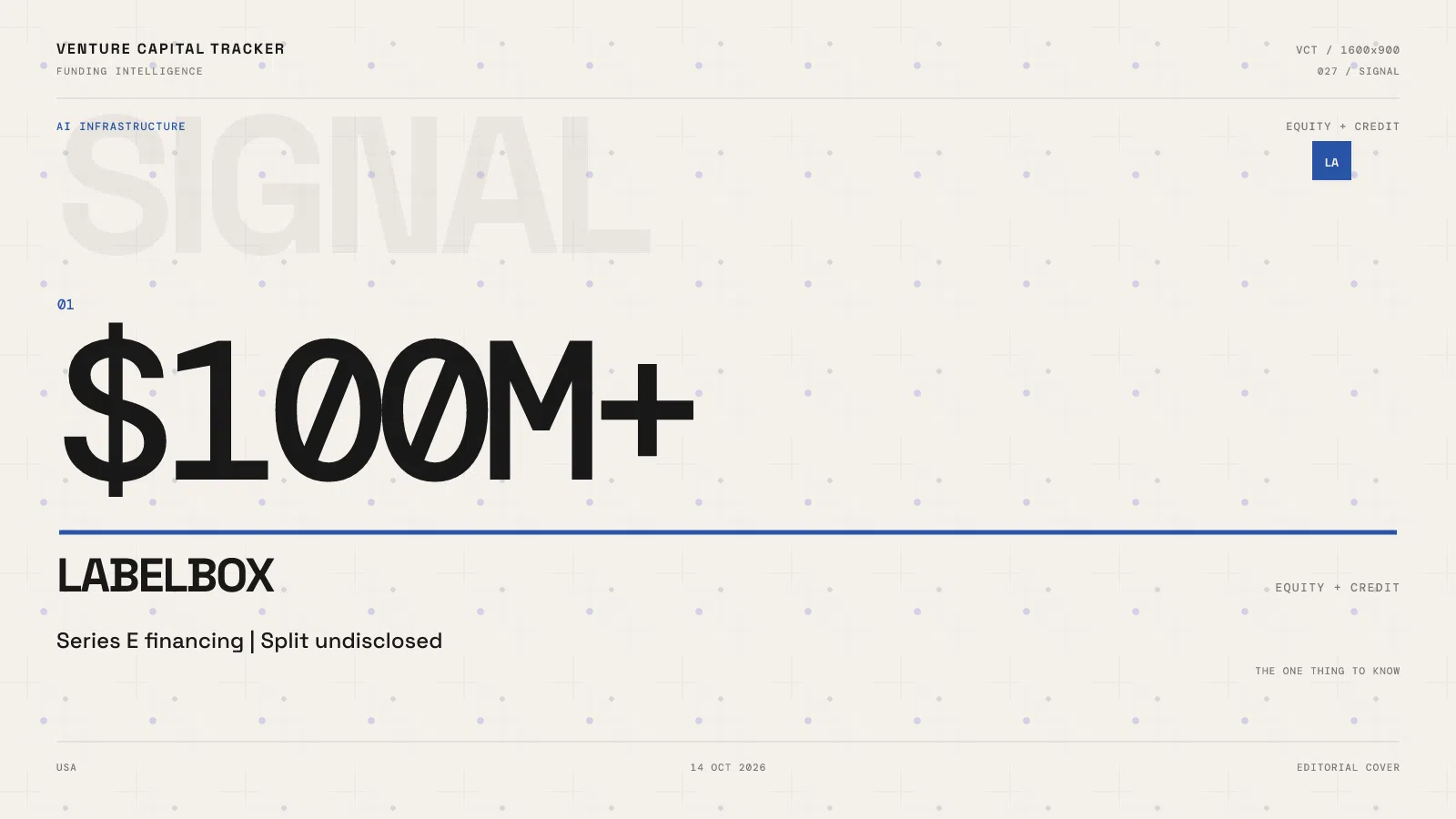
Labelbox announced more than $100 million in Series E financing on October 14, 2026, at a $1.25 billion pre-money valuation. The package combines equity with a credit facility. The company did not disclose the split.
That qualification is essential: this is not a confirmed $100M-plus equity round, and a facility commitment is not proof that all of its capacity has been drawn.
Who invested in Labelbox?
Infinitum Partners led, with Wipro Ventures, Andreessen Horowitz, B Capital, Tau Ventures, Snowpoint Ventures and other investors participating, according to Labelbox’s announcement.
The announcement does not itemize individual checks or identify the credit terms. It is therefore not possible to calculate the new ownership dilution or a reliable post-money valuation by adding the entire financing package to $1.25B.
Debt increases financing capacity without being equivalent to newly issued equity. Understanding its cost requires information on pricing, covenants, maturity and security—none of which was published in the materials reviewed.
What is Labelbox building with the money?
The company describes two connected businesses. Horizon provides work environments and evaluations for frontier-model training. Recursion Managed Agents brings agents into enterprise workflows and grades their output.
The company press release says Labelbox serves more than 400 customers, reached profitability in 2026 and grew more than fivefold year over year. Those are company claims. The release does not supply audited accounts or define the profitability measure and growth baseline.
The strategic shift is more important than rebranding data annotation. Training an agent to complete multi-step work requires a way to distinguish genuine success from shortcuts. Deploying it inside a business adds a second challenge: proving that measured success corresponds to useful, safe outcomes.
Why the two-product strategy could matter
Our analysis is that Horizon and Recursion share an underlying problem: specifying what good work looks like and evaluating whether a system has delivered it. A reusable evaluation capability could support both model development and production workflows.
But the buyers are different. AI laboratories purchase training infrastructure; enterprises buy operational results and manageable risk. Selling to both can broaden demand, while also creating competing product priorities and support requirements.
The investment case should therefore be tested at the product level. Strong demand from frontier labs does not automatically establish demand for managed enterprise agents. Likewise, an agent that performs well in a controlled environment has not necessarily demonstrated reliability across a customer’s changing applications.
The diligence questions behind the headline
For Horizon, watch repeat programs, customer concentration and the cost of maintaining realistic environments. For Recursion, watch paid deployments, error recovery, permission controls and human-review requirements.
A learning loop is only valuable if its evaluations remain trustworthy. Graders can reward the wrong behavior; memory can retain stale assumptions; workflows can change after deployment. Investors should look for evidence that improvement persists outside the original test conditions.
Compute and expert input also have costs. Reported growth should be examined alongside gross margin, delivery effort and cash generation. “Profitable” is useful information only when the accounting basis and durability are understood.
The existing Labelbox profile now records this mixed financing separately from earlier equity rounds. That preserves the distinction between a new funding package and a cumulative venture-equity total.
Bottom line
Labelbox’s Series E is a meaningful financing and product-transition story. The company is connecting the infrastructure that trains agents with the software that operates them. The next test is whether that connection produces repeatable customer outcomes and attractive economics. The undisclosed equity/credit split remains a material limitation, not a detail to hide behind a rounded funding headline.
Editorial note: AI tools assisted with research, structure, or drafting. Venture Capital Tracker retains human editorial responsibility for factual accuracy, relevance, and source quality before publication.