Siemens Backs Skeleton Technologies at $1B-Plus Valuation
Skeleton confirmed a Siemens-led strategic investment for AI power systems. Its exact amount is undisclosed; the $200M expansion plan is separate.
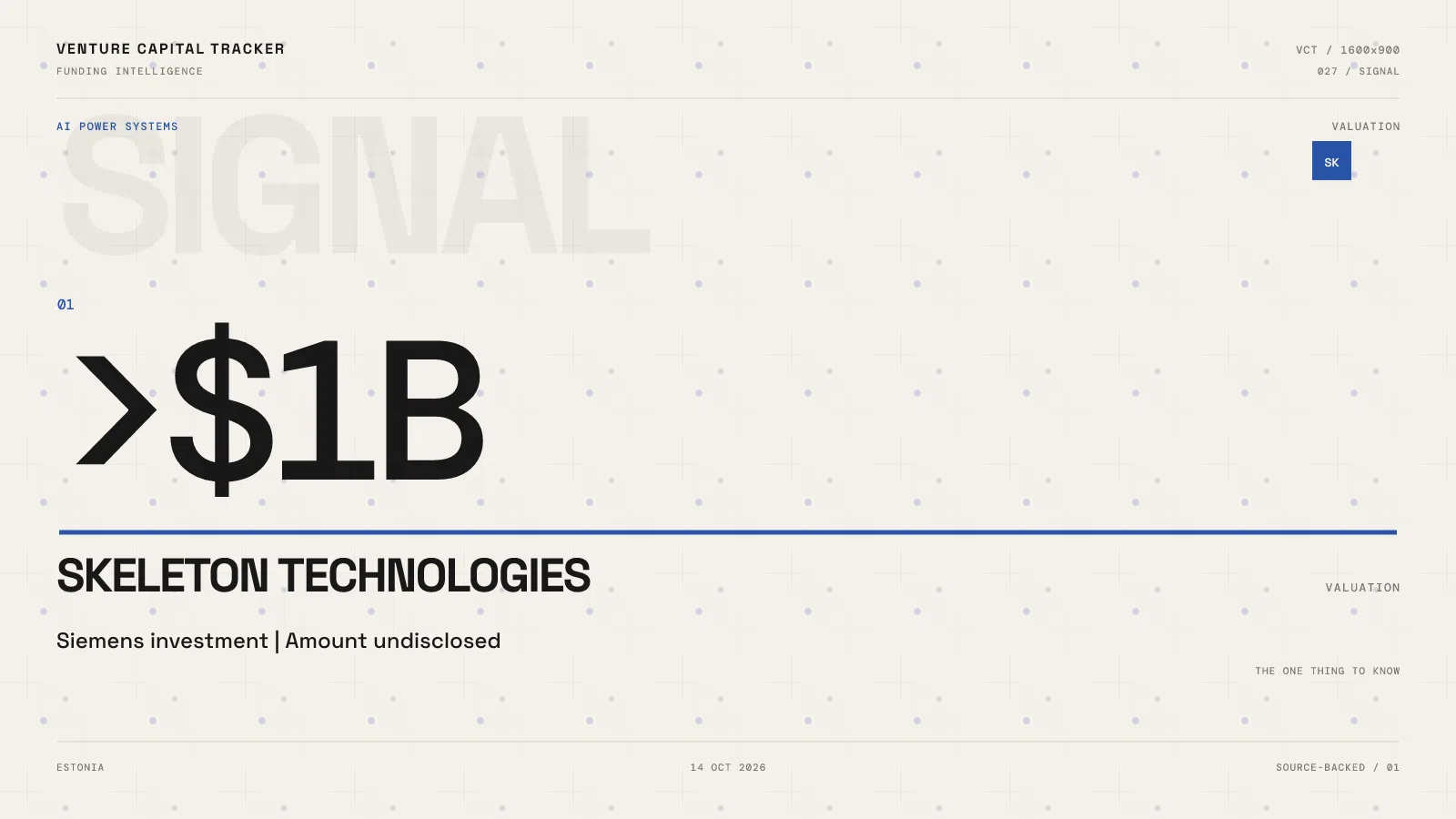
Skeleton Technologies announced a Siemens-led strategic investment on October 14, 2026, saying the transaction values the company at more than $1 billion. The exact investment amount, formal financing stage and full investor syndicate were not disclosed.
The company’s CEO described a nine-digit round. That is not the same as an itemized funding amount. Skeleton’s separate plan to spend more than $200 million on operational expansion and R&D must not be reported as the size of this investment.
What has been confirmed?
The company announcement confirms Siemens’ investment and a deeper commercial relationship focused on AI data-centre infrastructure. It does not specify whether the valuation is pre- or post-money.
This is a confirmed strategic investment with an undisclosed exact amount—not a fundraising rumor, grant or acquisition. Siemens is the named corporate investor; the announcement does not attribute this deal to Siemens Energy Ventures.
ESS News reports a financing above $100 million, citing Bloomberg. VCT retains the company’s more limited disclosure rather than inventing an exact figure or series label.
Why power quality is different from power supply
Skeleton sells high-power systems built around its cells, power electronics and controls. The company positions them as a way to manage rapid changes in electrical demand near AI workloads.
The investment thesis is distinct from financing a power plant or securing a utility connection. More annual energy does not by itself solve every short-duration load-management problem. Conversely, equipment that smooths load cannot create an unlimited supply of electricity.
Our analysis is that this distinction makes the financing relevant to AI infrastructure investors beyond the battery sector. The potential customer value lies in the performance and utilization of a complete installation, not simply in how much energy a storage device can hold.
What Siemens adds beyond capital
An industrial partner can help turn component technology into a product that large customers can specify, install and service. That is potentially valuable where procurement, integration and reliability matter as much as laboratory performance.
Data Center Dynamics emphasizes the investment alongside an exclusive partnership. The commercial scope and economics of that arrangement deserve attention: distribution access can accelerate adoption, but the announcement does not establish a guaranteed revenue stream.
A strategic shareholder is not automatically a customer order. Investors should distinguish investment proceeds, contracted sales and management’s addressable-market expectations.
The manufacturing execution test
Skeleton plans to expand its US footprint, including domestic cell production and Silicon Valley R&D. A more integrated local supply chain could bring manufacturing closer to customers, but it also introduces commissioning, staffing and capital-allocation demands.
The important milestones are operational ones: qualified production, reliable yields, deployment schedules and service performance. A factory announcement does not show that capacity is installed, accepted by customers or operating economically.
The company’s claimed energy savings and GPU-performance benefits should also be evaluated against test conditions and independent customer evidence. This article does not treat marketing percentages as universal results for every data centre.
VCT’s recent Switched Source coverage examines a different part of the electrical constraint: distribution-grid capacity. The two stories should be read as separate investment approaches, not competing estimates of one market.
Bottom line
The strongest angle is Siemens’ route to industrializing and commercializing fast-response power systems for AI infrastructure. The $1B-plus valuation gives the deal scale; the still-undisclosed financing amount limits what can be concluded about capital available for expansion. Customer deployments and manufacturing execution will be more informative than the unicorn label.
Editorial note: AI tools assisted with research, structure, or drafting. Venture Capital Tracker retains human editorial responsibility for factual accuracy, relevance, and source quality before publication.