· Venture Capital Tracker · venture-capital
Scanntech Reportedly Secures $180M, With About Half Secondary
Scanntech reportedly secured a $180 million growth transaction led by L Catterton, but only about half is estimated to be primary capital entering the company.
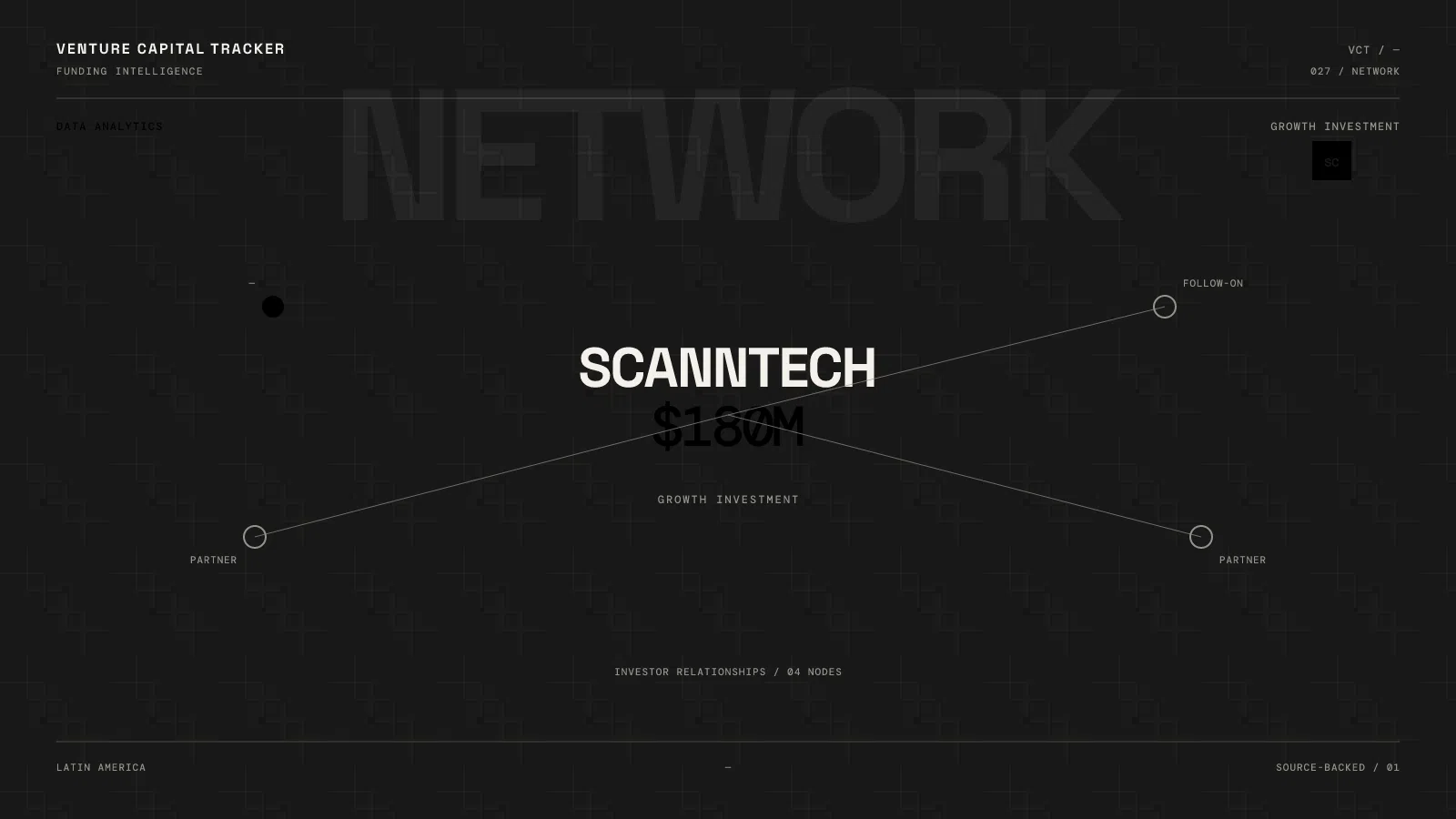
Scanntech has reportedly secured an approximately $180 million growth-equity transaction led by L Catterton, with Partners Group and Bradesco participating.
The headline amount does not all go to the company. Brazil Journal reported that roughly half of the transaction is newly issued equity and the other half is secondary purchases from existing shareholders. On that estimate, Scanntech would receive about $90 million of primary capital, while a similar amount would provide liquidity to shareholders.
Warburg Pincus, which invested in Scanntech in 2022, is reportedly selling part of its position but retaining a stake. The company and investors had not published detailed transaction terms when this article was verified.
The reported transaction at a glance
| Item | Detail |
|---|---|
| Total transaction | Approximately $180 million |
| Primary capital | Roughly $90 million, estimated from reporting |
| Secondary component | Roughly $90 million, estimated from reporting |
| Lead investor | L Catterton |
| Other investors | Partners Group and Bradesco |
| Seller | Warburg Pincus is reportedly making a partial exit |
| Stage | Growth equity / private investment |
| Valuation | Not disclosed |
| Status | Reported by Brazil Journal; detailed official close not yet published |
This is not a conventional $180 million venture round. The split between primary and secondary capital is the central fact: transaction value measures all shares changing hands, while only newly issued equity adds cash to Scanntech's balance sheet.
What Scanntech sells
Scanntech provides retail intelligence to consumer-goods manufacturers, distributors and grocery retailers across Latin America. Its systems connect to supermarket point-of-sale data and turn checkout activity into information about prices, promotions, demand, category performance and sales volumes.
The company says it works with more than 300 manufacturers and distributors and 450 of the 500 largest retail networks in its markets. Those figures are company-provided and should be treated as operating claims rather than audited disclosures.
Scanntech's value proposition is not simply analytics software. The harder-to-reproduce asset is the underlying data network: permissioned access to granular transactions across many retailers, categories and markets.
A competitor can build dashboards or add a language-model interface relatively quickly. Recreating years of retailer integrations, historical checkout data and commercial relationships is much harder.
Why L Catterton, Partners Group and Bradesco may be interested
The reported investor group combines consumer-sector specialization, global private-equity capital and a major Brazilian financial institution.
- L Catterton brings experience investing in consumer brands and retail ecosystems.
- Partners Group adds global growth and private-markets expertise.
- Bradesco contributes local-market reach and relationships across Brazilian commerce.
- Warburg Pincus retains exposure while realizing partial liquidity.
That structure can serve several objectives at once. Scanntech gets expansion capital, new investors gain a meaningful ownership position, and an existing shareholder receives liquidity without requiring an IPO or full sale.
Brazil Journal reported that the new investors would own close to 30% of the company after the deal. It also reported annual growth of about 30%, profitability and pricing near 5.5 times revenue. Those metrics have not been independently verified by Venture Capital Tracker, and the company's absolute valuation was not disclosed.
The primary-secondary distinction
If the reported 50/50 split is broadly accurate, calling this a “$180 million raise” would overstate the cash available for hiring, product development or expansion.
The more precise framing is:
- approximately $180 million of total transaction value;
- roughly $90 million of estimated new corporate capital; and
- roughly $90 million of estimated shareholder liquidity.
The exact amounts may differ because the parties have not published a formal allocation. Any final article or database entry should preserve “approximately,” “reported” and “estimated.”
This distinction is increasingly important in later-stage private markets. Secondary components allow founders, employees and early investors to sell part of their holdings while a company remains private. They can support cap-table transitions, but they do not finance operations in the same way as primary equity.
What the capital could support
Scanntech has not published a detailed use-of-proceeds plan for the reported transaction. Its logical growth priorities include expanding the retailer network, deepening coverage in Brazil, Mexico and Colombia, adding analytics products and entering new Latin American markets.
The company's data position could also support more AI-driven tools, but the investment case does not depend on attaching AI to every product. Reliable, timely transaction data already solves a valuable problem for brands and retailers trying to set prices, plan promotions and measure shifts in demand.
For investors, the relevant operating metrics are likely to include:
- the number and quality of connected points of sale;
- customer retention among manufacturers and retailers;
- revenue growth from new analytics products;
- coverage across countries and retail formats; and
- the cost of onboarding and maintaining data integrations.
Competitive position and risks
Scanntech competes with global retail-measurement groups such as NielsenIQ and Circana, newer retail-data platforms, and internal analytics teams at large retailers and consumer brands.
Its regional specialization can be an advantage. Latin American grocery markets vary by country, retailer size, data infrastructure and distribution model. Local coverage and commercial relationships can matter as much as the software itself.
The risks are equally concrete:
- retailers control access to the underlying transaction data;
- large customers may negotiate aggressively on price;
- data-privacy and cross-border governance requirements can tighten;
- global competitors can invest in local coverage; and
- the value of analytics depends on data quality, freshness and representative market coverage.
What competitor coverage missed
Most early summaries repeated the $180 million headline. The stronger investment analysis separates new money from secondary liquidity and treats the reported 5.5-times-revenue multiple as an unconfirmed pricing indicator, not a disclosed valuation.
SEO data for “Scanntech funding” shows little established U.S. search demand and a sparse English-language results page. That makes precision more important than keyword volume: the article should own the exact transaction explanation rather than compete on a broad startup-funding term.
The bottom line
Scanntech's reported transaction is a meaningful Latin American growth investment, but it should not be described as a confirmed $180 million primary financing.
The best current characterization is a reported $180 million primary-and-secondary transaction, led by L Catterton, with approximately half of the value expected to reach Scanntech and the balance providing shareholder liquidity. Official confirmation of the final allocation, closing status and valuation remains the next key disclosure.
Editorial note: AI tools assisted with research, structure, or drafting. Venture Capital Tracker retains human editorial responsibility for factual accuracy, relevance, and source quality before publication.