· Venture Capital Tracker · venture-capital
Catalyst Raises $30M Seed for AI Trading Agents
Catalyst raised a $30 million seed led by Sequoia to turn plain-language investment intent into monitored and executable trading strategies.
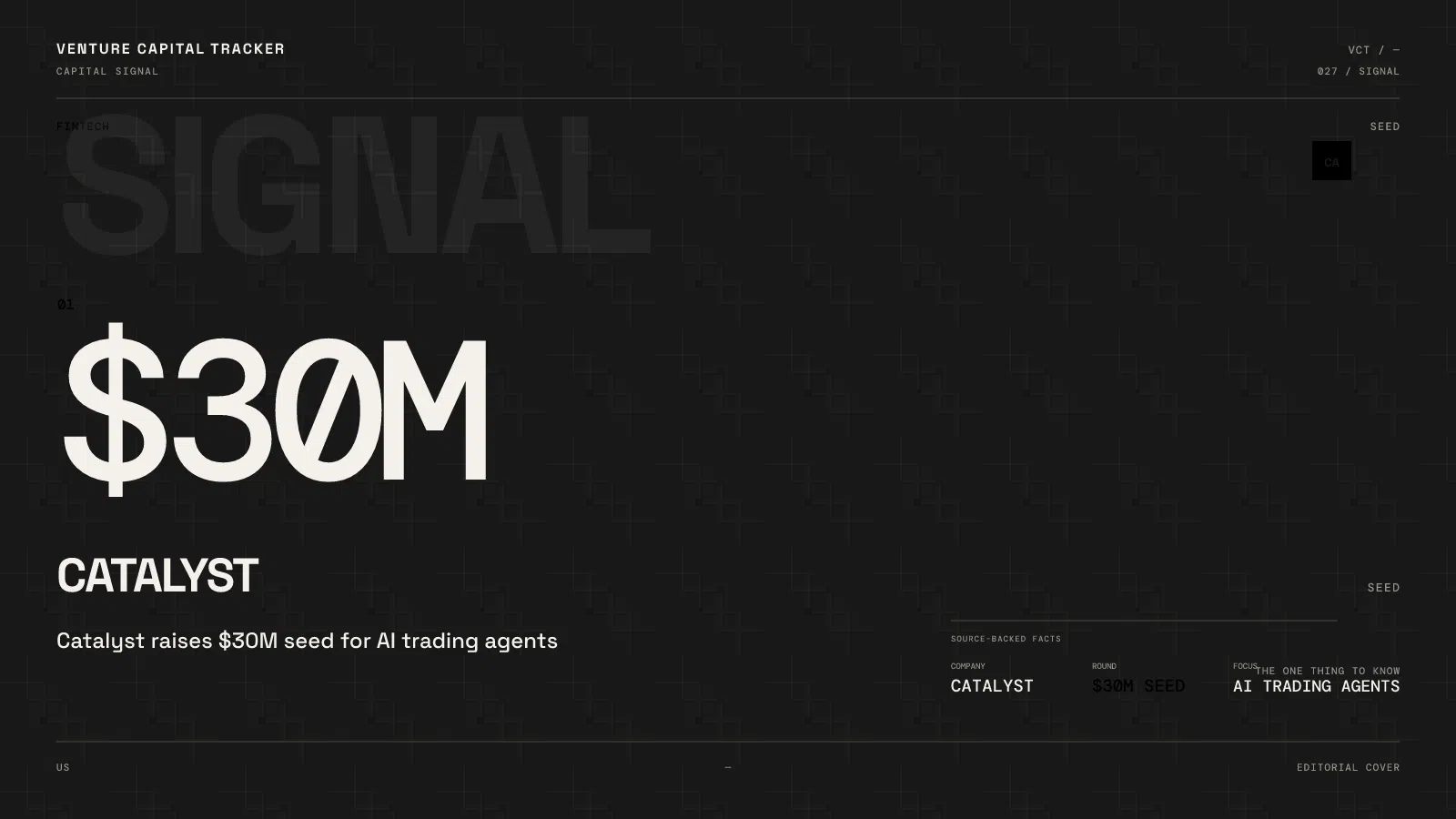
Catalyst has raised a $30 million seed round led by Sequoia Capital to build AI agents that turn a retail investor’s plain-language intent into a trading workflow.
Jump Trading, Peak XV Partners, Lux Capital, AntiFund, Coinbase and Premji Invest also participated, according to Fortune and the company’s announcement. Catalyst did not disclose a valuation.
The round is unusually large for a seed-stage consumer-finance company. It also brings together venture investors, a market maker and a crypto exchange—backers that can provide both capital and connections to the execution infrastructure Catalyst needs.
The central question is whether an AI agent can make sophisticated market tools more usable without encouraging users to trade more often, take risks they do not understand or surrender control to opaque automation.
What Catalyst is building
Catalyst describes itself as an “intent layer” for finance. A user states a thesis, monitoring request or trade in ordinary language. The platform can then research the idea, assemble a visual workflow, monitor signals and prepare an action.
During its research preview, Catalyst says it supports spot tokens, perpetual contracts, tokenized stocks and prediction markets. Strategies can combine market data, news, social activity and sentiment across different venues.
The current product retains a human checkpoint before execution. Fortune reported that users must confirm trades, even as the company’s longer-term vision extends toward more autonomous, end-to-end financial agents.
That distinction matters. Research assistance and alerting carry different risks from an agent with authority to route orders, choose instruments or optimize transaction costs.
Why investors are interested
Retail brokers made market access easier, but building and monitoring a multi-step strategy still requires data, coding or repeated manual decisions. Catalyst is betting that natural-language agents can compress that work into a consumer interface.
Fortune reported that a pilot aimed at power users generated hundreds of millions of dollars in trading volume over several weeks. Catalyst has not publicly disclosed the number of pilot users, their returns, how that volume was measured or whether the activity was profitable after fees and slippage.
Trading volume is evidence of engagement, not investment performance. That is the most important analytical caveat in the round.
Sequoia’s lead investment signals conviction that the interface to financial markets may shift from search screens and order tickets to agents that maintain persistent goals. Participation from Jump Trading and Coinbase adds market-structure experience, while Lux and Peak XV broaden the institutional syndicate.
The business-model tension
Catalyst has not disclosed its long-term pricing or revenue model. Its site says the research preview is free.
Future economics will shape product incentives. A subscription model can align revenue with software value, although retention may still reward activity. Payment for order flow, spreads, routing rebates or transaction fees would create a more direct link between revenue and trading volume.
That does not make an execution-based model inherently harmful, but it raises questions the company will need to answer:
- Which broker, exchange or venue executes each trade?
- How does Catalyst select among venues and disclose conflicts?
- What protections apply to leveraged or illiquid instruments?
- Can users inspect the reasoning and data behind an agent’s recommendation?
- How are losses, outages and erroneous orders handled?
- What data is retained from a user’s portfolio and stated financial goals?
For an agentic-finance product, those are core product questions rather than compliance footnotes.
A difficult regulatory boundary
Catalyst sits near several regulated activities. The obligations depend on what the product recommends, how personalized the output is, who executes orders and how the company is compensated.
An agent that merely organizes user instructions is different from one that gives personalized investment advice or exercises discretion. Supporting perpetual contracts, tokenized assets and prediction markets also introduces venue-specific rules and jurisdictional constraints.
The company’s human-confirmation step can preserve user control, but confirmation alone does not resolve suitability, disclosure or best-execution concerns. The user must understand what is being confirmed.
Catalyst says it is building education and safety tools. The quality of those controls—and whether they interrupt harmful behavior rather than simply explain it—will be a critical measure of product maturity.
Competitive landscape
Catalyst overlaps with several categories.
No-code platforms such as Composer let consumers automate investment strategies. Brokerage infrastructure providers such as Alpaca enable developers to embed trading. Retail platforms including Robinhood and Public are adding AI-assisted discovery and research.
Catalyst’s differentiation is orchestration: combining an intent, multiple signals, strategy construction, monitoring and execution in a single agent workflow across several asset classes.
The risk is that incumbents can add similar natural-language interfaces while controlling customer accounts, licenses and order routing. Catalyst therefore needs defensible workflow data, superior integrations or a trusted consumer brand—not only a better chat interface.
What to watch next
The next useful disclosures would be active-user counts, repeat usage, supported jurisdictions, execution partners and risk-adjusted outcomes rather than aggregate trading volume.
Investors should also watch whether Catalyst keeps a mandatory confirmation step as the product expands, how it handles leverage and whether it publishes clear routing and fee policies.
The $30 million seed gives Catalyst significant resources to build integrations, compliance systems and consumer safeguards. It also raises the standard for evidence. If AI agents become a new interface to investing, the winning product will need to prove that it improves decision quality—not just that it makes trading easier.
Follow Venture Capital Tracker in Google
Add VCT as a preferred source to make our venture-capital coverage easier to find in Google Search.
Last updated:
Editorial note: AI tools assisted with research, structure, or drafting. Venture Capital Tracker retains human editorial responsibility for factual accuracy, relevance, and source quality before publication.