· Venture Capital Tracker · venture-capital
TypeSafe AI Raises $870M Series A at $7.5B Weeks After Jev Launch
TypeSafe AI raised an $870 million Series A at a $7.5 billion valuation, led by Andreessen Horowitz, less than a month after launching its Jev decision model.
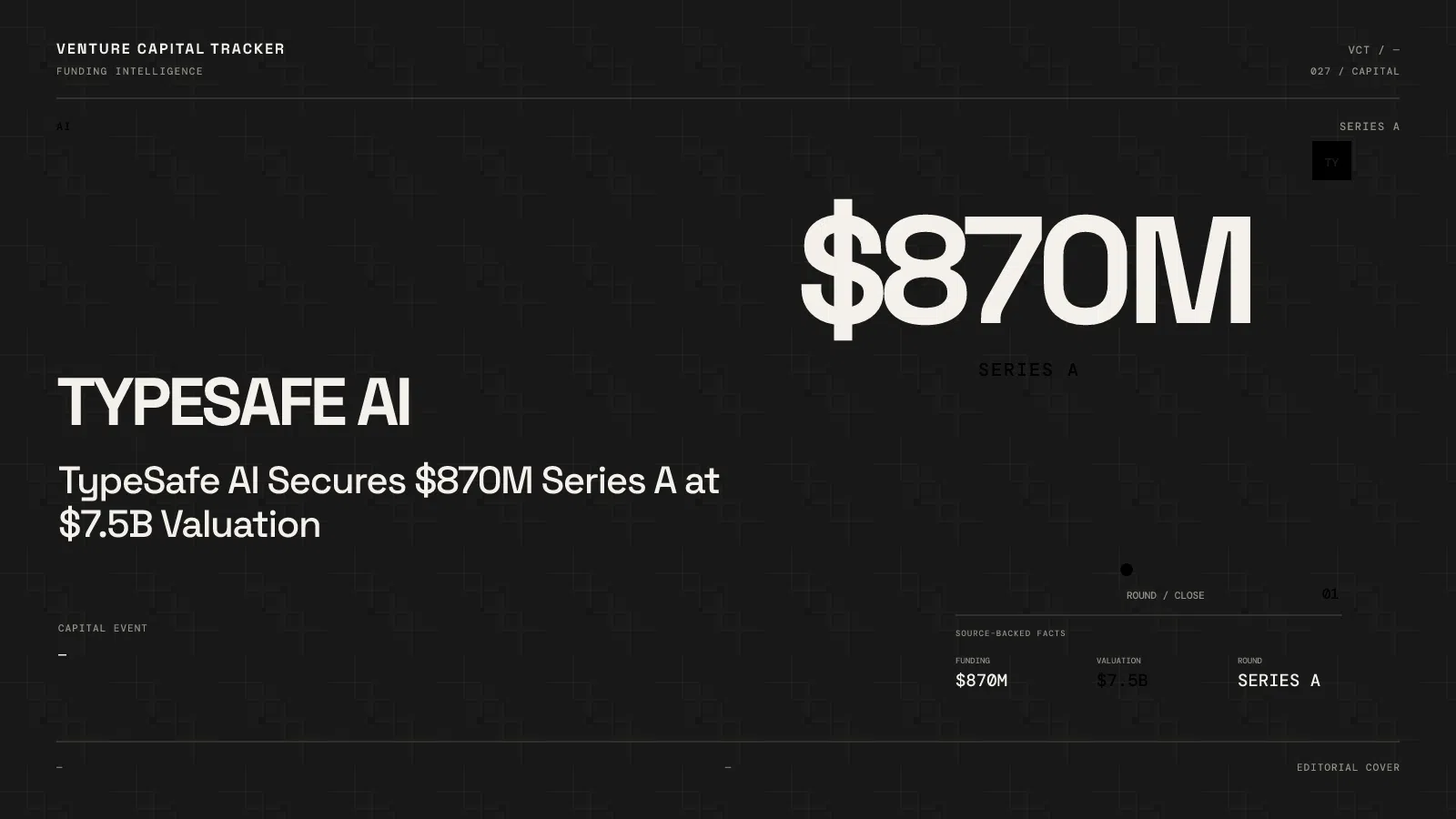
TypeSafe AI has raised an $870 million Series A at a $7.5 billion valuation, less than a month after emerging from stealth with a $40 million seed round and launching its Jev decision model.
Andreessen Horowitz led the round. Sequoia Capital, existing investor DCVC and undisclosed angel investors participated. A16z general partner Martin Casado is joining TypeSafe's board.
The financing was announced on October 9, 2026. TypeSafe did not specify whether the $7.5 billion valuation is pre- or post-money, the ownership sold, or any secondary component.
The round at a glance
| Item | Detail |
|---|---|
| Company | TypeSafe AI |
| Financing | $870 million Series A |
| Valuation | $7.5 billion; basis not specified |
| Lead investor | Andreessen Horowitz |
| Other investors | Sequoia Capital, DCVC and undisclosed angels |
| Board | Martin Casado joins |
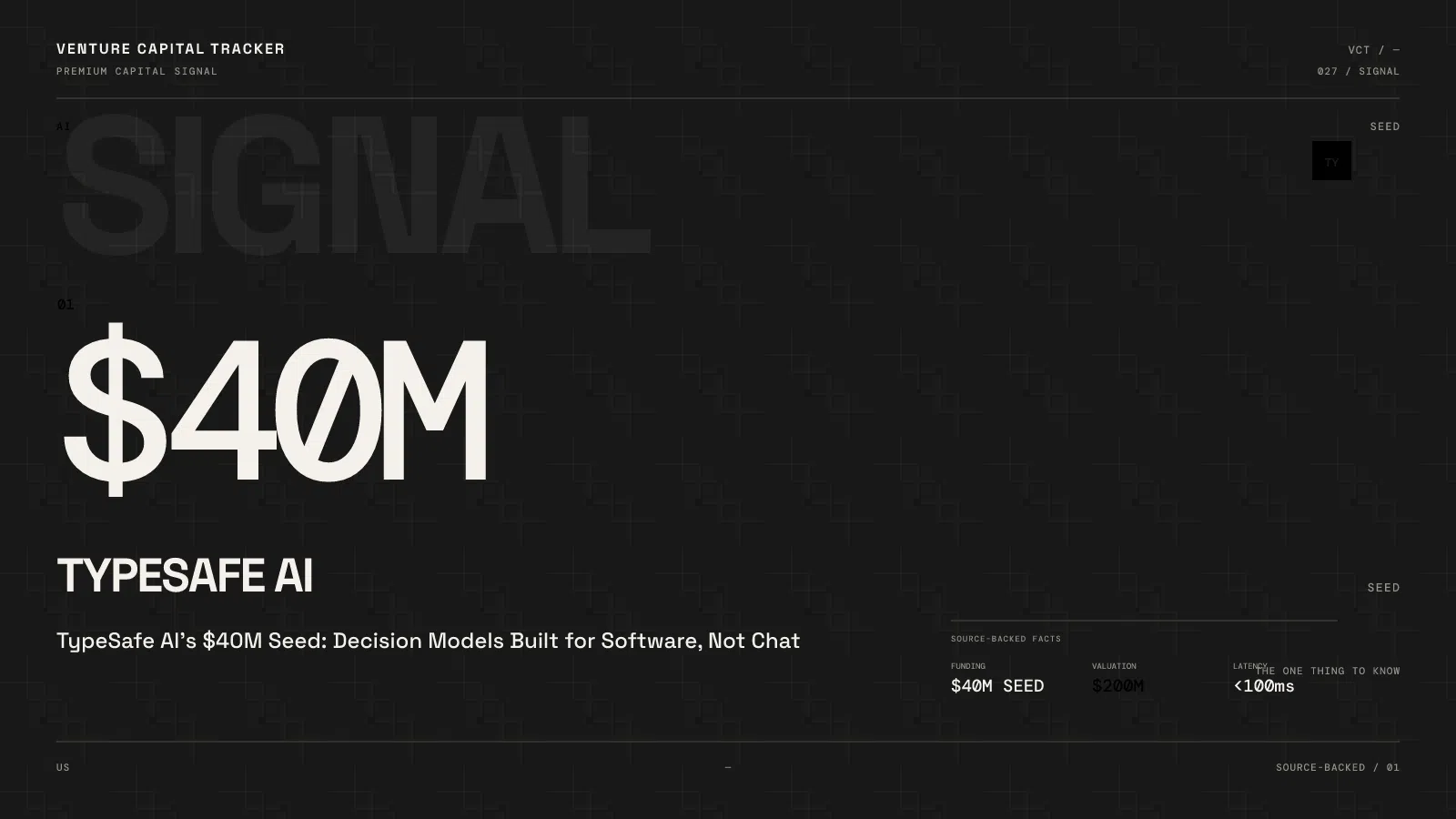
| Prior financing | $40 million seed led by DCVC in September 2026 |
| Product | Jev, a model that returns typed decisions rather than generated text |
Together with its seed round, TypeSafe has disclosed approximately $910 million of funding. The pace and size are exceptional: a company that announced a $40 million seed in September has moved directly into one of the largest Series A financings on record.
What Jev does differently
Most large language models turn an input into generated text. Software then has to parse that text, convert it into structured data and decide what action to take.
Jev is designed for a narrower job. It returns machine-readable choices, scores and probabilities that an application can use directly. TypeSafe calls this category a “System One” model: fast models for repeated decisions inside software rather than conversational systems intended to reason in prose.
Potential use cases include routing requests, prioritizing support tickets, classifying security alerts, moderating content and deciding whether an automated workflow should proceed or escalate.
That positioning gives TypeSafe a clear thesis: many production workloads do not need a general-purpose model to write an answer. They need a cheaper, faster component that chooses among predefined actions with a confidence score.
The adoption claims behind a $7.5 billion valuation
TypeSafe says about one-third of the Fortune 500 are using Jev and that customers have already saved millions of dollars in production. A16z says the model reached one trillion tokens within three days of launch and is roughly 100 to 500 times cheaper than frontier models while being 100 times faster for classification tasks at comparable accuracy.
Those are powerful claims, but they are not equivalent to disclosed revenue, retention or independently audited benchmarks. The company has not published:
- annual recurring revenue or booked contract value;
- the share of users running paid production workloads;
- customer concentration or retention;
- gross margin and inference costs at scale; or
- independently replicated cost and latency comparisons across representative tasks.
The valuation therefore rests on a mix of early usage, developer momentum and the possibility that decision models become a standard software layer.
A rapid valuation reset
Forbes previously reported a $200 million valuation around TypeSafe's seed financing. If that figure and the new $7.5 billion valuation are comparable, the implied step-up is about 37.5 times in less than a month.
That comparison needs caution. The earlier figure was media-reported, not stated in TypeSafe's seed announcement, and the new company disclosure does not say whether $7.5 billion is pre- or post-money. Even so, the change shows how quickly investor expectations moved after Jev's launch.
The round also creates a demanding benchmark. At this valuation, TypeSafe will need to turn viral adoption into repeatable enterprise spending while defending a technical category that major model providers can target.
What the $870 million can buy
TypeSafe said it plans to extend Jev, build additional machine-native models, add enterprise features and expand its infrastructure and team.
That capital gives the company room to pursue several strategies at once:
- Model development: train specialized decision models for more domains and task types.
- Inference capacity: absorb rapid usage without sacrificing the low-cost positioning.
- Enterprise controls: add security, governance, observability and administrative features.
- Distribution: turn developer experimentation into long-term corporate deployments.
- Talent: compete with frontier labs for researchers and systems engineers.
The risk is organizational as much as technical. Deploying nearly $1 billion of capital efficiently is difficult for a company founded in 2024, particularly when product-market fit is still being measured.
Competitive pressure
TypeSafe is not primarily competing with chatbots. Its nearer competitors include classification APIs, embedding and reranking systems, rules engines, small task-specific models and decision features added by frontier-model vendors.
Its advantage is a product designed around typed outputs and calibrated probabilities from the start. Its vulnerability is that classification and structured-output capabilities can be bundled into broader AI platforms with existing enterprise distribution.
The enduring moat will depend on whether TypeSafe can produce meaningfully better economics, reliability and developer experience—not simply whether Jev is faster than a large language model on tasks that never required generative text.
What competitors covered
TechCrunch highlighted the speed of Jev's adoption and the jump to a $7.5 billion valuation only weeks after launch. SiliconANGLE focused on structured outputs, calibrated confidence and the model's claimed speed and cost advantages. A16z framed Jev as a new primitive for making software itself intelligent.
The financing story is bigger than the viral launch. It is a test of whether investors will fund an alternative AI architecture at frontier-lab scale before the company discloses conventional business metrics.
The bottom line
TypeSafe AI's $870 million Series A is a confirmed equity financing, not a rumor or debt package. It gives the company a $7.5 billion headline valuation and brings disclosed funding to roughly $910 million.
The opportunity is substantial: typed, low-cost decisions could become a core layer for agentic and automated software. The unresolved question is whether TypeSafe can translate an explosive launch into durable revenue and a defensible platform before large model providers converge on the same use cases.
Editorial note: AI tools assisted with research, structure, or drafting. Venture Capital Tracker retains human editorial responsibility for factual accuracy, relevance, and source quality before publication.