· Venture Capital Tracker · venture-capital
Fortastra Raises $30M Series A for Maneuverable Orbital Security
Fortastra closed a $30 million Series A led by First In to turn its Watchdog spacecraft demonstration into a production-scale orbital-security platform.
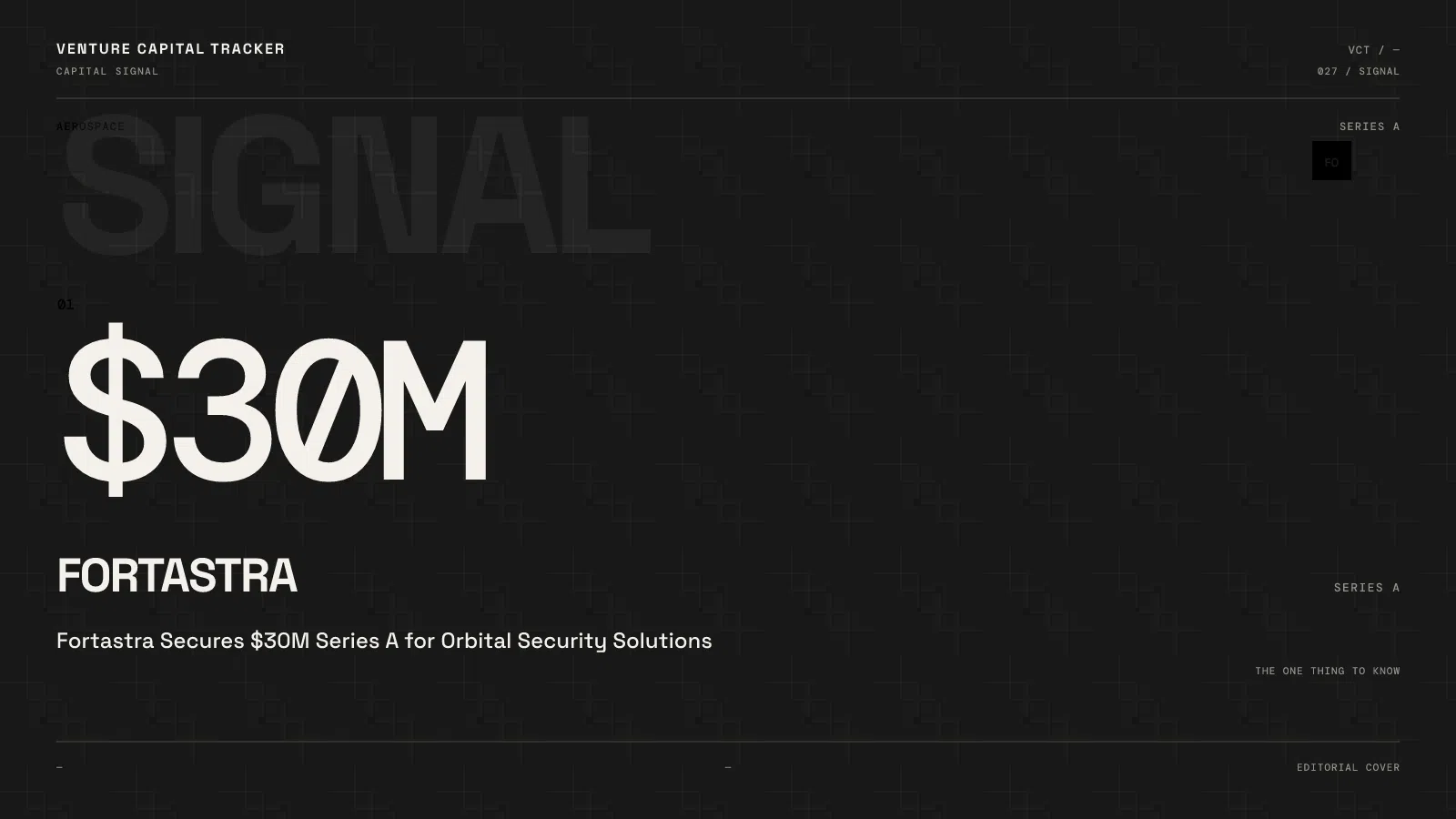
Fortastra has closed a $30 million Series A to move its maneuverable orbital-security spacecraft from an initial in-space demonstration toward an operational fleet.
First In led the round. Upfront Ventures, Space Capital, Rsquared, Side Door Ventures and ATX Ventures participated alongside other new and existing investors. Fortastra did not disclose a valuation.
The financing follows more than $8 million of seed funding and the launch of Watchdog V0, Fortastra’s first spacecraft. The company says the new capital will accelerate development and commissioning, expand engineering and operations, and build out the autonomy and manufacturing capabilities needed for higher-rate production.
Why this round matters
Fortastra is not pitching another observation satellite. It is developing spacecraft intended to stay close to important government or commercial assets, understand activity around them and maneuver when a potential threat appears.
That puts the company at the intersection of three increasingly important markets:
- space-domain awareness, or knowing what objects are doing in orbit;
- rendezvous and proximity operations, which require precise relative navigation;
- orbital protection, where a spacecraft may need to reposition, inspect or shield another asset.
The hard part is not simply reaching orbit. A protective spacecraft must perceive other objects, estimate their motion, plan safe trajectories and act with limited operator input. Those functions also have to work reliably across a fleet.
Fortastra says Watchdog V0 provided an initial operational demonstration. Founder and CEO Mike Smayda said the company progressed from seed funding to orbit in roughly a year. The Series A is meant to convert that first flight experience into a repeatable capability.
From a prototype to production
Fortastra plans to spend the Series A across flight software, guidance, navigation and control, perception, autonomy and manufacturing.
Chief technology officer Josh Jetter described proximity operations as the gate for the company’s wider roadmap. In practice, that means Fortastra must solve relative navigation—determining where another spacecraft is and how it is moving—before higher-level security missions become possible.
At the same time, the company is designing a modular spacecraft bus for production at rate. That parallel approach matters. Defense customers may fund demonstrations, but a persistent orbital-security network would require many vehicles, not a handful of exquisite satellites.
Fortastra’s manufacturing thesis therefore deserves as much scrutiny as its autonomy software. The company has signed a memorandum of understanding with Hadrian to apply precision machining and additive manufacturing to national-security spacecraft programs. It has also hired former Space Systems Command official Scott Klempner as director of product for national security.
The market opening
Satellites now underpin communications, navigation, weather data, financial timing and military operations. As those systems become more strategically valuable, governments are paying greater attention to resilience and defense in orbit.
That demand has created an opening for venture-backed companies such as True Anomaly, Turion Space and Fortastra. Satellite-servicing companies including Starfish Space develop adjacent rendezvous capabilities, although their commercial missions and operating concepts differ.
Fortastra’s differentiator is its combination of flight heritage, an autonomy stack for close operations and a bus designed for mass deployment. First In general partner Arthur Karell framed the strategy as making “mass” an advantage in space defense.
The investor syndicate also offers useful signals. First In focuses on security technologies; returning investor Upfront backed Fortastra at seed; and Space Capital specializes in the space economy. Their participation suggests confidence that orbital protection can become a durable procurement category rather than a one-off experimental program.
What could go wrong
The opportunity comes with substantial execution risk.
First, rendezvous and proximity operations are technically unforgiving. Navigation errors can damage the protected asset or create debris. Fortastra must demonstrate safe autonomous behavior well beyond a single prototype mission.
Second, customer concentration is likely. National-security space programs involve long procurement cycles, classified requirements and shifting budgets. Early government contracts validate demand but do not guarantee fleet-scale orders.
Third, security spacecraft operate in a sensitive regulatory and geopolitical environment. Export controls, licensing and rules governing behavior near another operator’s satellite can affect deployments.
Finally, production economics remain unproven. Building hundreds of reliable spacecraft at lower cost is different from launching one demonstration vehicle.
What to watch next
The most important milestones are not another funding announcement. They are the commissioning results from Watchdog V0, government contract growth, repeatable proximity operations and evidence that Fortastra can shorten the design-build-flight cycle.
A successful transition into full-rate production would make the company a meaningful part of the emerging orbital-security stack. A delay in flight validation or procurement would expose how early that market still is.
For now, the Series A gives Fortastra enough capital to test whether its rapid first launch can become a repeatable operating system for defending infrastructure in orbit.
- startup-funding
- space-tech
- defense-tech
- +2 more
Follow Venture Capital Tracker in Google
Add VCT as a preferred source to make our venture-capital coverage easier to find in Google Search.
Last updated:
Editorial note: AI tools assisted with research, structure, or drafting. Venture Capital Tracker retains human editorial responsibility for factual accuracy, relevance, and source quality before publication.