· 7 sources · Verified
Humble Robotics' $51M Series A: Cabless Truck, $75M Funding and Real Deployment Risks
Humble raised $51M led by Obvious, taking its disclosed funding to $75M. See what its cabless electric truck actually does, 2027 pilot plans, range and rivals.

By Venture Capital Tracker
Funding event
Humble Robotics
Led by Obvious Ventures
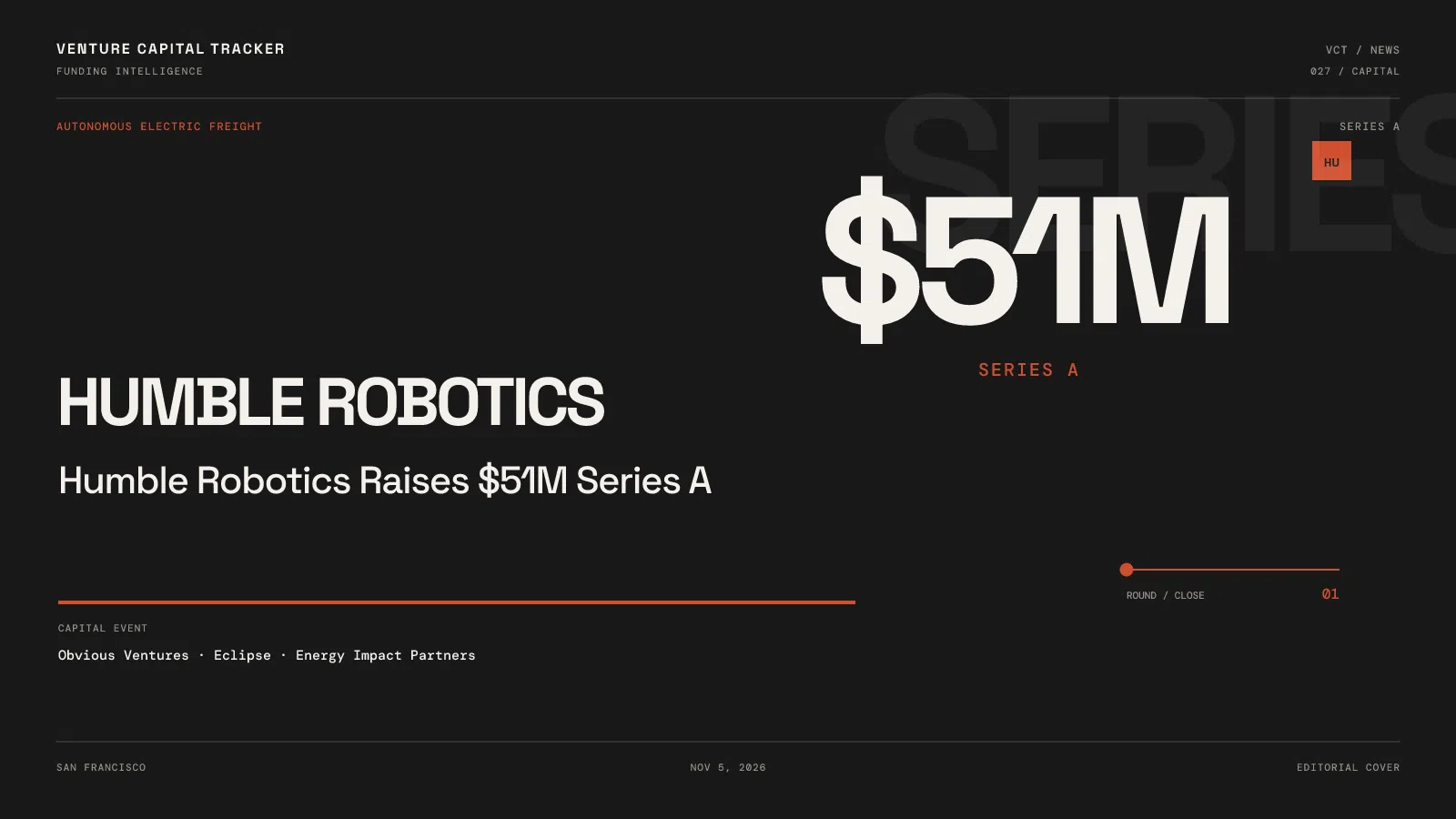
Humble Robotics announced a $51 million Series A on November 5, 2026, led by Obvious Ventures and joined by existing backers Eclipse and Energy Impact Partners. The San Francisco startup says it has raised $75 million in total, including the $24 million seed announced April 21. Its valuation and revenue are undisclosed. Importantly, this is financing for testing, customer pilots and early manufacturing—not evidence that a commercial driverless freight fleet has launched.
Humble's wager is that autonomous trucking should not begin with an ordinary truck designed for a human. Its Humble Hauler combines a battery-electric powertrain, cargo platform and autonomous driving into a cabless vehicle designed to move freight between ports, rail terminals, warehouses and distribution centers. That integration could eventually lower freight costs, but the engineering and commercial claims remain to be validated.
Funding facts—not just the headline
| Measure | Confirmed detail |
|---|---|
| Series A | $51M, announced November 5, 2026 |
| Lead investor | Obvious Ventures |
| Returning investors | Eclipse and Energy Impact Partners |
| Previous seed | $24M, announced April 21, 2026, led by Eclipse |
| Total disclosed financing | $75M cumulative (not $75M of new money) |
| Valuation and commercial revenue | Undisclosed |
| Product | Humble Hauler, purpose-built cabless electric heavy freight vehicle |
| Company's advertised range and top speed | 200 miles and 55 mph; manufacturer specifications |
| Next milestones | Supervised customer pilots planned for Q1 2027; commercial operations targeted for Q3 2027 |
The latest issuer announcement explicitly allocates capital to pilots, testing, validation, manufacturing preparations and a larger family of vehicle designs. The company's VCT profile preserves the two rounds separately.
What does the Hauler actually do?
Humble proposes an integrated tractor, trailer and driver platform. The cab is removed, rather than replacing its driver with software while retaining the entire conventional cabin. The first vehicle is designed to carry shipping containers, with future configurations intended for other cargo. The company markets all-electric propulsion, remote support and charging management.
Its product website cites a maximum 200-mile range and 55-mph speed. Its April 2026 original announcement identifies cameras, LiDAR and radar, plus a vision-language-action approach to vehicle control. “Vision-first” does not mean it has publicly established a camera-only safety architecture. Humble has not published independently validated operating costs, collision statistics, customer SLAs or fleet utilization.
An operator would consider this for a container shuttle from port to warehouse; a recurring plant-to-warehouse trip; moves inside or between rail yards; or repeated runs between a carrier's freight terminals. The product aims to avoid a human handoff between a highway-autonomy system and the loading dock. That is the intended benefit, not an achieved deployment.
A real buyer's deployment sequence
Consider an illustrative logistics company with repeated trips from a seaport to a nearby warehouse. It would need to:
- Choose a lane with predictable pickup and delivery points, dock compatibility, allowed roads and clear freight-handling responsibilities.
- Measure the duty cycle: loaded and empty miles, cargo mass, speed, elevation, turning clearances, waiting time, charging power and vehicle reserve.
- Collect route data and simulate it. In a November 5 Business Insider interview, founder Eyal Cohen said planned customer pilots would initially use conventional trucks for data collection, before simulation and deployment of Humble's own vehicle.
- Run supervised testing and establish safety operations: pedestrians, emergency stops, remote assistance, incident response, maintenance and regulatory permissions.
- Verify economics across the whole trip: hauling reliability, hourly utilization, electricity and charging downtime, maintenance, insurance, remote operations, customer integration and backup-truck requirements.
Humble has not disclosed a purchase price or standard per-mile freight tariff. No real customer example can yet be described as a completed revenue-producing driverless service.
The 200-mile limit versus the 250-mile opportunity
Humble highlights regional movements under 250 miles, citing a market where 87% of US truck tonnage traveled under that distance. The underlying US Department of Energy report uses 2021 domestic freight data: 44% of tonnage moved under 100 miles, and 43% moved 100–249 miles. That is tonnage, not the percentage of trucks, journeys or customers that Humble can serve with its current vehicle.
The company's maximum rated range is 200 miles, so route selection matters. A hypothetical 60-mile delivery leg and 60-mile return total 120 miles, leaving 80 miles of arithmetic headroom against the advertised maximum. This is not a verified operating reserve: loaded consumption, weather, hills, battery aging, idle time and charging availability still determine the actual route. A 110-mile leg followed by the same return would already exceed the nominal rating. Counting the entire under-250-mile market as immediately serviceable would be misleading.
This discrepancy offers a practical diligence question: what share of actual customer round-trip duty cycles, not historical freight tonnage, fits within the vehicle's tested reserve requirements?
Funding history and why investors participated
The company's April 21, 2026 PR Newswire release announced $24 million in seed financing led by Eclipse, with Energy Impact Partners participating. It reported a first prototype assembled within six months and planned customer pilots. Eclipse partner Jiten Behl emphasized that autonomy, heavy-vehicle engineering and electrification needed to be built together rather than separately.
The November 5 $51 million Series A was led by Obvious Ventures; Eclipse and Energy Impact Partners returned. Obvious partner Mo Islam emphasized more dependable, efficient freight movement between industrial facilities. Neither round disclosed individual investor allocations, a share price or valuation.
These are two rounds totaling $75 million, not a newly raised $75 million round. The money says something about investor willingness to fund a difficult physical-AI thesis; it says nothing by itself about the startup's profitability or customer adoption.
What has been proven, and what remains a forecast?
Humble's vehicle is more than a static rendering: it built a prototype and has conducted supervised testing. Business Insider reported seeing a vehicle navigate an R&D site near San Francisco around pedestrians and unexpected obstacles. The prototype retained a temporary cab during supervised testing. That is not a production driverless freight fleet.
Cohen told the outlet Humble holds a California permit to test with a safety driver, but would need further regulatory steps to test or operate without one. He said Q1 2027 customer pilots and Q3 2027 commercial operations were targets. They are not completed milestones, verified paid contracts or public-road autonomy approvals. The company did not disclose the number of signed customers, deliveries, recognized revenue, production vehicles or audited costs.
Alternatives freight operators should compare
| Option | Main strength | Different challenge |
|---|---|---|
| Aurora | Established autonomous trucking and commercial highway freight experience | Primarily highway networks rather than a ground-up cabless dock-to-dock vehicle |
| Kodiak AI | Freight and industrial autonomous trucking programs | Different vehicle and route integration; check degree of human supervision |
| Gatik | Repeated middle-mile freight routes | Different payload and vehicle format, with commercial scale varying by lane |
| Human-driven electric trucks | Electrification without driverless regulatory exposure | Retain a human driver, cab and associated expenses |
| Humble Hauler | Purpose-built cabless electric vehicle for industrial and regional moves | Commercial delivery, pricing, reliability and large-scale manufacture unproven |
These are alternatives for the shipping task, not necessarily identical vehicle designs. The Next Web also noted competing progress by Gatik and cabless-truck operator Einride. Humble's precommercial status should not be flattened into equivalence with already operating services.
The unit economics that decide whether this works
Humble argues a lighter cabless electric platform reduces cost per mile. However, a shipper must compare all-in cost per completed movement: vehicles and financing, usable payload, loaded and empty mileage, energy, charging, maintenance, remote intervention, software, insurance, depot changes and labor still required at the loading dock. Removing the driver's cab does not eliminate every operational person or support cost.
For investors, a successful pilot must turn into repeated contracts with strong fleet utilization, manageable safety and maintenance costs, reliable manufacturing, and an affordable supply of expansion capital. Humble has not disclosed vehicle gross margin, expected service pricing or required investment per deployed lane. It would be speculative to claim a fixed payback period or proven savings.
The key next evidence is a named paying freight customer, a specific supervised route, tested uptime and safety outcomes, disclosed deliveries, and documented permission to scale from supervised piloting to driverless service. The $51 million round buys the opportunity to prove those steps. It does not establish that the commercial model has already succeeded.
Follow Venture Capital Tracker on Google
Add VCT as a preferred source to see more of our venture-capital reporting in Google Search.
Editorial note: AI tools assisted with research, structure, or drafting. Venture Capital Tracker retains human editorial responsibility for factual accuracy, relevance, and source quality before publication.