Agility Robotics AGLT IPO: $465M SPAC Deal, Digit Orders and Real Revenue
Agility Robotics began Nasdaq trading as AGLT on November 5, 2026. Where the $465M comes from, why $300M orders aren't revenue, SEC sales, Digit pricing and competitors.

By Venture Capital Tracker Editorial
IPO
Agility Robotics
Led by Foxconn
Reported valuation $2.5B
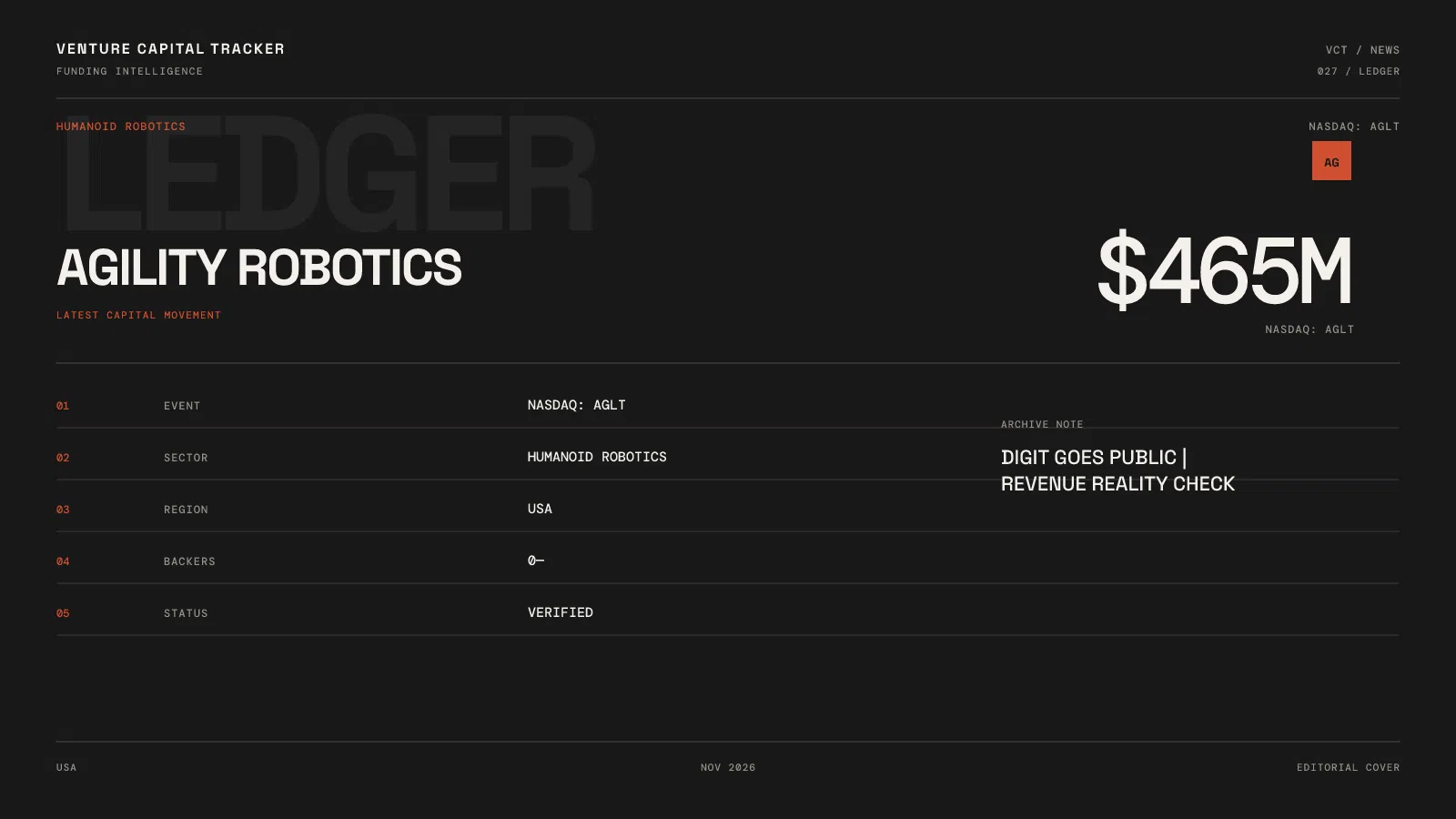
Agility Robotics completed its merger with Churchill Capital Corp XI on November 4, 2026, and its shares began trading on Nasdaq as AGLT on November 5. The maker of the Digit humanoid warehouse robot said the transaction and related financings provided about $465 million in gross capital before expenses. That is materially different from the more than $620 million originally anticipated in June and does not represent one new venture-capital round.
The useful investment question is not whether a humanoid robot can move a tote. Agility has demonstrated that in customer facilities. It is whether the company can turn repeatable deployments into profitable, high-volume revenue before its cash needs outrun its commercial adoption. Agility's November 5 filing-backed announcement and the merger documents supply unusually concrete numbers to test that thesis.
What actually closed: the $465 million breakdown
| Component | Approximate amount | What it means |
|---|---|---|
| Churchill XI trust account after redemptions | $164M | SPAC cash remaining for the combination |
| Foxconn-led private investment in public equity (PIPE) | $201M | Committed new common equity sold at $10 per share |
| Equity funding received before closing | $100M | Already received in the period after the merger announcement |
| Total gross capital related to the transaction | $465M | Before deal expenses; not all raised on listing day |
The company disclosed this mix in its November 2 shareholder-approval release, confirmed completion on November 4 and the listing on November 5. The numbers are approximate and refer to financing associated with the transaction. They should not be added on top of each other as separate $465 million raises.
Why did the June estimate fall? The original June 24 merger announcement assumed roughly $420 million in the SPAC trust without public-shareholder redemptions, plus about $200 million in PIPE money. By the November update, only about $164 million remained in the trust; a separate $100 million had already been received. Comparing $620 million of originally expected closing components with approximately $365 million from the actual trust plus PIPE shows the dilution of the cash expectation. Comparing $620 million directly with the later $465 million total without isolating the pre-close $100 million obscures the mechanics.
Agility's deal specified a $2.5 billion negotiated pre-money equity value. This is a merger pricing reference established in June, not the live market capitalization of AGLT after listing. The public-market share price can produce a different value as the stock trades.
What Digit does for a warehouse—and what a customer actually buys
Agility builds a two-legged industrial robot called Digit. Its core initial job is repetitive material handling in warehouses and factories, particularly carrying containers between fixed workstations and placing them on conveyors. Unlike a conveyor or an autonomous mobile robot (AMR) optimized for a particular route, Digit aims to navigate existing spaces originally laid out for people. That flexibility is the premise; it must still justify the added complexity of legs, perception and manipulation.
Consider an illustrative warehouse manager evaluating the system:
- Choose a repetitive job. Identify tote movements that impose awkward carrying, frequent walking or staffing pressure; measure the current volume, queueing and error rate.
- Test the physical cell. Map the workspace and handoff points, check traffic patterns, floor conditions, load weight and safe separation from people; compare with conveyor or AMR alternatives.
- Connect the software. Use Agility Arc to define the workflow and integrate robot work orders into the warehouse management/execution system, or a manufacturing execution system, through the vendor's published API approach.
- Pilot and measure. Run a limited number of robots, track totes moved per hour, uptime, mean time between incidents and placement accuracy. Include recovery, charging, supervision and safety interventions in the results.
- Decide whether to expand. Only after total operating cost and reliability justify the project would a buyer expand across shifts or sites, with maintenance, service levels and software integration included in the contract.
These are buyer-evaluation steps derived from Agility Arc's product description, not a claim that VCT personally tested the robot.
There is at least one specific customer case: GXO Logistics and Agility jointly reported that Digit had moved more than 100,000 totes at a Georgia fulfillment operation under a commercial robots-as-a-service agreement begun in 2024. In October 2026 they announced plans to deploy at two additional GXO sites in North Carolina and Tennessee beginning in early 2027, initially with the current Digit 4 generation. That is evidence of a real use case and expansion plans, but the published tote count alone does not prove sustained profitable throughput or transferable ROI at every customer. Read the joint GXO–Agility announcement.
Other company-named relationships include Schaeffler, Toyota Motor Manufacturing Canada, Mercado Libre and AGCO. They span existing deployments, signed programmes and future pilots, not identical stages of commercial adoption. Agility also reports more than 65,000 cumulative real-world operating hours across its fleet, not 65,000 hours per robot or a published uptime percentage.
What does Digit cost? Price, assumptions and procurement risk
Agility has not published a universal commercial price list covering all customers. Its SPAC prospectus provides illustrative robot-as-a-service unit economics, including a figure around $8,500 per robot per month, while actual commercial terms are negotiated. This is a modelling input, not a verified quote available to every buyer.
For context, one hypothetical robot at that modelling rate would cost $102,000 in recurring annual fees, excluding one-off deployment, changes to the workcell, integration, site supervision and other buyer costs. Two robots would imply $204,000 per year before those extras. Whether that is economical depends on productive hours, reliable items handled per hour, labour-cost displacement or redeployment, intervention frequency and the value of flexibility. No competent ROI estimate should assume that 24-hour availability equals 24 hours of productive work.
Agility's newer Digit 5 was unveiled in September 2026, but is not yet generally available. Early customer access is planned for the first half of 2027 and general availability for late 2027. Its proposed 50-pound repetitive-lifting capability, closer cooperation with people, and nine-minute charging are design or development claims that still need commercial validation and relevant safety approvals; they are not established performance across a mature deployed fleet. RoboFab's stated 10,000 robots-per-year capacity is the factory's design ceiling, not current deliveries.
The $300 million order number is not $300 million of revenue
The November 5 company release cites more than $300 million in committed multi-year Digit 5 orders, subject to product specifications, contractual milestones and deployment. Its June 2026 SEC investor presentation described the initial roughly $300 million commitment as 1,000 Digit 5 robots on a three-year RaaS agreement with one unnamed purchaser, with purchaser warrants vesting as units deploy. An updated customer-by-customer split of the larger November figure was not disclosed.
That distinction matters because Agility separately describes more than 30 prospective customers in discussions or paid evaluation programmes. Thirty potential customers do not equal thirty purchasers behind the $300 million order. The deal terms in the earlier presentation imply an average of roughly $8,333 per robot-month if $300 million were spread evenly across 1,000 robots and 36 months. This is an arithmetic illustration, not a published contract fee, and warrants, rollout schedules and negotiated terms complicate the comparison.
The order figure could support future sales only if the relevant specifications, approvals, deliveries and milestones are met. It is neither cash received nor current-period audited sales.
What the SEC filings reveal about revenue, losses and runway
The 2026 SPAC prospectus provides a rare financial picture of a humanoid robotics company before it has scaled commercial revenue.
| Filed metric | Period | Amount | Interpretation |
|---|---|---|---|
| Net sales | Full year 2025 | $1.78M | Recognised sales, not customer order book |
| Net loss | Full year 2025 | $138.1M | Company still heavily loss-making |
| Net sales | First half 2026 | $174,000 | Down from $625,000 in H1 2025 |
| Net loss | First half 2026 | $361.9M | Includes significant noncash share-based expense |
| Cash used in operations | First half 2026 | $86.2M | Closer to operating cash burn than accounting net loss |
| Cash and equivalents | June 30, 2026 | $14.7M | Historical pre-transaction balance, not post-listing cash |
The six-month net-sales decline was about 72% year on year. Some $252.5 million of the dramatic first-half net loss related to incremental stock-based compensation, so it would be misleading to describe the entire accounting loss as cash consumed. The pre-merger filings carried going-concern language. The new financing significantly changes the company's liquidity picture, but does not retrospectively turn its earlier financials profitable.
There is another warning in 2025 gross economics: recorded cost of goods sold exceeded net sales. Early-stage hardware makers can incur high costs during low-volume deployment, but those losses mean published unit-economics forecasts must be tested against actual production and service experience. The prospectus figures are more decision-useful than a robot demonstration on social media.
Funding history: keep venture rounds, cumulative capital and IPO proceeds separate
The Agility Robotics company profile and its linked canonical investment events now distinguish these verified milestones:
| Date | Financing or market milestone | Amount and scope |
|---|---|---|
| October 15, 2020 | Company-announced venture investment led by DCVC and Playground Global | $20M new investment; stage not specified in the company release |
| April 22, 2022 | Series B led by DCVC and Playground Global; Amazon Industrial Innovation Fund participated | $150M new Series B |
| June 24, 2026 | Proposed Churchill XI business combination | $2.5B negotiated pre-money valuation; $620M+ expected gross proceeds if no redemptions |
| November 4–5, 2026 | Business combination completed; AGLT trading began | ~$465M gross transaction-related capital, including $100M already received |
The private share-class financings described in the SEC filing should not be turned into a made-up single $400 million new Series C simply because that number appears in secondary funding databases or cumulative preferred-capital disclosures. Exact tranche dates, gross proceeds and the earlier Series C funding structure require a separate filing-level reconciliation.
For investor context, DCVC and Playground Global supported the company well before its public debut. Foxconn led the 2026 PIPE. The June agreement identified other strategic backers including NVIDIA, Amazon, SoftBank Vision Fund 2 and Schaeffler; their individual investments in the PIPE were not all disclosed.
Who competes with Agility—and what buyers should compare
Apptronik develops the Apollo humanoid for industrial use. It disclosed a $520 million Series A extension in February 2026, taking the cumulative Series A to more than $935 million; that is not $935 million of fresh February funding. Figure AI reported more than $1 billion committed in its September 2025 Series C at a $39 billion post-money valuation, although a private round valuation is not directly comparable with Agility's public trading market cap. Tesla Optimus is another humanoid programme, but Tesla's shares also represent its much larger automotive and energy businesses.
For a procurement decision, the most serious competitor may be a non-humanoid alternative: conventional conveyors, goods-to-person systems, AMRs or redesigning the workcell. Those can be cheaper, simpler and safer in predictable operations. Digit's distinctive wager is that enough workplaces already have human-designed layouts and changeable workflows to justify a more general-purpose machine.
What must happen next
Agility's strongest evidence is operational: commercial robot deployments, GXO's reported tote milestone and field data that can improve physical-AI models. Its greatest open questions are financial and engineering: Can Digit 5 deliver on contracted specifications? Can throughput and uptime support a workable customer ROI? Will safe collaboration withstand certification and varied customer sites? Can the company build and service robots profitably at scale?
A listing supplies capital and more public reporting, not answers by itself. Readers should track the first post-listing quarterly filings, actual delivered robots and recognised RaaS sales, gross margin, operating cash use, and how much of the conditional order book converts into deployed, revenue-generating machines.
Reported financial amounts are drawn from the company's dated releases and SEC registration documents. Future deliveries, capacity and order values are management claims or contractual expectations, not audited current revenue. This article concerns the company's financing and operations, not a recommendation to buy or sell AGLT stock.
Follow Venture Capital Tracker on Google
Add VCT as a preferred source to see more of our venture-capital reporting in Google Search.
Editorial note: AI tools assisted with research, structure, or drafting. Venture Capital Tracker retains human editorial responsibility for factual accuracy, relevance, and source quality before publication.