· 6 sources · Verified
Flashpoint Capital's $141.5M Fund Closures Explained: Fund IV, Debt Sidecar and History
Flashpoint closed a $116M venture fund and a separate $25.5M growth-debt sidecar—not one $141.5M VC fund. Explore fund history, LPs, strategy and unresolved figures.

By Venture Capital Tracker
Fund close
Flashpoint Venture Growth Fund IV
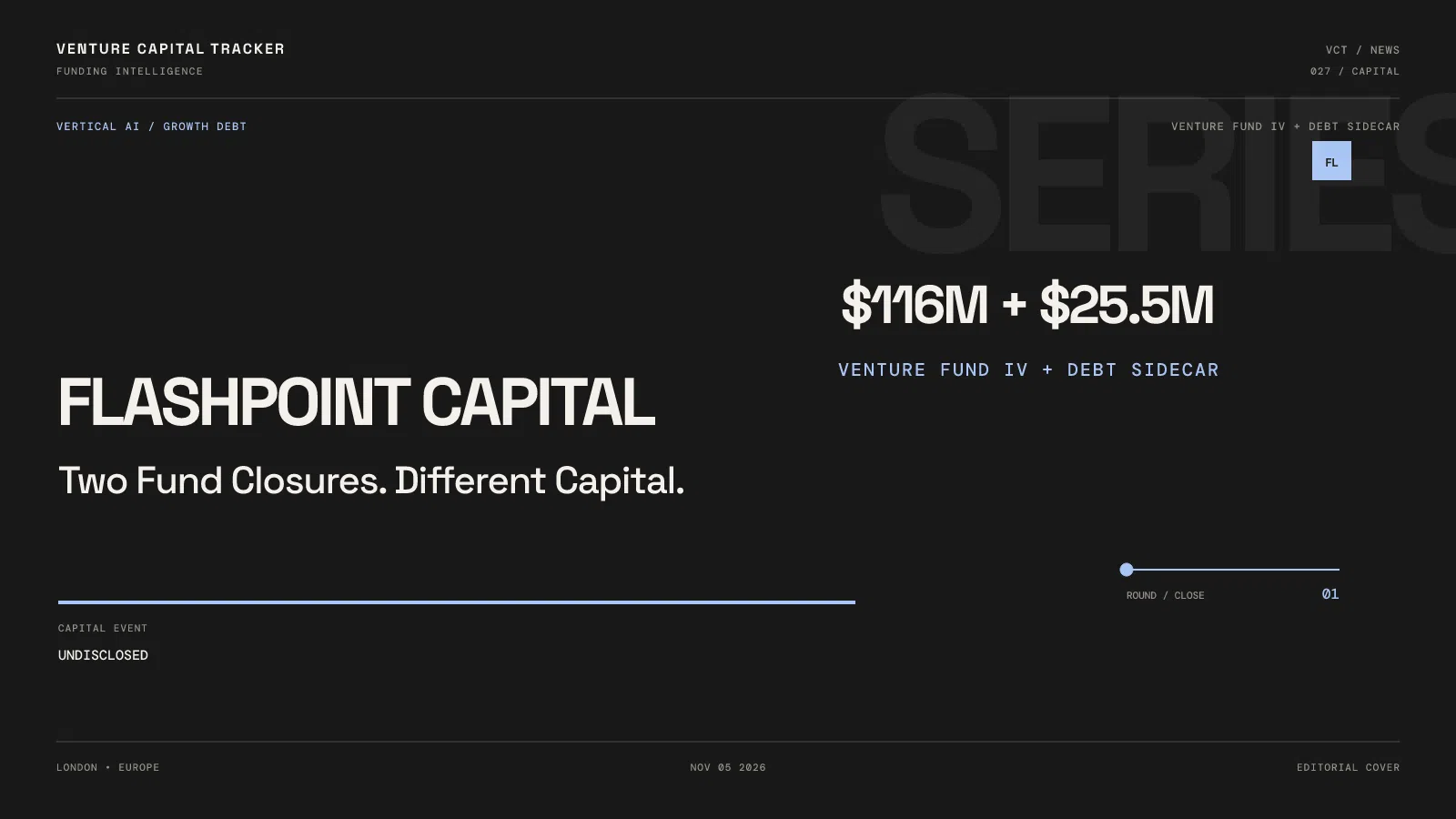
Flashpoint Capital announced $141.5 million in fund closures on November 5, 2026, but that is not the size of a single venture capital fund. The London-based investment manager reached the $116 million final close of Venture Growth Fund IV, focused on vertical AI, and separately closed a $25.5 million growth-debt co-investment sidecar. The first vehicle buys equity in technology companies; the second finances borrowers through credit. Neither is a startup funding round.
That distinction is important for investors searching Flashpoint's actual fund size, founders deciding which strategy fits their business, and analysts counting capital raised. A venture fund's final commitments, a debt sidecar, deployed loans and firmwide assets under management measure different things.
The numbers: what closed, what did not
| Vehicle or measurement | Amount | Status and interpretation |
|---|---|---|
| Venture Growth Fund IV | $116M | Final close announced Nov. 5, 2026; venture equity |
| Growth Debt Co-investment Sidecar | $25.5M | Separate close announced Nov. 5; growth debt, about 60% drawn |
| Combined November closures | $141.5M | Arithmetic sum of the two different vehicles, not a standalone fund |
| Growth Debt Fund II | $66.1M | Historical 2025 close, described as fully drawn in the new release |
| Entire growth-debt platform | $127M | Managerwide debt-platform figure; NOT incremental November fundraising |
| Flashpoint Capital AUM | About $600M | Assets under management across strategies; NOT money raised this month |
The figures come from Flashpoint's original November 5 announcement. The $141.5 million headline can be independently reconciled as $116 million + $25.5 million. That simple split matters: a database entry that assigns the full amount to Fund IV would overstate its size by about 22%.
A second, less obvious accounting question remains open. Flashpoint says its debt platform totals $127 million, but the two specifically quantified vehicles—the $66.1 million Fund II and $25.5 million sidecar—sum to $91.6 million. The difference is $35.4 million. It could reflect older debt funds or other platform capital, but the announcement does not provide the full reconciliation. It would be wrong to call the difference a newly closed fund, an investment gain, or uncommitted cash.
What Venture Growth Fund IV actually invests in
Flashpoint says Fund IV backs business-to-business vertical AI applications built by European or Israeli technology founders and scaled into the US. Think software designed around the specialized data, procurement, regulations and working practices of a particular sector—not a general-purpose chatbot.
By the final-close announcement, Flashpoint reported 10 investments, naming SiPhox, Qase, Mermaid and Inspekt AI, and an ambition to build a portfolio of 15–20 companies. It said its first exit from the fund came earlier in 2026 with Kaiko. The exit price, invested capital, net return and fund-level performance were not disclosed. Ten investments is a deployment count, not a measure of returns.
For an illustrative founder visit, take a B2B AI company selling compliance or operational software to US businesses:
- Establish fit. Present the vertical customer, specific problem and evidence that the product changes a costly workflow. A generic AI pitch is weaker than a clearly defined buyer and deployment path.
- Show the actual economics. Provide revenue quality, renewal evidence, customer acquisition costs and gross margins wherever available. Flashpoint has not issued a published Fund IV minimum ARR threshold or fixed ticket size in this close.
- Explain the US expansion. Describe which customers pay, who controls budgets, the integration burden and the competitive substitutes.
- Expect investor diligence. A VC manager normally examines ownership, cap table, governance, security risks and financial assumptions before negotiating a primary investment. These are illustrative market-standard steps, not a claim that VCT tested Flashpoint's proprietary investment process.
The critical uncertainty is how much of Fund IV remains available for new investments versus follow-ons, operating costs and other commitments. The $116 million close is capital committed by LPs, not $116 million ready to issue as first checks.
The three strategies: equity, credit and existing shares
Flashpoint had widened its identity beyond venture capital, rebranding from Flashpoint VC to Flashpoint Capital in March 2026. Its three strategies serve different situations.
Venture growth equity. Fund IV buys an ownership stake in a company and shares upside and dilution risk. Founders should evaluate its operating support, follow-on appetite and board terms—not just the amount the fund raised. Flashpoint's release identifies vertical AI and Europe/Israel-to-US growth as the current mandate.
Growth debt. The second growth-debt fund offers loans rather than the same instrument as a priced equity round. In its November 25, 2025 final-close release, Flashpoint said it targeted venture-backed post-Series-A businesses with at least $3 million in annualized revenue, more than 30% annual revenue growth and product-market fit. Those criteria were issued for the debt fund, not for Fund IV equity. Borrowers gain financing without necessarily issuing as many new shares but must account for repayment, interest, covenants and downside risk. Standard rates and covenant terms were not made public in those statements.
The 2025 press release rounded Debt Fund II to $67 million; the 2026 update specifies $66.1 million, describing it as fully drawn. These refer to the same fund, not a new $66.1 million close in 2026. The new sidecar is separate and was approximately 60% drawn by November 5. A rough $15.3 million drawn estimate follows from that percentage, but is illustrative, not a verified cash-disbursement total.
Direct secondary investments. Direct Secondary Fund II seeks to buy shares from existing holders in mature private companies, potentially providing liquidity to early investors, founders or employees. That payment ordinarily goes to the selling shareholder, not to the company as new operating cash. The fund announced a first close on January 22, 2026, with 20 LPs, while stating a $75 million–$100 million fundraising target. The exact amount closed was not disclosed. Fund II's target is neither its verified size nor November's new financing.
An employee considering a secondary sale would first establish the share class and transfer restrictions, obtain any required company permission, agree a valuation with a buyer, and complete settlement and tax review. This is an illustrative sale process, not a tested Flashpoint product interface. Discounts to primary valuations, transfer rules, fees and taxes vary; the manager did not disclose standardized terms.
Fund history: from VC III to the 2026 portfolio
| Announced | Fund milestone | Amount | What the record actually says |
|---|---|---|---|
| August 4, 2022 | Venture Growth Fund III close | $102M | Original manager-issued Business Wire release, including a $20M Széchenyi Funds LP commitment |
| November 25, 2025 | Growth Debt Fund II final close | ~$67M | Later described more precisely as $66.1M |
| January 22, 2026 | Direct Secondary Fund II first close | Undisclosed | $75M–$100M target, not closed amount |
| November 5, 2026 | Venture Growth Fund IV final close | $116M | Equity vehicle; around 10 investments made |
| November 5, 2026 | Growth-debt sidecar close | $25.5M | Separate debt co-investment vehicle |
The 2022 milestone contains a notable archival discrepancy. Flashpoint's original manager-issued Business Wire release calls the VC III close $102 million, and contemporaneous reporting follows that figure. Its current republished archive page instead displays a $105 million headline, even though the URL retains “102-million” and the body only says it exceeded the $100 million target. VCT uses the original signed release's $102 million and flags the inconsistency. There is insufficient evidence here to explain whether the later headline reflects subsequent commitments or an editorial error. It is not evidence of a separate round.
Measured against the original $102 million figure, Venture Growth Fund IV's $116 million represents roughly 14% more nominal committed capital than VC III. That is a fund-size comparison, not an investment return or inflation-adjusted growth measure.
Who supplies the capital—and what LPs still need to know
The November announcement describes returning and new international institutions and family offices behind Fund IV without publishing each investor's commitment. Flashpoint has historically named Azimut and Széchenyi Funds among its fund investors. Its 2022 issued release identified a $20 million Széchenyi commitment to VC III. That is proof of participation in VC III, not evidence the same LP owns a particular fraction of Fund IV.
A prospective institutional LP evaluating Flashpoint would need vehicle-specific audited statements, realized and unrealized performance, distributions, capital-call schedules, GP commitment, fees, carry, leverage policy and the exact legal structure. The public announcements do not establish these figures. Firmwide AUM of approximately $600 million provides scale context, but cannot substitute for fund-by-fund net performance.
What changes after this close
Flashpoint also announced Denis Mosolov as CEO and co-founder Alexander Konoplyasty as CIO, while co-founder Michael Szalontay is moving away from daily management to focus on its direct-secondary strategy, subject to the stated joint-venture approvals. The manager plans to launch Growth Debt Fund III; a plan is not a verified launch or first close.
For founders, the actionable conclusion is to match the request to the right strategy: equity for a vertical-AI growth company, debt for an eligible revenue-generating borrower, or a secondary transaction for an existing shareholder. For LPs and analysts, the accounting conclusion is equally specific: $116 million Fund IV + $25.5 million debt sidecar = $141.5 million across two capital pools. Future evidence should clarify the debt-platform residual, fund-level terms and whether later manager disclosures resolve the VC III size discrepancy.
Follow Venture Capital Tracker on Google
Add VCT as a preferred source to see more of our venture-capital reporting in Google Search.
Editorial note: AI tools assisted with research, structure, or drafting. Venture Capital Tracker retains human editorial responsibility for factual accuracy, relevance, and source quality before publication.