DailyPay Completes $200M ABS—Debt, Not a New Equity Round
DailyPay's second $200M ABS lifts receivables-backed debt capacity to about $1.4B. It is debt financing, not a new venture round.
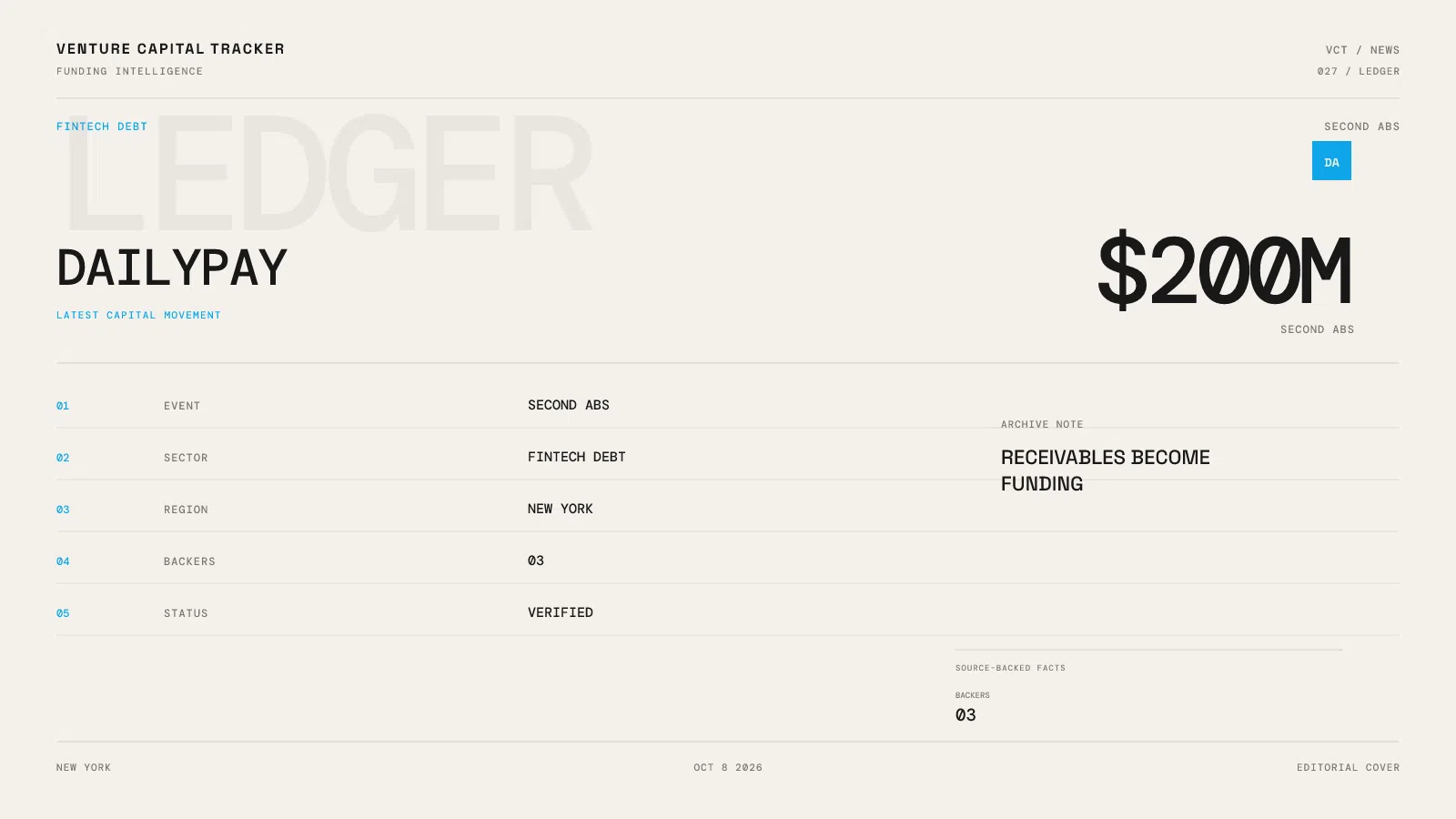
DailyPay has completed a $200 million asset-backed securitization of its on-demand-pay receivables. It is the company's second ABS transaction and expands the funding available to advance workers wages they have already earned.
This is debt financing, not venture equity. The transaction does not establish a new valuation and should not be counted as a $200 million startup funding round in equity league tables.
DailyPay's 2026 ABS at a glance
| Field | Detail |
|---|---|
| Financing type | Asset-backed securitization |
| Amount | $200 million |
| Collateral | On-Demand Pay receivables |
| Status | Completed |
| Lead bookrunner and structuring agent | Citi |
| Joint bookrunners | Bank of America and Barclays |
| Co-managers | KeyBanc, Scotiabank and Wells Fargo |
| Ratings | Four note classes rated from AA (sf) to BB (sf) by Morningstar DBRS |
| Announced | October 8, 2026 |
DailyPay says this transaction, its first $200 million ABS in 2025 and a $960 million secured credit facility bring receivables-backed debt capacity to approximately $1.4 billion.
Why an ABS matters for earned-wage access
DailyPay advances employees money before the normal payroll date, then recovers the funds through payroll flows. That creates a pool of short-duration receivables that can be financed.
An asset-backed securitization packages exposure to those receivables into rated notes sold to capital-market investors. If performance remains stable, this can diversify funding away from a smaller group of banks and lower the marginal cost of capital.
For DailyPay, funding cost is a product metric. Cheaper and more reliable financing can support more employer programs and more employee transfers without requiring the company to raise an equivalent amount of equity.
What the capital structure says
The second issuance is more informative than the first. A repeat ABS suggests DailyPay can provide the data, servicing history and investor reporting needed to return to securitization markets.
The four-class structure also distributes risk. Senior investors receive stronger protection and lower yields, while junior classes absorb more risk in exchange for higher returns. Morningstar DBRS assigned ratings ranging from AA (sf) to BB (sf), according to the company announcement.
That does not make the assets risk-free. Performance depends on payroll settlement, employer concentration, advance behavior, operational controls and the legal treatment of earned-wage products.
Why this is not a venture round
Debt capacity and equity capital solve different problems.
- Equity absorbs business risk and typically dilutes shareholders.
- An ABS funds a defined receivables pool and must be repaid from cash flows.
- The $200 million therefore increases funding capacity; it does not add $200 million to DailyPay's equity valuation.
- The approximate $1.4 billion total is cumulative debt financing, not cash newly raised in October.
This distinction is especially important for fintech companies whose reported “funding” can combine corporate equity, warehouse lines, forward-flow agreements and securitizations.
Operating scale—and the caveat
DailyPay says its platform serves more than 2,000 employers and over 6 million employees. Those company figures help explain why the receivables pool is large enough to securitize.
The quality of the model, however, depends on more than user count. Investors should watch advance frequency, average balance, repayment timing, employer diversification, fraud losses and whether regulatory changes alter fees or product design.
Earned-wage access continues to receive scrutiny over whether products function more like payroll services or consumer credit. A durable financing advantage will matter only if DailyPay can preserve compliant economics across jurisdictions.
Competitive and search context
Current search results are dominated by DailyPay's earlier 2025 securitization, its $960 million facility and syndicated versions of the new press release. The useful editorial gap is a clear explanation of the capital stack: this is a second ABS, the $1.4 billion figure is cumulative, and none of it should be treated as a fresh equity valuation.
Bottom line
DailyPay's $200 million ABS is a meaningful fintech financing because it shows earned-wage-access receivables attracting repeat institutional demand. It belongs in the debt-facility category, not confirmed startup equity. The next test is whether repeat securitization lowers funding costs without increasing credit, servicing or regulatory risk.
Follow Venture Capital Tracker in Google
Add VCT as a preferred source to make our venture-capital coverage easier to find in Google Search.
Editorial note: AI tools assisted with research, structure, or drafting. Venture Capital Tracker retains human editorial responsibility for factual accuracy, relevance, and source quality before publication.