Brellium Raises $23M to Audit Every Clinical Note Before Billing
Brellium raised $23M in stage-undisclosed venture financing for CortexLM, which audits clinical notes before billing. Its financial guarantee makes model accuracy an economic liability.
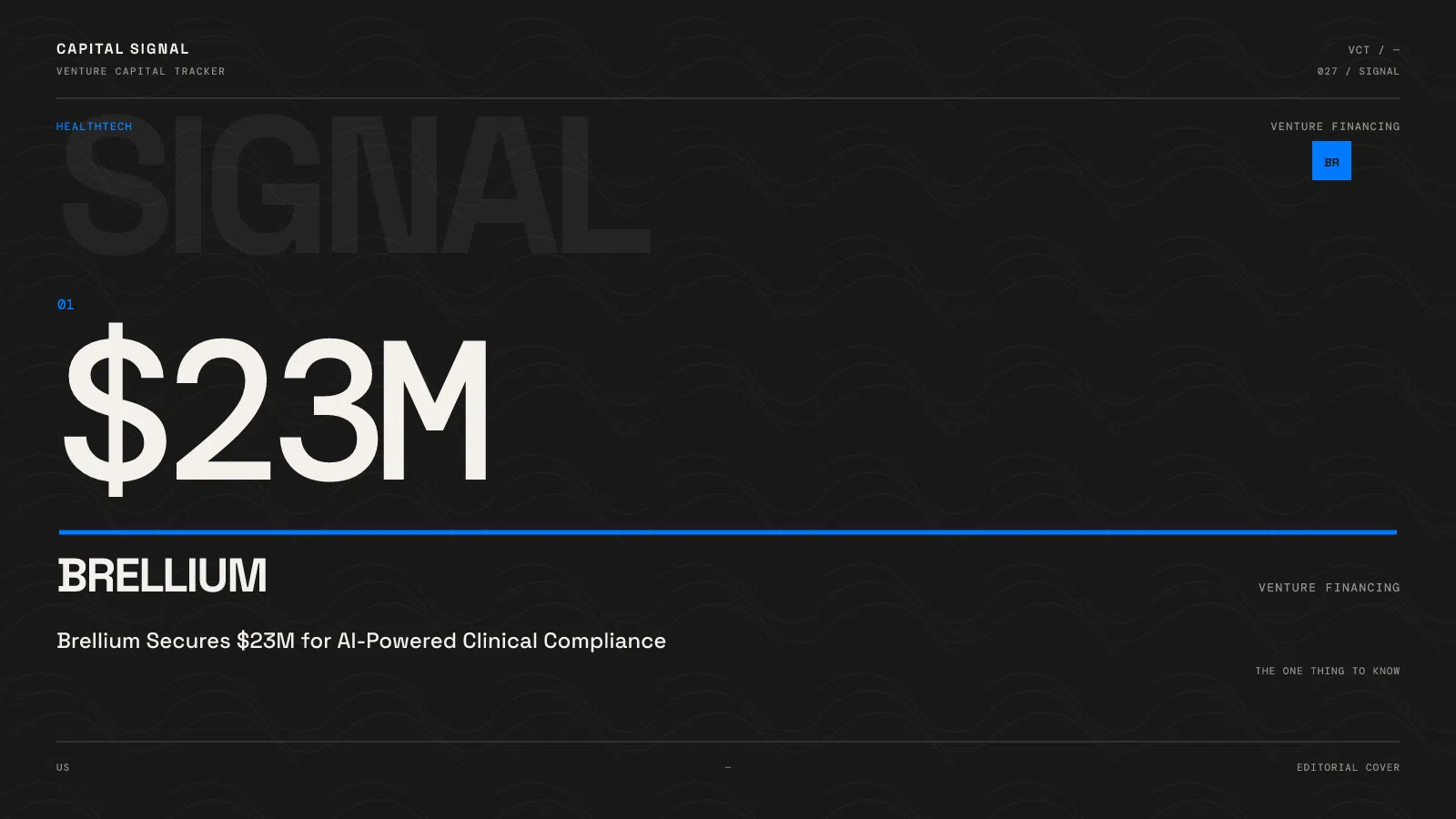
Brellium has raised $23 million in venture financing to expand its AI-powered clinical compliance and revenue-integrity platform.
Left Lane Capital and First Round Capital led the round, with Digital Health Venture Partners participating. The company did not disclose a formal stage or valuation, so the financing should not be labeled a Series A, Series B or debt facility.
Brellium funding: the deal at a glance
| Field | Detail |
|---|---|
| Financing type | Venture funding |
| Stage | Not disclosed |
| Amount | $23 million |
| Valuation | Not disclosed |
| Lead investors | Left Lane Capital; First Round Capital |
| Participant | Digital Health Venture Partners |
| Announced | October 13, 2026 |
| Use of proceeds | New clinical specialties, deeper revenue-cycle workflows and provider expansion |
Brellium also introduced CortexLM, a system designed to review every clinical note before billing, identify gaps in care or documentation and propose corrections.
The business case is revenue protection
Clinical documentation errors are expensive. A missing justification, inconsistent coding or incomplete note can turn into a denied claim, payer audit or clawback months after care is delivered.
Most providers review only a sample of charts because manual auditing is labor-intensive. Brellium’s proposition is to audit the full set before billing and create a defensible record against payer, regulatory and quality requirements.
That positions the product closer to revenue-cycle infrastructure than a conventional clinical assistant. The buyer is not only paying for automation; it is paying to reduce preventable revenue loss and compliance exposure.
The guarantee changes the risk model
Brellium says that if CMS or a payer identifies a problem after the platform has cleared a chart, Brellium will cover the cost rather than the provider.
That guarantee is strategically important. It aligns the vendor with the customer’s financial outcome and can make procurement easier. It also creates underwriting risk: the company must price contracts, model accuracy and claim exposure carefully enough that guarantee losses do not overwhelm software margins.
Investors should treat the guarantee as both a sales advantage and a liability that requires disciplined reserving and monitoring.
Scale claims need attribution
Brellium reports that it has:
- audited 22 million patient visits;
- protected nearly $2 billion in provider revenue from recoupments;
- reached more than 215,000 providers; and
- served approximately 200 provider groups across all 50 states.
Those figures come from the company and have not been independently audited. They nevertheless indicate that Brellium is operating at a scale where model performance can be measured across many specialties and payer rules.
The company says Headspace increased its clinical quality review coverage from 2% of therapy notes to 100% after adopting Brellium and reached 99.2% provider compliance with documentation standards. That is a customer example supplied through Brellium’s announcement.
Expansion raises the complexity
The financing will support expansion beyond current strengths into cardiology, pain management and primary care. Each specialty has different documentation standards, coding rules, medical necessity criteria and clinical nuance.
A model that performs well in behavioral health cannot simply be assumed to work in cardiology. The central execution question is whether CortexLM can adapt to specialty-specific requirements without relying on excessive manual configuration.
Brellium must also maintain strong controls around protected health information, explainability and human review. A platform that proposes fixes to clinical documentation needs to preserve the distinction between correcting missing evidence and manufacturing support for a claim.
Competitive context
Brellium competes with manual audit teams, clinical documentation integrity vendors and AI coding platforms such as Fathom and CodaMetrix. It also overlaps with broader revenue-cycle companies.
Its differentiator is timing and accountability: identify the problem before the claim is submitted, then stand behind the result economically. The risk is that incumbents add similar pre-bill review to existing coding and revenue-cycle contracts.
What investors should watch
The strongest proof points after this round will be:
- loss ratios under the financial guarantee;
- denial and clawback reduction by specialty;
- audit precision and false-positive rates;
- provider correction time;
- customer retention and expansion; and
- gross margin after implementation and guarantee costs.
The headline metric—nearly $2 billion protected—sounds large, but investors need to understand how much of that represents truly avoided loss versus the aggregate value of claims reviewed.
Bottom line
Brellium’s $23 million financing is confirmed venture funding, with the stage and valuation undisclosed. The company is applying AI to a painful, measurable healthcare workflow: proving that clinical documentation supports the care delivered and the amount billed.
The most distinctive part of the model is not the language model. It is the promise to bear financial consequences when the audit fails. If Brellium can price and manage that risk while expanding across specialties, CortexLM could become core revenue-integrity infrastructure.
Follow Venture Capital Tracker in Google
Add VCT as a preferred source to make our venture-capital coverage easier to find in Google Search.
Editorial note: AI tools assisted with research, structure, or drafting. Venture Capital Tracker retains human editorial responsibility for factual accuracy, relevance, and source quality before publication.