Character.AI Files for Bankruptcy: Disney's $20M Bid and the Fall of an AI Unicorn
Character.AI entered Chapter 11 in October 2026. Analyze Disney's $20M IP-license bid, the $1B unicorn history, user shutdown risks, and what investors should watch.
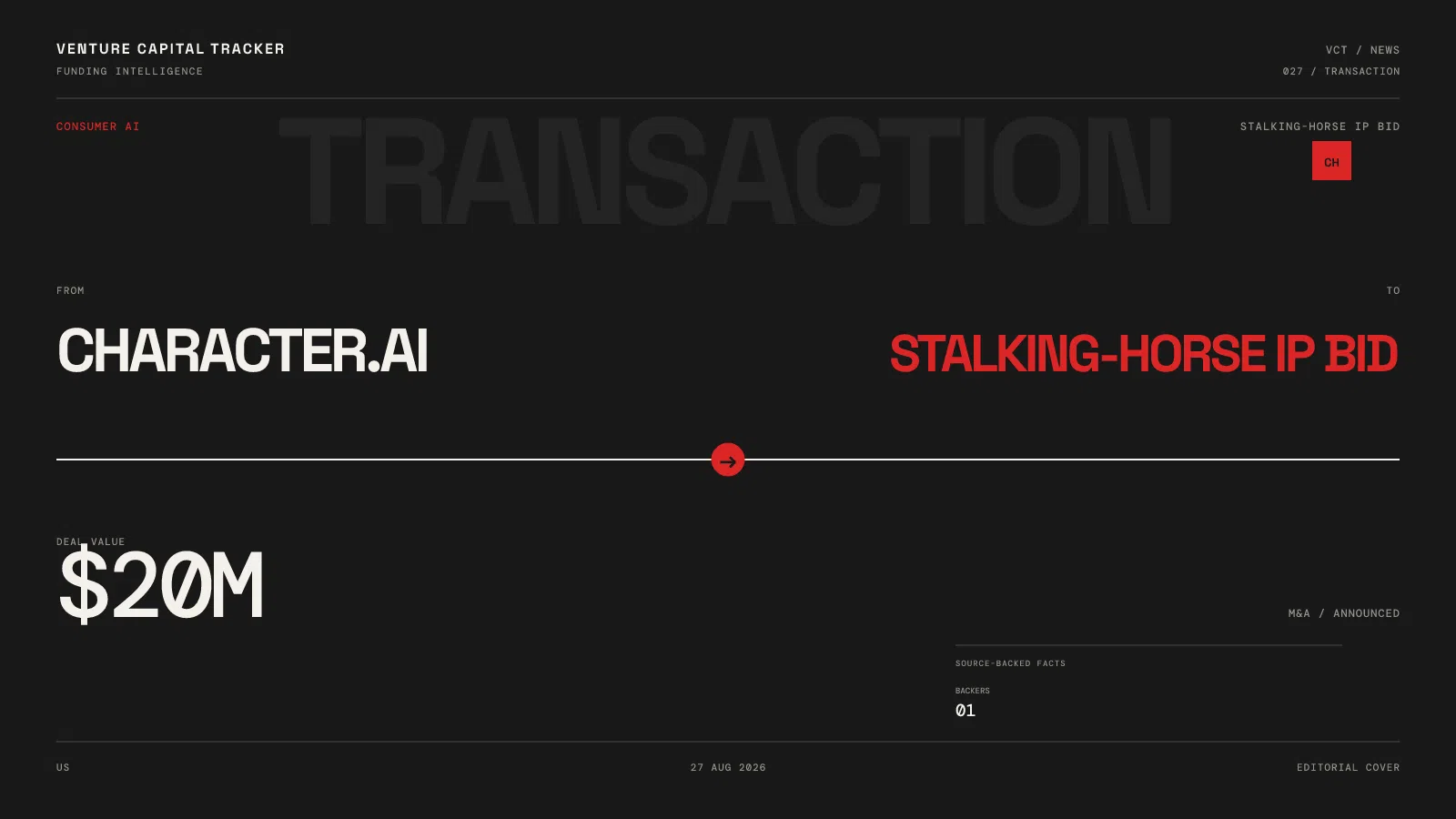
Character.AI filed for Chapter 11 bankruptcy in October 2026 and is seeking a court-supervised sale. Disney has agreed to serve as a stalking-horse bidder in a $20 million arrangement involving a non-exclusive, perpetual license to certain intellectual property and certain claims. This is not a $20 million purchase of the whole company, and the platform has not shut down.
What happened to Character.AI?
On October 12, 2026, Character Technologies announced a voluntary Chapter 11 proceeding in Delaware, citing legal, regulatory and operational challenges. The company expects its sale process to finish by late November or early December 2026. It says the app remains operational, paid subscriptions continue, and privacy practices are unchanged. If no actionable bid supports continued operations, however, the platform may be wound down.
The announcement makes Character.AI an unusually revealing case study in the economics of consumer generative AI: large audiences and strong engagement do not by themselves demonstrate sustainable margins, sufficient monetization or manageable legal exposure.
Disney's $20 million proposal: what it does and does not mean
Disney Worldwide Services is the initial, or stalking-horse, bidder. Under the announced arrangement, Disney would pay $20 million for a non-exclusive perpetual license to certain Character.AI IP and certain claims, with transition services involving former Character.AI employees now at Disney. A stalking-horse bid sets an initial transaction framework in a competitive, court-supervised process; other qualifying bids may emerge.
Disney has not been confirmed as the buyer of Character.AI's entire business. Nor does $20 million represent a fresh valuation for all Character.AI equity. The scope of the licensed IP, assets sold, liabilities assumed and competing bids matters much more than the headline price.
Disney's interest is strategically notable because it operates valuable entertainment franchises and has previously challenged unauthorized uses of its characters. A license could provide technology capabilities without necessarily assuming the full obligations of operating a consumer chatbot community. That is an interpretation, not a disclosed Disney integration plan.
From a $1 billion unicorn to Chapter 11: the timeline
| Date | Development | How to interpret it |
|---|---|---|
| March 2023 | Character.AI raised a $150 million Series A led by Andreessen Horowitz at a reported $1 billion valuation | A priced venture financing |
| August 2024 | Google entered a technology-licensing and talent-related transaction reported at $2.7 billion | Not a conventional new equity round or directly comparable valuation |
| 2024 | Character.AI reportedly reached 20 million monthly active users | Evidence of reach, not profitability |
| 2025–2026 | Product shifts, safety interventions and legal disputes | Important context, but not a quantified bankruptcy-causation breakdown |
| October 12, 2026 | Voluntary Chapter 11 and proposed asset-sale process | A restructuring and sale process, not a completed acquisition |
| Late November–early December 2026 | Company expects sale process to conclude | Forward-looking target, subject to court process and bids |
For the earlier valuation methodology, see VCT's Character.AI valuation analysis and the Character.AI company profile.
Why did Character.AI file for bankruptcy?
The company's own explanation cites legal, regulatory and operational headwinds. Reporting also describes lawsuits concerning alleged harms to minors from chatbot interactions and subsequent safety changes. Allegations in lawsuits should not be mistaken for adjudicated findings.
A second issue is the unit economics of AI companionship. Unlike a traditional social network, additional engagement can generate ongoing inference and moderation costs. More time spent chatting is valuable only when subscriptions, advertising or other monetization ultimately cover those costs and overhead. Character.AI's publicly reported engagement figures cannot establish its gross margin or cash burn. Its filing should not be attributed solely to compute bills without supporting financial evidence.
The departure of its original founders to Google in the 2024 licensing arrangement also changed its technology and leadership trajectory. That does not prove the deal caused the bankruptcy; it does help explain why the company of 2026 is not identical to the foundation-model startup investors originally backed.
What does the bankruptcy mean for venture investors?
First, financing value and asset-sale value are different measures. A $1 billion post-money venture valuation in 2023, a reported $2.7 billion technology-and-talent transaction in 2024 and a $20 million license bid in 2026 refer to different assets, rights and transaction structures. None should be presented as a straightforward 98% or 99% fall in the same equity valuation.
Second, Chapter 11 changes the distribution question. Recoveries depend on the bankruptcy estate, secured claims, administrative costs, creditor priority, sale proceeds and the rights attached to individual securities. The outcome for preferred shareholders or employees cannot be calculated from the Disney bid alone. Equity may be at risk, but no specific investor recovery percentage is established here.
Third, strategic buyers can want technology without the consumer platform. A non-exclusive IP license and transition support may have value even when maintaining the original service is economically or legally unattractive.
Fourth, engagement is not the same as defensibility. Investor diligence on AI companion products should separately assess paid conversion, retention by cohort, contribution margin per conversation, safety costs, age-related restrictions, IP rights and the sustainability of distribution.
Bankruptcy filings: assets, liabilities and creditors
Contemporaneous reporting on the Delaware Chapter 11 petition puts both assets and liabilities in the $50 million–$100 million filing ranges. These are broad petition categories, not audited asset appraisals, and they cannot be subtracted to calculate an exact equity value. Business Insider's October 14 report says the 20 largest unsecured creditors are owed more than $10.6 million, including more than $4 million to Google and more than $2.6 million across law firms. These are reported creditor claims, not confirmed final allowed amounts. Business Insider; TechCrunch.
This changes the investor analysis: a $20 million stalking-horse IP arrangement is not the same thing as the amount available for common or preferred equity. The court must establish the final asset-sale consideration, transaction expenses, priority of claims and distribution waterfall. In a distressed sale, unsecured claims and equity can experience very different outcomes. No specific shareholder recovery can yet be verified from these headlines.
What made this collapse especially unusual?
The company combined a mass-market AI entertainment product with recurring inference costs and unusually sensitive safety and intellectual-property exposure. In 2025 Disney reportedly objected to unauthorized character use; in 2026 it emerged as the initial bidder for selected IP rights. Meanwhile, former Character.AI CEO Karandeep Anand became Disney's chief technology officer. These connections are significant, but do not establish that Disney is acquiring the operating platform or that its planned uses of the licensed technology have been disclosed. TheWrap; Ars Technica.
Investor takeaway: The case highlights the risk of underwriting consumer-AI startups on usage and headline strategic-deal values without separately validating contribution margins, legal exposure, IP licensing rights, management continuity and creditor seniority. It does not establish that every AI-companion business is structurally unprofitable.
What happens to Character.AI users and subscribers?
As of the company's announcement, the platform remains available and subscriptions continue to be billed. Character.AI says users may export their data or delete their accounts, and that it intends to notify paying subscribers before changes affecting paid features. It has not announced a definitive shutdown date. Users who rely on saved conversations may reasonably consider exporting them while the service is operating.
What should investors watch next?
The next evidence points are the bankruptcy court's sale procedures, any competing bids, the precise scope of the Disney license, proposed treatment of liabilities and any buyer willing to keep the platform running. A successful license transaction would not automatically guarantee continued operation of Character.AI.
Frequently asked questions
Is Character.AI shutting down?
Not yet. Character.AI says the platform remains online during Chapter 11, but it could be wound down if no viable proposal supports continued operation.
Did Disney buy Character.AI for $20 million?
No completed acquisition of the whole company has been announced. Disney's $20 million stalking-horse arrangement concerns certain intellectual-property rights and claims.
Was Character.AI valued at $2.7 billion?
The reported 2024 Google transaction involved $2.7 billion, but it was a licensing, talent and liquidity arrangement—not a standard priced equity round establishing a $2.7 billion post-money valuation.
What was Character.AI's confirmed venture valuation?
Its March 2023 $150 million Series A was announced at a $1 billion valuation. That historical figure is not a current valuation or expected bankruptcy recovery.
When will the bankruptcy sale finish?
Character.AI has indicated late November or early December 2026 as its expected timeline, subject to the court-supervised process.
Reporting updated October 14, 2026. Transaction terms and outcomes remain subject to the bankruptcy process. This analysis is informational, not investment advice.
Sources
Follow Venture Capital Tracker in Google
Add VCT as a preferred source to make our venture-capital coverage easier to find in Google Search.
Last updated:
Editorial note: AI tools assisted with research, structure, or drafting. Venture Capital Tracker retains human editorial responsibility for factual accuracy, relevance, and source quality before publication.