Albert Invent Raises $55M Series B at Reported $340M Valuation
Albert Invent's confirmed $55M Series B backs chemistry-native AI for industrial R&D. Forbes reported a roughly $340M valuation; the company did not disclose it.
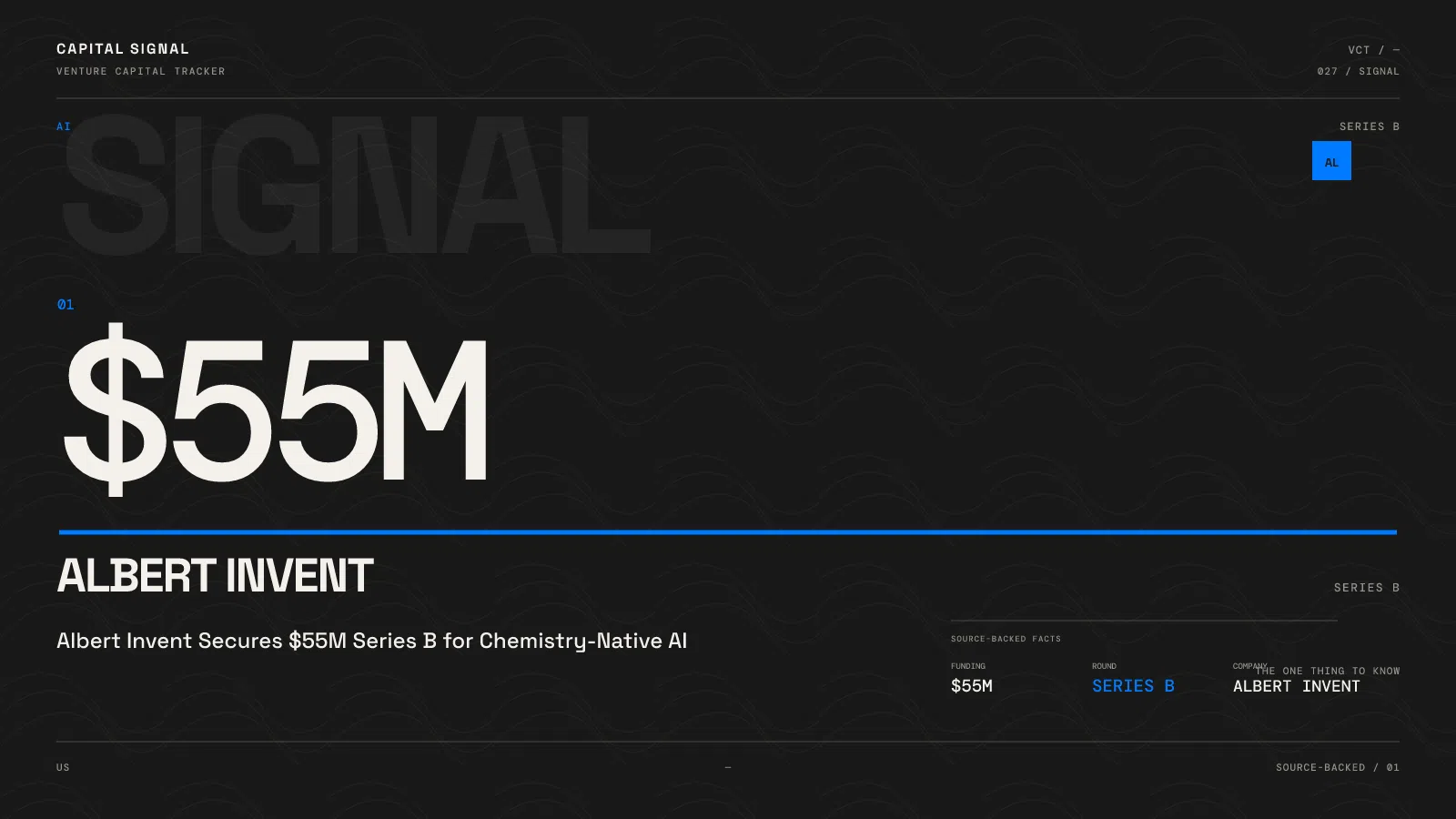
Albert Invent has raised a $55 million Series B led by TCV to expand its chemistry-native AI platform for industrial research and development.
New investors Delta-v Capital, Socium Ventures, HighSage Ventures, Coral Capital and Legion VC participated. Existing investors Coatue, J.P. Morgan Growth Equity Partners, Index Ventures and Applied Ventures also joined.
The round and stage are company-confirmed. A valuation of approximately $340 million was reported by Forbes, citing a person familiar with the transaction; Albert did not disclose valuation terms in its announcement.
Albert Invent Series B: the deal at a glance
| Field | Detail |
|---|---|
| Financing type | Venture equity |
| Stage | Series B |
| Amount | $55 million |
| Valuation | Approximately $340 million, reported |
| Lead investor | TCV |
| New investors | Delta-v Capital; Socium Ventures; HighSage Ventures; Coral Capital; Legion VC |
| Returning investors | Coatue; J.P. Morgan Growth Equity Partners; Index Ventures; Applied Ventures |
| Announced | October 13, 2026 |
| Use of proceeds | Expand chemistry-native AI and shorten industrial R&D cycles |
This is a vertical-AI investment, but the underlying asset is not simply a chatbot for scientists. Albert is trying to become the data and workflow system through which materials companies record experiments, retrieve prior work and decide what to test next.
Why chemistry needs a domain-specific model
Formulation chemistry is unusually sensitive to context. Two materials can look similar in text while behaving differently because of concentration, temperature, process order or interactions with other ingredients.
Albert argues that general-purpose retrieval models miss those distinctions. Its Valence model is trained to recognize chemical composition and function, while Albert OS structures the experimental record around a scientific ontology.
The company says Valence was 45 times more accurate than general-purpose systems on its FormBench retrieval benchmark. That is a company-defined benchmark and should not be treated as independent proof of real-world performance. The more important evidence will be whether customers reduce duplicated experiments, shorten development cycles and launch products faster.
The commercial wedge is institutional memory
Industrial R&D still relies heavily on notebooks, spreadsheets and fragmented laboratory systems. Failed experiments often contain the most useful knowledge, yet they are difficult to find and reuse.
Albert centralizes raw materials, formulations, notebook entries and test results. Ask Albert can search that history, suggest formulation candidates, design experiments and run analyses.
The pitch is economically attractive: every avoided duplicate experiment saves materials, scientist time and development delay. It also gives Albert a path to becoming embedded infrastructure rather than a standalone AI assistant.
Early adoption is promising—but still self-reported
Albert names AkzoNobel, Avient, BASF, Chemours, Clorox, Henkel, Kenvue and Nouryon among its customers and partners. Forbes reported that roughly 2,000 AkzoNobel scientists use the platform.
The company says project creation increased 26-fold year over year, its scientist user base grew sixfold, and workflow creation grew fourfold. Those adoption figures are company-reported and do not reveal contract values, retention or margins.
For investors, the most useful next metrics would be:
- expansion revenue within large enterprise accounts;
- time saved per formulation program;
- conversion from pilots to global deployments;
- gross retention across regulated manufacturers; and
- measurable reduction in duplicate or failed experiments.
Why the reported valuation matters
At a reported $340 million valuation, the $55 million round would represent meaningful but not extreme pricing for a company selling into large industrial R&D budgets.
The valuation is not company-confirmed. Even so, it frames the execution bar: Albert must prove that chemistry-specific AI can produce repeatable savings across multiple industries, not only deliver impressive benchmark results.
The opportunity extends from consumer products and coatings to batteries, semiconductors and advanced materials. The risk is that deployments become consulting-heavy, data integration takes longer than expected, or large customers build similar layers inside existing laboratory systems.
Competitive context
Albert competes with electronic lab notebooks, scientific informatics suites and emerging AI-for-science companies. Benchling and Dotmatics provide adjacent workflow and data infrastructure, while newer companies are trying to automate discovery itself.
Albert’s strongest potential moat is the combination of chemistry ontology, customer-specific experimental data and workflow integration. Its weakness is the complexity of enterprise implementation: every customer has different instruments, data quality, access controls and regulatory requirements.
Bottom line
Albert Invent’s $55 million Series B is a confirmed venture round led by TCV. The approximately $340 million valuation is reported, not company-disclosed.
The round is compelling because chemistry is a large, software-poor market with expensive experimental cycles. The investment case now depends on whether Albert can turn domain accuracy and early customer adoption into durable enterprise expansion and measurable reductions in R&D time.
Follow Venture Capital Tracker in Google
Add VCT as a preferred source to make our venture-capital coverage easier to find in Google Search.
Editorial note: AI tools assisted with research, structure, or drafting. Venture Capital Tracker retains human editorial responsibility for factual accuracy, relevance, and source quality before publication.