Allara Raises $30M to Scale Insurance-Covered Women’s Health
Allara raised $30M in stage-undisclosed venture financing, taking total funding to $75M. Its investment case rests on insurance distribution, longitudinal care and clinician-supporting AI.
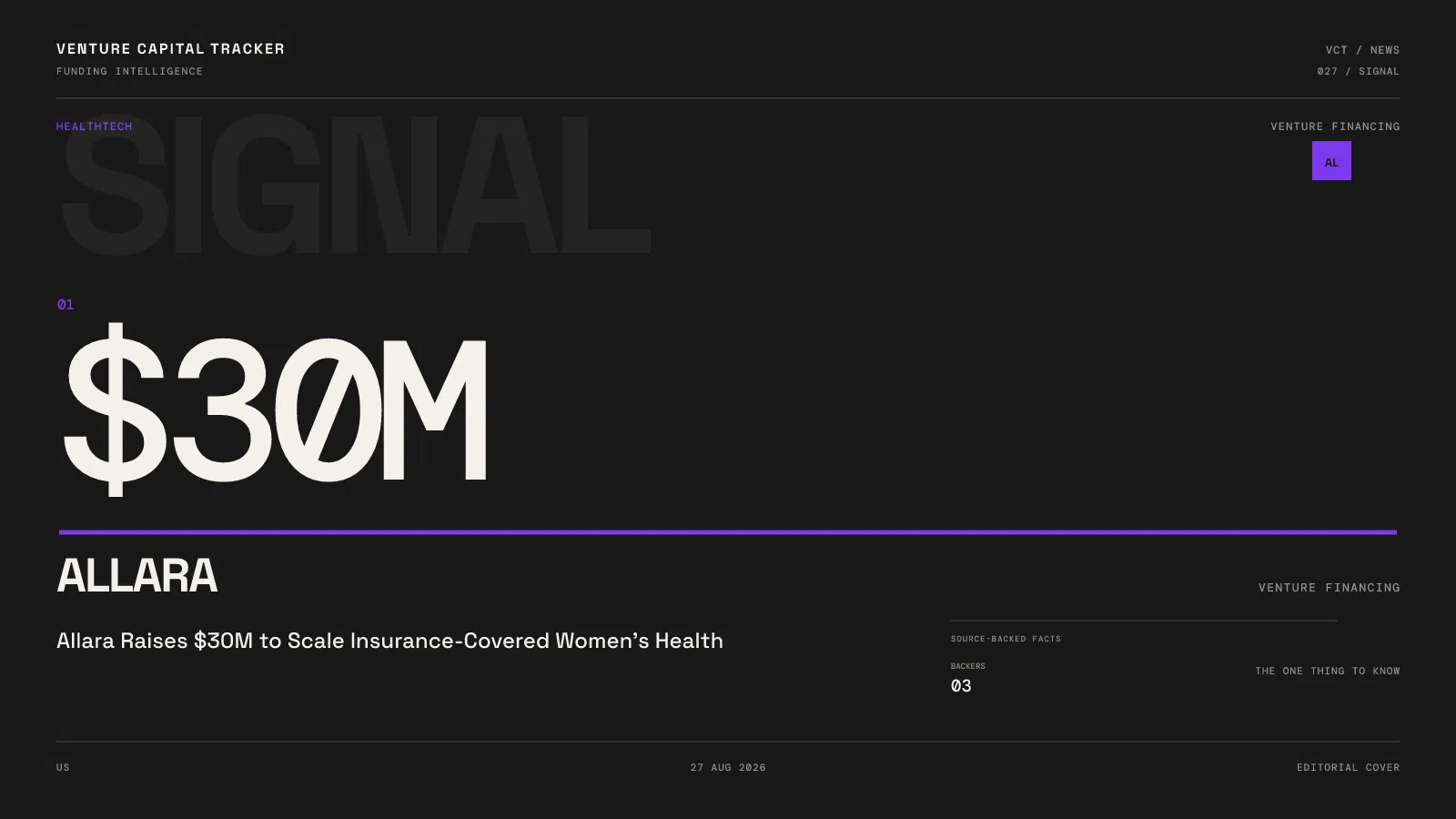
Allara has raised $30 million in venture financing to expand its insurance-covered virtual care platform for hormonal, metabolic and reproductive health.
Existing investors Index Ventures and GV increased their commitments. New investors Camino Partners, Foreground Capital and Family Fund also participated. The financing brings Allara’s total funding to $75 million.
Allara did not disclose the formal round stage or valuation. It should therefore be described as a confirmed venture financing, not automatically labeled a Series C or another numbered stage.
Allara funding: the deal at a glance
| Field | Detail |
|---|---|
| Financing type | Venture equity |
| Stage | Not disclosed |
| Amount | $30 million |
| Total funding | $75 million |
| Valuation | Not disclosed |
| Returning investors | Index Ventures; GV |
| New investors | Camino Partners; Foreground Capital; Family Fund |
| Announced | October 13, 2026 |
| Use of proceeds | Distribution, care expansion, AI capabilities and research |
The company’s strategy combines insurance reimbursement, longitudinal specialty care and AI intended to increase clinician capacity rather than replace physicians.
Why the insurance model matters
Many virtual-care companies begin with cash-pay subscriptions. That can speed launch but limits the addressable population and creates high customer-acquisition pressure.
Allara is building an in-network model through major insurers in most states. Insurance distribution can lower out-of-pocket friction and support longer care relationships, but it adds reimbursement complexity, payer negotiations and administrative cost.
The investment thesis depends on whether Allara can retain patients across multiple needs—PCOS, thyroid conditions, fertility, postpartum care, metabolic health and perimenopause—rather than treating each condition as a separate episode.
If that longitudinal model works, customer lifetime value can rise while the cost of acquisition is spread over a longer relationship.
Care coordination is the product
Allara pairs women’s health clinicians with registered dietitians and combines medical care, nutrition support, prescriptions, laboratory testing and treatment plans.
The company argues that hormonal, metabolic and reproductive conditions are frequently treated in isolation even when they overlap. Its model is designed to give one care team a broader view of the patient.
Allara says it has served more than 120,000 women. Among members with irregular cycles, 69% reported improved menstrual regularity, according to company-provided data. Those outcomes are promising but should be evaluated by cohort, duration and clinical methodology before being generalized.
AI is positioned as capacity infrastructure
Allara is developing technology to synthesize patient information, support clinical decisions and reduce administrative work. It is also working on patient-facing AI inside its app to guide members between visits.
That framing is important. Complex specialty care still depends on licensed clinicians and human relationships. The company says investors questioned whether AI would replace doctors; Allara’s answer is that AI should give clinicians more time and context.
The opportunity is to improve provider capacity without reducing clinical oversight. The risk is that automated guidance creates safety, liability or trust problems—especially when symptoms span multiple conditions and treatment pathways.
Distribution and data could reinforce each other
Allara plans to expand payer and employer partnerships. Broader distribution can bring more patients onto the platform, while a larger longitudinal dataset may improve care protocols and research.
The company is also interested in research involving GLP-1 care, endometriosis and longer-term pregnancy outcomes. That creates potential strategic value, but patient data must be governed with strong consent, privacy and bias controls.
A large dataset is not automatically a moat. It becomes defensible only if it improves outcomes, reduces cost or supports a differentiated care model.
Competitive context
Allara competes with virtual women’s health platforms such as Maven Clinic, Midi Health and Tia, along with general telehealth providers and traditional specialty practices.
Its differentiation is the combination of:
- insurance-covered care;
- clinicians and dietitians working together;
- multiple hormonal and metabolic conditions in one relationship; and
- AI embedded around, rather than instead of, clinical care.
The operating challenge is to scale that integrated model without turning it into a costly services business with software attached.
What investors should watch
The most informative metrics after this financing will be:
- patient retention across multiple care needs;
- contribution margin after clinician and dietitian costs;
- payer reimbursement and denial rates;
- clinical outcomes by condition and cohort;
- provider productivity gains from AI tools; and
- employer and payer partnership growth.
Social reach and patient count can support acquisition, but durable value will come from retained care relationships and reimbursable outcomes.
Bottom line
Allara’s $30 million financing is confirmed venture equity, with the formal stage and valuation undisclosed. The round raises total funding to $75 million.
The company’s stronger story is not simply “AI for women’s health.” It is an attempt to build a reimbursed, longitudinal care platform in which AI expands clinician capacity. The next proof point is whether that model can scale outcomes and economics together.
Follow Venture Capital Tracker in Google
Add VCT as a preferred source to make our venture-capital coverage easier to find in Google Search.
Editorial note: AI tools assisted with research, structure, or drafting. Venture Capital Tracker retains human editorial responsibility for factual accuracy, relevance, and source quality before publication.