· Venture Capital · 21 sources · Verified
Biotech Funding 2026: Latest Startup Rounds, Investors and Venture Deals
A dated biotech funding tracker covering notable 2026 rounds, investor syndicates, AI drug discovery, European deals and the difference between equity, debt, licensing and fund closes.

Editorial team
Biotech investment in 2026 is not a single story of rising or falling venture capital. Large late-stage rounds, smaller seed financings, pharma-backed investments and alternative clinical-asset funds are all appearing in the same market. Treating them as interchangeable makes funding data less useful.
This curated funding tracker is current through November 13, 2026. It focuses on therapeutic biotech, AI drug discovery and relevant biological platforms. The dates are the dates of public announcements unless a company disclosed a separate closing date; announcements and legal closings are not always identical.
Recent biotech funding rounds: November 2026
| Announced | Company and sector | Financing | Named investors / stage of development |
|---|---|---|---|
| Nov 12 | Biomatter — AI enzyme engineering | $18M Series A | Astanor-led; protein-design and industrial-biotechnology platform, included as an adjacent biotech rather than a drug developer |
| Nov 11 | VectorY Therapeutics — ALS/neurodegeneration | €74.5M financing package | Invest-NL, European Investment Bank, Angelini Ventures and returning investors; mixed instruments, not all equity |
| Nov 11 | Neurosterix — neuropsychiatry | $105M Series B | Syndicate not fully disclosed in initial reporting; supports Phase II planning for the M4 modulator NTX-253 |
| Nov 10 | Oyster Therapeutics — Alzheimer's/protein degradation | $60M Series A-2 | 4BIO Capital, Lilly, CE Ventures and others; renamed from Kesmalea |
| Nov 10 | Switchpoint Bio — blood epigenomics | $5.3M pre-seed | Predominantly Treehouse Delmar Investments; assay for assessing biological treatment effects, not a therapeutic drug round |
| Nov 9 | Delix Therapeutics — neuroscience | $100M Series C | Co-led by J&J Innovation–JJDC and SV Health Investors' Dementia Discovery Fund; future Phase IIb study |
| Nov 9 | SRTD Biotech — targeted RNA medicines | €31.5M seed | Mérieux Equity Partners, NRW.BANK, Boehringer Ingelheim Venture Fund and others; preclinical pipeline |
| Nov 5 | T-Therapeutics — oncology/immunology | $133M Series B | Advent Life Sciences and British Business Bank co-led; funds clinical proof-of-concept programs |
| Nov 5 | Alethio Therapeutics — blood cancers | $90M Series A | Sofinnova Partners and RA Capital co-led; advances ATX-011 and additional programs |
These are new announced amounts, not company lifetime funding. For example, Estuary's October launch described $103 million total, comprising a $93 million Series A plus $10 million seed funding; only the $93 million belongs in its 2026 Series A row.
The VectorY transaction requires particular care: the €74.5 million headline includes a €30 million European Investment Bank convertible loan, a €7 million Invest-NL equity investment and additional investor financing. It should not be labeled an all-equity Series B or counted as €74.5 million of pure venture equity.
Selected October and September rounds
| Announced | Company | New financing | Lead investor / purpose |
|---|---|---|---|
| Oct 23 | Pathos AI | $237M Series E | Bristol Myers Squibb led; AI-supported oncology pipeline |
| Oct 16 | Estuary Biotherapeutics | $93M Series A | RA Capital led; gene therapy for inherited kidney disease |
| Oct 15 | OMass Therapeutics | $310M Series C | Bain Capital Life Sciences, Forbion, Novo Holdings co-led; endocrinology/immunology clinical programs |
| Sep 30 | AnaCardio | €62.5M Series B | Advances Phase IIb heart-failure medicine AC01 |
| Sep 24 | BigHat Biosciences | $75M Series C | DFJ Growth and Premji Invest; AI-designed protein therapeutics |
| Sep 23 | Enveda | $311M Series E | Catalio Capital Management led; advances clinical-stage medicines discovered from natural chemistry |
| Sep 23 | Basecamp Research | $140M Series C | S32 led; therapeutic models and experimental development |
| Sep 9 | Encoded Therapeutics | $275M Series F | Supports Dravet syndrome pivotal work and manufacturing |
| Sep 8 | Moonwalk Biosciences | $70M Series B | Advances RNA interference pipeline for obesity and metabolic disease |
The rows above are a selected, verified editorial set, not every global financing. A drug program described as “advancing” toward a study has not necessarily started enrolling patients.
The biggest AI-associated company rounds earlier in 2026
For context, several of the largest disclosed transactions happened before the latest quarter. These are still 2026 company equity rounds:
| Date | Company | Round | Named investors |
|---|---|---|---|
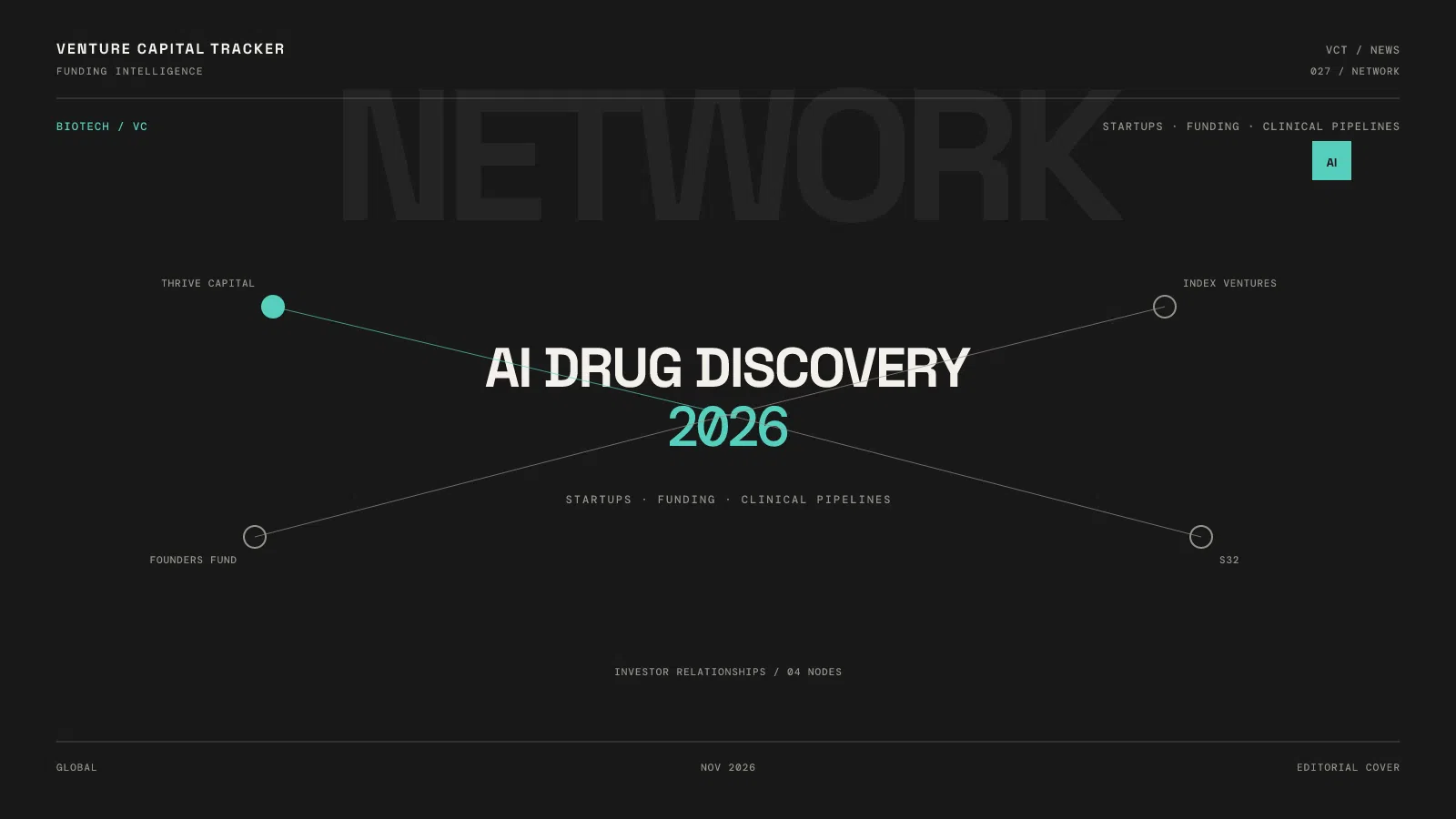
| May 12 | Isomorphic Labs | $2.1B Series B | Thrive Capital led; Alphabet, GV, MGX, Temasek and others |
| June 2 | NewLimit | $435M Series C | Founders Fund led; Thrive, Greenoaks and others |
| July 14 | Chai Discovery | $400M Series C | Index Ventures and other investors |
The selected examples above illustrate that AI drug discovery can attract outsized rounds. They should not be taken as proof that AI represents the majority of biotech investment or that model-first companies have achieved superior clinical results.
Compare the companies' business models and clinical maturity in VCT's AI drug-discovery guide.
How does 2026 compare with the broader financing market?
J.P. Morgan's October 2026 biopharma deal report, built on DealForma data through September 30, provides a useful industry-wide baseline.
| Biopharma market measure | First nine months of 2026 |
|---|---|
| Venture rounds | 385 |
| Venture capital raised | $23.9B |
| Venture funding in Q3 alone | $6.7B |
| Venture funding in Q2 alone | $9.9B |
Venture funding was slower in the third quarter than in the second, even as other transaction channels remained active. A handful of very large AI rounds therefore cannot tell the full story of what happened to the median early-stage biotech seeking a Series A.
The larger capital markets provide potential exits and financing routes, but they also have different definitions:
- M&A: $138.9 billion in biopharma acquisition upfront consideration through Q3, across 113 deals.
- Licensing: $221.1 billion of announced R&D agreement value, but only about 6% of the headline value was upfront cash.
- IPOs: $7.5 billion of biopharma public-offering proceeds through Q3, across 22 offerings.
Those measures describe different flows of money; they should not be summed together as a total VC market.
For why large drugmakers depend on new medicines and what that means for startups, see the $2 trillion pharmaceutical market investment breakdown.
Which funds are financing the next generation of biotechs?
It is important to distinguish a venture fundraising event from an investment into a biotech company.
| Date | Fund manager / investment vehicle | Amount | What it finances |
|---|---|---|---|
| Oct 6, 2026 | Forbion Ventures VIII and Growth Opportunities IV | €2.3B combined fundraise | Early and later-stage specialist life-sciences investments |
| Oct 28, 2026 | Formation Bio Drug Development Accelerator Fund | $600M in commitments | Individual clinical-stage drug programs in separate asset companies |
| Apr 2026 | Jeito Capital Fund II | More than €1B | Growth and clinical-stage biopharma investments |
Formation's fund is particularly unusual: it backs individual drug assets and their associated entities, rather than being simply another Series E investment into Formation Bio. Its 10–15-drug deployment plan is prospective, and the terms and economics for the individual assets are not all disclosed.
Forbion and Jeito highlight a different market dynamic: European investment managers are raising substantial pools of specialized capital for therapeutic companies that may need much larger follow-on checks than typical software startups.
What the funding mix tells founders and investors
Large rounds are clustered around specific milestones
Late-stage companies can raise hundreds of millions because conducting randomized trials, scaling manufacturing and reaching registrational data can cost far more than proving an early discovery. The investor is not necessarily paying for a software model. It may be financing a very specific human trial or a portfolio of clinical assets.
OMass is funding endocrinology and immunology programs; T-Therapeutics is taking novel T-cell-receptor-based programs toward clinical proof of concept; Delix intends to run additional neuroscience studies. These are therapeutics financing events with different biological hypotheses.
The sub-$50 million segment matters, too
Large funding trackers often apply minimum thresholds. Fierce Biotech's 2026 tracker, for example, generally includes rounds of $50 million or more. That provides an efficient view of headline financings but can omit interesting company formations and early platform investments.
SRTD Biotech (€31.5 million seed) and Switchpoint Bio ($5.3 million pre-seed) show why smaller events deserve inclusion. They do not yet have the same clinical evidence or financial resources as mature drug developers, but their technologies may become valuable research inputs, future partnered assets or acquisition targets.
Strategic pharmaceutical participation is a signal, not an exit
Lilly, Johnson & Johnson and Bristol Myers Squibb are appearing as investors or financing partners in several recent deals. That can indicate access to potential strategic customers and relevant industry expertise. It is not a guarantee of future licensing income, acquisition consideration, clinical success or regulatory approval.
Investors should distinguish an ordinary venture investor, a strategic corporate venture arm, a development collaborator, and the eventual commercial rights-holder.
Regional concentration is changing
The United States remains home to many of the largest AI-biotech financings, but recent UK, German, Dutch and Chinese transactions show that the market is not exclusively American. International drug asset licensing also creates competition: European or US startups increasingly compete with assets generated across several geographies.
The practical investment issue is not country alone. It is intellectual-property control, availability of clinical data, jurisdiction-specific regulatory requirements and a credible partner or commercialization plan.
How VCT records biotech funding
The objective of this tracker is to make each transaction reconstructable rather than maximize the number of impressive-looking dollar figures.
- One event, one date convention: the table uses the public announcement date unless explicitly noted; a legal close may precede it.
- New money vs. lifetime funding: a $93 million Series A following a $10 million seed is not a $103 million Series A.
- Equity vs. debt: loans, grants, convertible instruments and mixed packages are labeled rather than recategorized as venture equity.
- Company round vs. fund closing: an investment manager's capital commitments are shown separately from a startup equity round.
- Licensing: upfront payments are separated from future milestones; a billion-dollar potential deal is not a billion-dollar venture investment.
- Currencies: EUR, GBP, RMB and USD stay in their announced currencies; amounts in different currencies are not added without a dated FX methodology.
- Research coverage: first-party issuer announcements take precedence; trusted reporting is used when primary disclosures are incomplete. Missing investors or valuations are left undisclosed instead of estimated.
Frequently asked questions
How much biotech venture capital was raised in 2026? The latest complete aggregate dataset cited here covers January–September, not the entire year: $23.9 billion across 385 biopharma rounds according to J.P. Morgan and DealForma.
Are the entries all AI companies? No. This is a biotech funding tracker. It includes AI-enabled drug developers, conventional therapeutics, RNA platforms, rare-disease companies and selected adjacent biological infrastructure businesses. The separate AI-drug-discovery company guide is narrower.
Does a large financing make a drug more likely to work? No. Capital can finance more experiments and trials, but it does not remove biological uncertainty. Clinical data, safety, differentiation and regulatory progress remain central.
Is this a complete realtime database? No. This page is a dated editorial snapshot, with transaction-level links to VCT company records and primary sources. The site's investment feed and startup profiles may include additional deals outside the selected rows.
Last verified November 13, 2026. Funding amounts are issuer- or filing-disclosed unless otherwise specified; prospective drug outcomes are not verified clinical successes. This page provides market information, not investment advice.
- biotech
- biotech-life-sciences
- biopharma
- +1 more
Editorial note: AI tools assisted with research, structure, or drafting. Venture Capital Tracker retains human editorial responsibility for factual accuracy, relevance, and source quality before publication.