· Venture Capital Tracker Editorial
Forbion Raises €2.3B Across Two Biotech Funds
Forbion raised €2.3 billion across Ventures Fund VIII and Growth Opportunities Fund IV, giving the two vehicles capacity to finance about 30 biotechs.
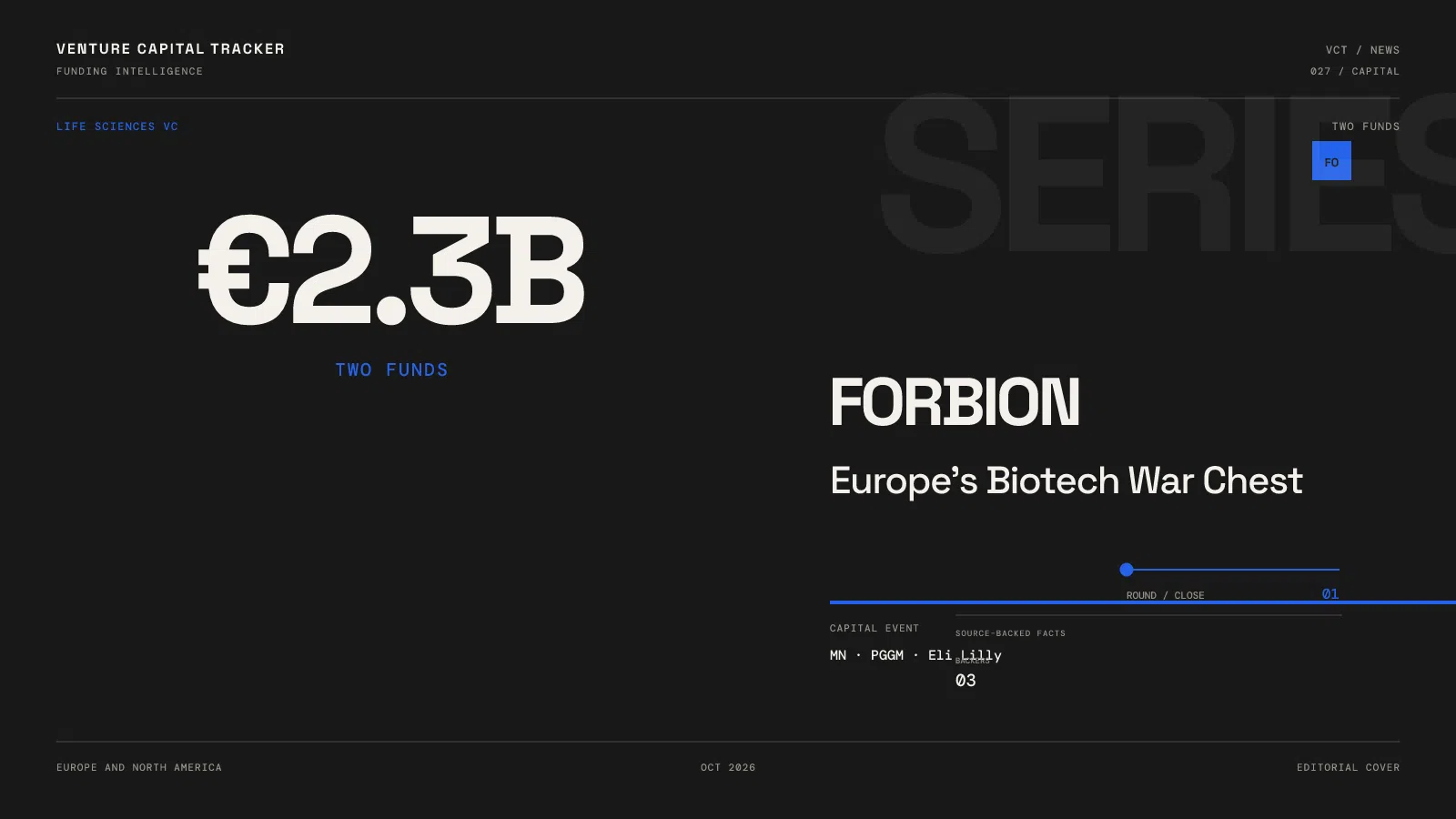
Forbion has raised €2.3 billion, approximately $2.6 billion, across two new life-sciences funds—its largest fundraising to date and one of the largest biotechnology venture-capital raises of the past five years.
The capital is divided between Forbion Ventures Fund VIII and Forbion Growth Opportunities Fund IV. Forbion disclosed only the combined amount, so €2.3 billion should not be described as the size of either individual fund.
Forbion's two-fund close at a glance
- Aggregate commitments: €2.3 billion
- Vehicles: Forbion Ventures Fund VIII and Forbion Growth Opportunities Fund IV
- Portfolio capacity: Approximately 30 companies across both funds
- Assets under management: Approximately €7.5 billion
- Selected LPs: MN, PGGM, KfW Capital, Kauffman Foundation and Eli Lilly
- Status: Firm-announced and confirmed
Forbion says the fundraising exceeded its target and that both vehicles have already started investing. The individual allocations, management fees and fund-level targets were not disclosed in the announcement.
Two strategies, not one fund
Forbion Ventures VIII will invest in therapeutics-focused biotech companies, including existing startups and businesses formed around promising drug assets and experienced teams. Growth Opportunities IV is intended primarily for later-stage biopharma companies in Europe and North America.
The split lets Forbion invest across company formation, clinical development and pre-commercial growth without forcing all opportunities into one risk profile. Early therapeutics investments may take many years to produce clinical evidence. Growth-stage investments can deploy larger checks into businesses with more mature programs.
For limited partners, the two vehicles provide different exposure to development risk and duration. Forbion did not disclose how the €2.3 billion is divided between them, so any estimate of individual fund size would be speculative.
Why this close matters for European biotech
European researchers generate significant drug-discovery science, but local companies often struggle to raise the large rounds required for clinical trials. Capital constraints can push businesses toward US investors, acquirers and stock exchanges.
Forbion says the new vehicles create substantial investment capacity during a scarce funding market. The firm plans to finance approximately 30 companies. It has already invested from the vehicles, including in Sling Therapeutics and Solstice Oncology.
The LP base also sends a useful signal. Dutch pension managers MN and PGGM, Germany’s KfW Capital, the Kauffman Foundation and Eli Lilly combined institutional, public and strategic capital. Independent reporting says roughly 60% of commitments came from Europe and 40% from North America.
The raise does not solve Europe’s biotech-financing gap by itself. Thirty companies are a small portion of the continent’s pipeline, and late clinical development can consume hundreds of millions per drug. But a specialist manager closing more than €2 billion shows that large pools can still form around European life-sciences expertise.
Scale brings portfolio-construction pressure
Forbion now manages approximately €7.5 billion. The larger capital base gives the firm more ability to support winners through expensive trials, but it also creates pressure to deploy bigger checks.
Biotech venture returns are highly concentrated. A few successful medicines can repay a fund, while clinical failures can erase years of investment. The firm must maintain scientific selectivity while putting a larger pool of capital to work.
The two-vehicle structure can help. Ventures VIII can build and finance earlier companies, while Growth Opportunities IV can invest after technical risk has fallen. It also creates potential overlap: portfolio companies may receive capital from more than one Forbion strategy, making allocation policies important for LPs.
What to watch
- Capital allocation: The eventual size and deployment pace of each vehicle.
- Company creation: How many of the 30 planned investments are new companies built by Forbion.
- Follow-on capacity: Whether the funds can support expensive Phase 2 and Phase 3 programs.
- Liquidity: IPOs, licensing deals and acquisitions in a difficult biotech exit market.
- European retention: Whether portfolio companies keep research, management and listings in Europe.
The bottom line
Forbion’s €2.3 billion close is a major vote of confidence in specialist biotech investing, especially in Europe. The headline is an aggregate across two funds, not one enormous vehicle. Its real significance is strategic: Forbion can now finance companies from formation through later-stage development, giving European science a larger pool of patient capital before founders need to look elsewhere.
Editorial note: AI tools assisted with research, structure, or drafting. Venture Capital Tracker retains human editorial responsibility for factual accuracy, relevance, and source quality before publication.