· Investment Strategies · 3 sources
Skan AI Raises $63M Series C for the Enterprise Context Graph of Work
Cathay Innovation and Dell Technologies Capital co-led Skan AI’s $63M Series C — Citi and State Farm Ventures joined as customers-turned-investors — to map how work actually runs before agents automate it.

Editorial team
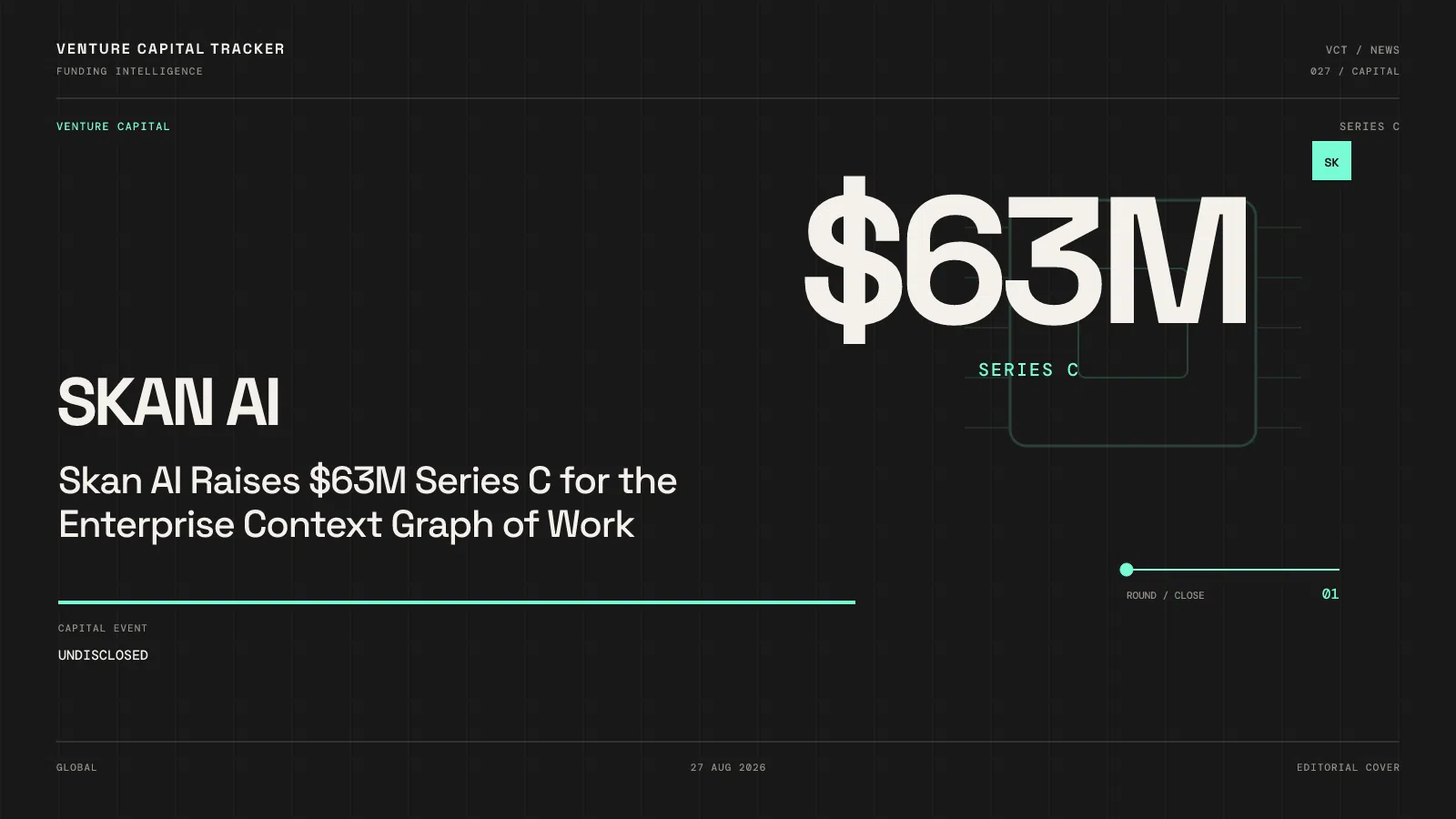
Skan AI raised $63 million Series C, announced August 12, 2026, co-led by Cathay Innovation and Dell Technologies Capital. Citi Ventures, Bloomberg Beta, State Farm Ventures, and Wipro Ventures participated. Total funding is about $120M (press).
Deal details & investors
Funding event
Skan AI
Led by Cathay Innovation , Dell Technologies Capital
Key facts
- Company
- Skan AI (Menlo Park) — context graph of enterprise work
- Round
- $63M Series C
- Date
- August 12, 2026
- Co-leads
- Cathay Innovation, Dell Technologies Capital
- Participants
- Citi Ventures, Bloomberg Beta, State Farm Ventures, Wipro Ventures
- Continuity
- Cathay led A; Dell Tech Capital led B ($40M, 2022); Citi across rounds
- Product moment
- GA of Skan AI Blueprint + Skan AI Agents (+ existing Intelligence)
- GTM tell
- State Farm & Citi were customers before becoming investors
Who uses the product — and for what job
Users: COOs, transformation leads, and AI platform owners in banks, insurers, and health systems who are past the chatbot pilot.
Job: see how work actually moves across apps (not how Visio says it should), then deploy agents against that observed map.
Without that graph, “enterprise agents” guess. With it, automation has a ground truth.
Why now
- Agent budgets are real; ROI questions are stuck on process truth.
- Returning leads (Cathay + Dell) plus customer-VCs (Citi, State Farm) is a classic “platform is working” Series C shape.
- Blueprint + Agents GA turns observation into a full deploy loop — discover → model → automate.
- Irony the CEO flags: automated work needs more observation than human work, not less.
Why this syndicate — portfolio fit
Cathay and Dell Technologies Capital have bookended Skan for years — thesis continuity, not a tourist lead. Citi and State Farm convert production usage into capital. Wipro adds services-channel adjacency; Bloomberg Beta adds data/enterprise network.
Likely founder rationale: raise with the same institutions that already understand the observation thesis, while customer investors de-risk enterprise sales cycles.
| Investor type | What they bring |
|---|---|
| Cathay / Dell Tech Capital | Multi-round conviction + infra/enterprise networks |
| Citi / State Farm Ventures | Design partners who already bought |
| Wipro Ventures | SI/channel path into global accounts |
(No VCT /fund/ pages for Cathay or Dell Tech Capital yet — covered editorially.)
Competitive map
| Player | Lane |
|---|---|
| Celonis / process mining | Event-log mining; different capture model |
| Task mining / RPA vendors | Automation without full agent context graph |
| Generic agent builders | Execution without observed enterprise process truth |
| Sapiom | Agent cost/routing control plane — complementary |
Market signal
Customer-led capital at Series C beats logo slides. If a fourth of the Fortune 50 claim holds even directionally, work-context is graduating from “nice analytics” to AI infrastructure.
When not to use this as a template
- Wrong if observation creates privacy/works-council blockers you have not modeled.
- Wrong if the graph never reaches production agents (insights-only shelfware).
- Wrong if you pitch this as a chatbot wrapper.
Practical takeaway
- Founders (enterprise AI): Sell the map before the agent.
- Investors: Prefer rounds where customers write checks — literally.
- Operators: Inventory real process variance before you buy agent seats.
Follow Venture Capital Tracker on Google
Add VCT as a preferred source to see more of our venture-capital reporting in Google Search.
Editorial note: AI tools assisted with research, structure, or drafting. Venture Capital Tracker retains human editorial responsibility for factual accuracy, relevance, and source quality before publication.