· Investment Strategies · 4 sources · Updated
Sapiom's $35M Series A: Routing Layer for a Trillion AI Agents
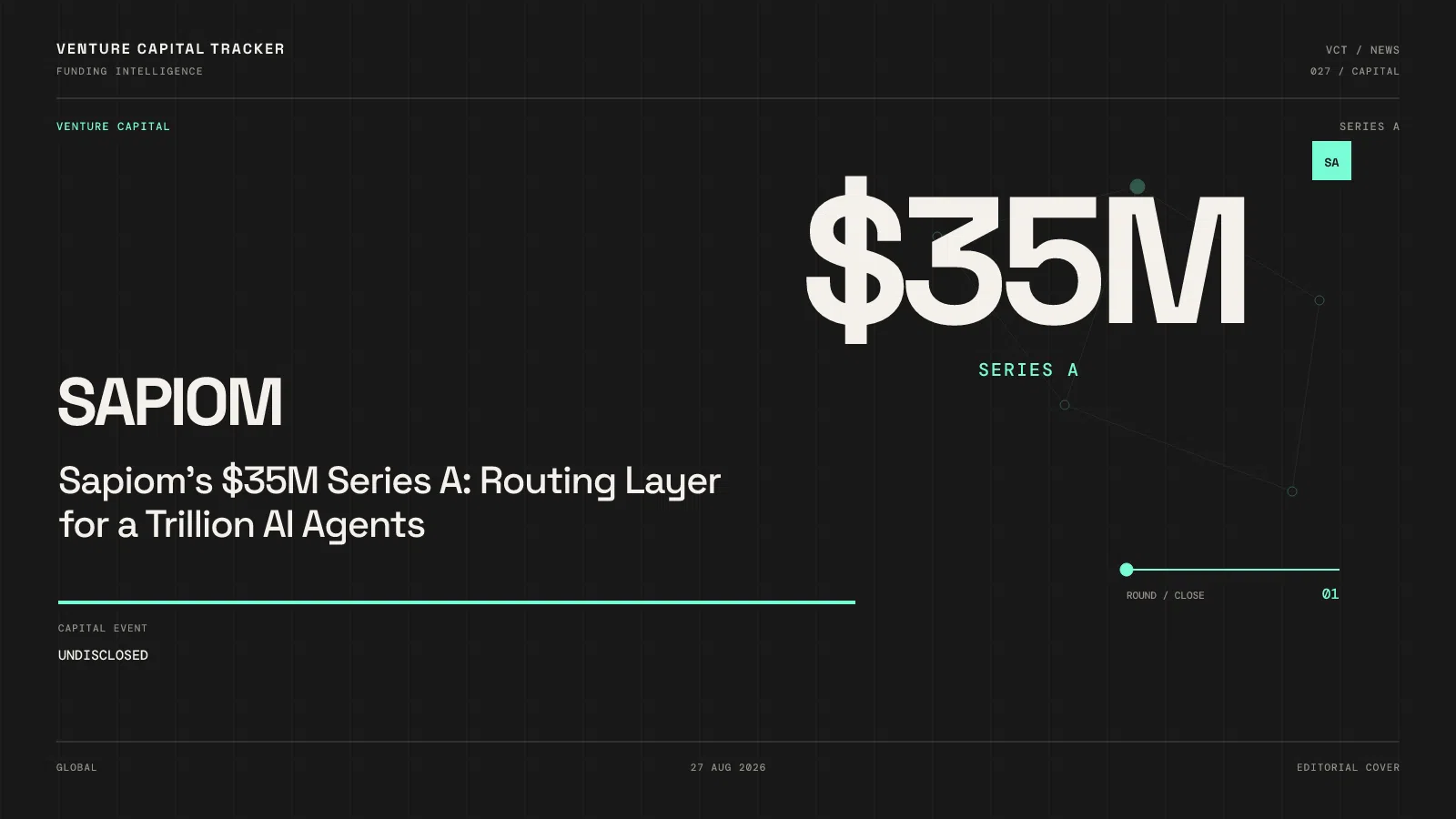
Dragonfly led Sapiom’s $35M Series A (total $50M) with Accel, Menlo, Coinbase Ventures, and Anthropic among backers — infrastructure that picks the cheapest reliable path for each agent step.

Editorial team
Funding event
Sapiom
Led by Dragonfly
Sapiom raised a $35 million Series A led by Dragonfly (announced early August 2026), with participation from Accel, Gradient, Coinbase Ventures, and returning investors including Menlo Ventures, Okta Ventures, Anthropic, and Array Ventures. Total funding: $50 million. Dragonfly’s Haseeb Qureshi joins the board.
Key facts
- Company
- Sapiom (San Francisco; founded 2025 by Ilan Zerbib)
- Round
- $35M Series A · ~$50M total
- Date
- August 5–6, 2026 coverage
- Lead
- Dragonfly
- Directory investor
- Menlo Ventures (returning)
- Also named
- Accel, Gradient, Coinbase Ventures, Okta Ventures, Anthropic, Array, Operator Collective, Formus, VanEck
- Traction cited
- 270M+ transactions; 100k+ agent runs/day
- Prior
- $15M seed led by Accel (~6 months earlier)
Who uses the product — and for what job
Users: platform teams and agent builders who have moved past a single model API key.
Job: for each agent step, pick an allowed path across models, compute, tools, and services under constraints — cost, quality, latency, reliability, and company policy — before execution burns budget.
This is not another agent framework. It is a runtime control plane: budgets and permissions enforced; routing decided in real time. When you run “a trillion agents,” the bottleneck becomes economics and governance, not prompting.
Why now
- Agent workloads multiply tokens vs chat copilots.
- Enterprises deploy dozens of agents with different SLAs — one GPT-class default is wasteful.
- Seed-to-Series-A in ~6 months with Accel → Dragonfly signals the category is heating while still early.
Why Menlo (and this syndicate) — portfolio fit
- Menlo Ventures: Comfortable with infra that sits under enterprise software. Sapiom is the spend/policy layer for agents — closer to API gateway / observability DNA than to a vertical SaaS app.
- Dragonfly: Crypto/AI-fluent lead writing the board seat — useful when routing spans models and on-chain/tool ecosystems (Coinbase Ventures also present).
- Accel: Seed lead defending ownership into A.
- Anthropic: Strategic signal that model providers may prefer an open routing layer to opaque shadow IT — or simply want visibility into how agents consume models. Label as judgment.
Likely founder rationale: keep Accel/Menlo continuity, add a lead that understands multi-provider agent economics, and welcome a frontier lab that validates the category even if incentives look paradoxical.
Competitive map
| Player | Difference |
|---|---|
| LiteLLM / open routers | Open-source routing; less enterprise policy/budget plane |
| Cloud AI gateways (Bedrock, Azure AI) | Strong inside one cloud; weaker multi-vendor agent runtime |
| Observability suites | See spend after the fact; Sapiom claims pre-execution control |
| In-house routers | Fine at 3 models; brittle at fleet scale |
Market signal
$35M Series A 11 months after founding for agent runtime economics says VCs believe the next AI infra fortune is in controlling agent opex, not only training clusters.
Practical takeaway
- Founders: Instrument cost-per-successful-task, not tokens alone.
- Investors: Diligence whether Sapiom’s moat is data network effects on routing or just integration surface area.
- Operators: Put budgets and allow-lists in front of agent fleets before your CFO finds the OpenAI invoice.
Sources
- FinSMEs: finsmes.com
- The Next Web: thenextweb.com
- Morningstar/Business Wire: morningstar.com
- Related batch: 2026 August 6 Investment News Cyber Defense Agents
Follow Venture Capital Tracker on Google
Add VCT as a preferred source to see more of our venture-capital reporting in Google Search.
Last updated:
Editorial note: AI tools assisted with research, structure, or drafting. Venture Capital Tracker retains human editorial responsibility for factual accuracy, relevance, and source quality before publication.