Pathway AI Funding: $30M Seed Funding at a $500M Valuation
Pathway AI has raised additional funding at a $500 million valuation, bringing total seed funding to $30 million. Here are the investors, team, BDH architecture, and what is still unconfirmed.
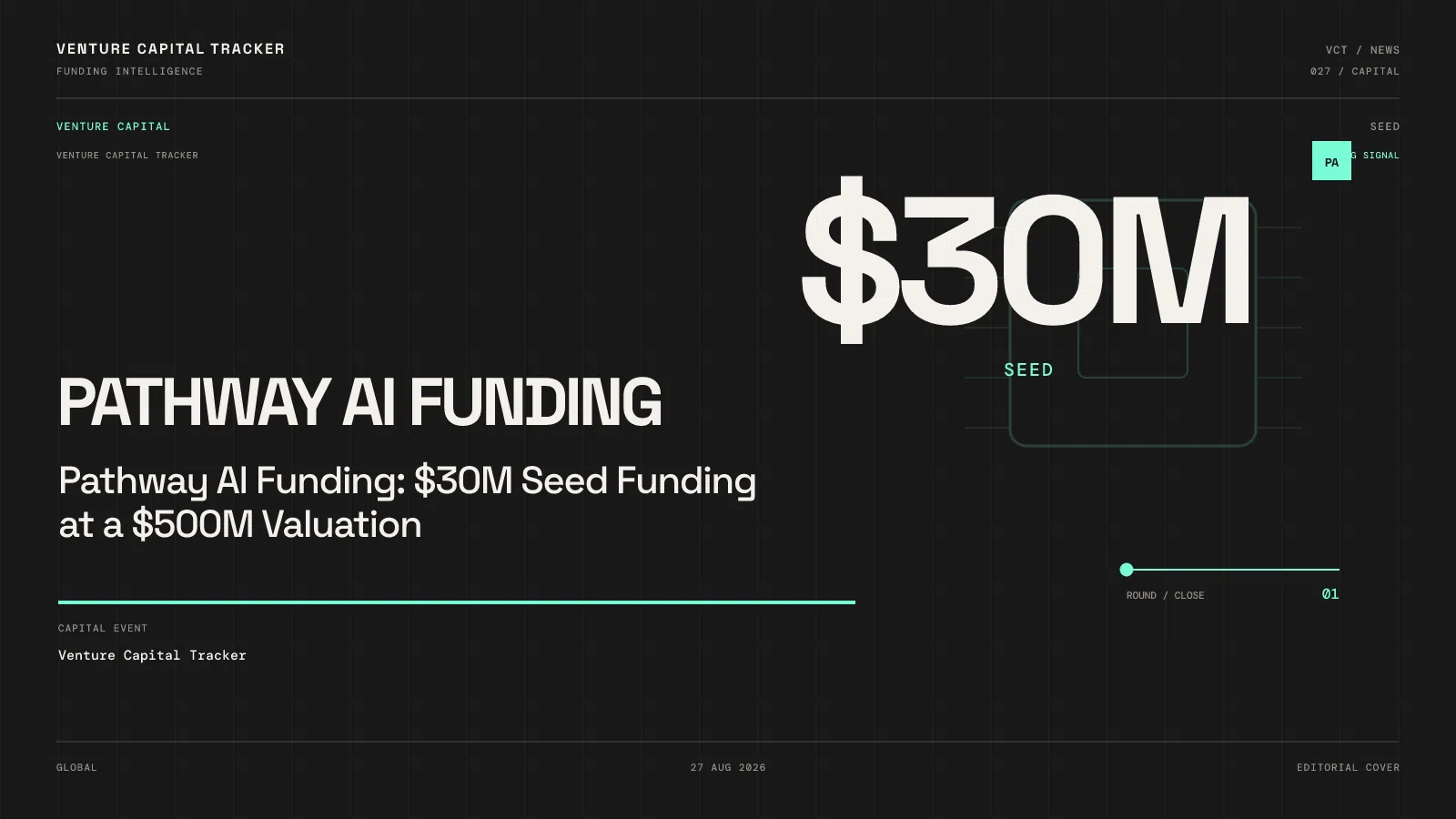
Pathway AI funding, in one sentence: Pathway announced additional financing at a $500 million valuation, bringing its total seed funding to $30 million. The company named Id4 Ventures, TQ Ventures, Red Bridge Ventures, Kadmos Capital, WS Investment Co., and angel investor Jonathan Frankle as participants.
The wording matters. Pathway did not say it had just raised a new $30 million round. Its August 11, 2026 announcement says the additional financing brought cumulative seed funding to that amount. That makes $500 million the latest disclosed private valuation mark, not a public stock-market value.
Pathway AI funding and valuation at a glance
| Question | Answer | Evidence or caveat |
|---|---|---|
| Latest financing | Additional funding announced August 11, 2026 | Pathway described the capital as additional funding rather than a newly named priced round |
| Total funding | $30M in seed funding | Company-reported cumulative total |
| Latest valuation | $500M | Private financing valuation, not a public market cap |
| Lead investor | Not specified by Pathway | The announcement lists participating investors but does not identify a lead |
| Capital use | Mostly more compute capacity | Pathway specifically referenced new GB300s |
| Headquarters | Palo Alto, California | Pathway media kit |
| Public stock | None | Pathway remains private |
Who invested in Pathway AI?
Pathway’s financing announcement lists these investors and backers:
- Id4 Ventures
- TQ Ventures
- Red Bridge Ventures
- Kadmos Capital
- WS Investment Co., the investment arm of Wilson Sonsini
- Jonathan Frankle, an angel investor and Chief AI Scientist at Databricks
The public announcement does not provide each investor’s ownership percentage, check size, liquidation preferences, board rights, or the exact amount of the additional financing. Those are normal limits of private-company funding disclosures. A named participant is not automatically the lead investor or a controlling shareholder.
Pathway says the new capital will be used mostly to increase compute capacity. That is a useful clue about the business: the next milestone is not simply hiring or distribution. It is putting enough hardware behind training and evaluating a different model architecture.
What does Pathway AI do?
Pathway is a frontier AI lab developing BDH, which stands for the company’s post-Transformer architecture. Pathway’s thesis is that an AI system should not have to choose between reasoning and memory. Its public technical material describes BDH as a design in which memory, adaptation, and inference are more closely integrated instead of treating memory as an external patch around a conventional language model.
In practical terms, Pathway is pursuing models that can:
- retain useful state across interactions;
- adapt more continuously than a static model;
- reason through problems with less dependence on ever-longer context windows; and
- operate efficiently enough to make new hardware economics possible.
These are company goals and architectural claims, not proof that BDH has replaced the Transformer in production. Pathway has published research and benchmark material, including a 150-million-parameter BDH model, but early benchmark results should be read as model-specific evidence rather than a guarantee of commercial superiority.
Pathway’s own BDH conclusion says the architecture is intended to support memory, continual learning, and reasoning. Its media kit describes BDH as a post-Transformer system built around persistent state, sparse activity, and local interaction. The distinction between a research direction and a proven product is important for investors evaluating the round.
Who founded Pathway AI?
Pathway is led by co-founder and CEO Zuzanna Stamirowska. The company’s public team materials also highlight:
- Jan Chorowski, CTO, an AI researcher who worked with Geoff Hinton at Google Brain;
- Adrian Kosowski, CSO, a computer scientist and quantum physicist; and
- advisors including Łukasz Kaiser, who co-invented the Transformer architecture.
The team gives Pathway credibility in the exact area it is trying to challenge: model architecture, learning dynamics, and the relationship between reasoning and memory. It does not remove the core venture question, however: can the research become a repeatable model and a product that customers will pay to run?
Why the $500M valuation is notable
At seed stage, a $500 million valuation is a strong statement about expected technical leverage. Investors are effectively underwriting the possibility that a better architecture can change the cost, capability, or reliability curve of AI systems—not merely that Pathway can sell another application layer on top of existing models.
The financing also reflects a capital-intensive roadmap. Compute capacity, model training, evaluation, and hardware access can consume significant capital before a frontier lab has predictable revenue. Pathway’s reference to GB300s suggests that at least part of the capital is going directly into the infrastructure needed to test its thesis.
That creates a simple diligence checklist:
- Benchmark quality: Are improvements measured on broad, reproducible tasks or only selected demonstrations?
- Inference economics: Does the architecture reduce costs at useful quality levels after full serving overhead is included?
- Continual learning: Can the system adapt without introducing instability, security problems, or catastrophic forgetting?
- Product wedge: Which developer, enterprise, or research workflow gets value first?
- Capital intensity: How much additional compute is required before the model is commercially competitive?
Pathway AI is not the medical Pathway app
The query Pathway AI is unusually ambiguous. Google also surfaces Pathway Medical, Doximity’s clinical-reference acquisition, career-planning products, and Google’s unrelated Pathways architecture. This article covers Pathway, the Palo Alto AI lab building post-Transformer models, at pathway.com.
That distinction is useful for readers and for search engines. A page that mixes the AI lab with the medical app may attract impressions but fail the underlying intent. The funding, $500 million valuation, BDH research, and investors above all refer to the frontier AI company.
Is Pathway AI publicly traded?
No. Pathway is a private company. There is no confirmed Pathway stock ticker, IPO filing, or public-market price in the company’s financing announcement. A private valuation is a negotiated financing reference and should not be confused with a liquid market capitalization.
Bottom line
Pathway is one of the more interesting new AI financing stories because the round funds a technical architecture thesis rather than another thin application wrapper. The company says additional financing at a $500 million valuation brought total seed funding to $30 million, with capital going largely toward compute.
The investment case is still a research-to-product conversion problem. Pathway has a credible technical team and a clear position on memory, adaptation, and reasoning. The next evidence to watch is not another valuation headline; it is whether public benchmarks, inference economics, and customer use cases validate the post-Transformer bet.
_Funding figures and company claims are presented for research and educational purposes. A private financing valuation is not investment advice or a guarantee of future performance._
Sources
- ai-ml
- startup-funding
- venture-capital
- +2 more
Last updated:
Editorial note: AI tools assisted with research, structure, or drafting. Venture Capital Tracker retains human editorial responsibility for factual accuracy, relevance, and source quality before publication.