· Venture Capital Tracker · venture-capital
Capitolis Raises $120M at $1.9B and Adds $100M Debt for eSecLending
Capitolis completed a $220 million package—$120 million of Series E equity at a $1.9 billion valuation and an implied $100 million of debt—to support its pending $200 million eSecLending acquisition.
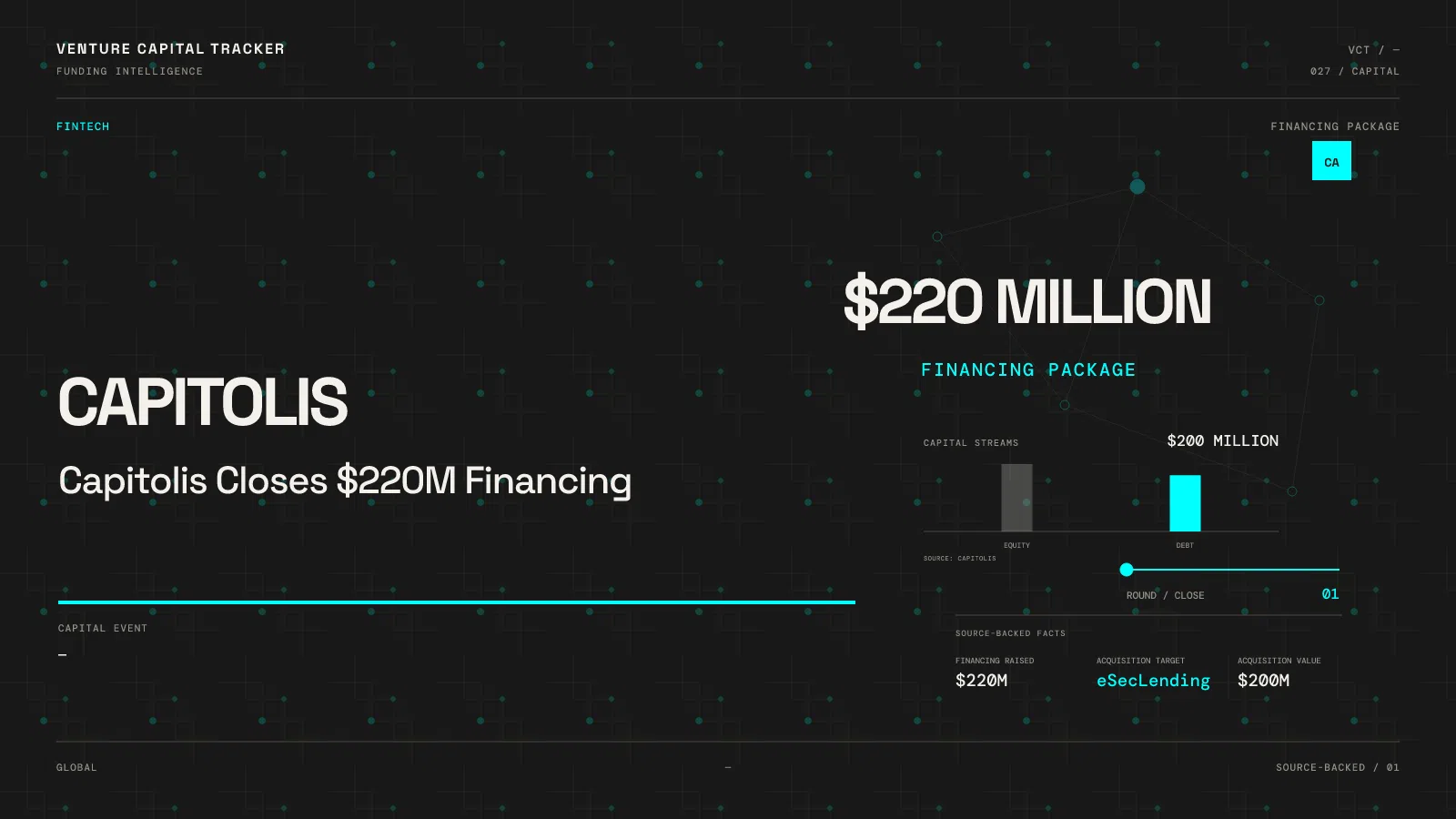
Capitolis has completed a $220 million financing package to fund its next phase of growth and support its planned acquisition of securities-lending specialist eSecLending. The package combines a $120 million Series E led by Citi with an implied $100 million of debt financing. Beyond the headline amount, the strategic test is whether Capitolis can turn a network of bank customers and investors into a broader market-infrastructure platform spanning dealers and institutional asset owners.
The equity round values Capitolis at $1.9 billion. New strategic investors Bank of America, Nomura and Tradeweb Markets joined existing backers Barclays, BNP Paribas, J.P. Morgan, State Street and UBS, according to the company's October 6 announcement.
The distinction between the financing components matters. Capitolis disclosed the $220 million total and the $120 million equity round, but did not separately state the debt amount. Subtracting the equity from the package implies approximately $100 million of debt, provided by First Citizens Innovation Banking, Hercules Capital and Pinegrove Venture Partners. The company did not disclose the loan's interest rate, maturity, security package or covenants.
Capitolis funding: equity, debt and acquisition separated
| Component | Amount | Status | Key counterparties |
|---|---|---|---|
| Series E equity | $120M | Completed | Citi led; Bank of America, Nomura, Tradeweb Markets, Barclays, BNP Paribas, J.P. Morgan, State Street and UBS |
| Debt financing | ~$100M implied | Completed as part of the package | First Citizens Innovation Banking, Hercules Capital and Pinegrove Venture Partners |
| Total new financing | $220M | Completed | Equity plus debt |
| eSecLending acquisition | $200M cash | Agreement announced; approvals pending | Capitolis buying from Parthenon Capital and management |
That separation prevents two common errors: describing the full $220 million as venture equity, or treating the acquisition price as undisclosed. Capitolis's September 29 transaction announcement states that the purchase price is $200 million in cash.
A modest valuation step-up with strategic weight
Capitolis was valued at $1.6 billion in its 2022 Series D. The new $1.9 billion valuation represents a roughly 19% nominal increase over four years. That is a measured step-up rather than the rapid repricing seen in the most aggressive AI rounds.
The investor list is arguably more important than the headline valuation. Several of the world's largest banks are simultaneously customers, strategic partners and shareholders. That overlap can accelerate distribution and product adoption because the institutions supplying capital also understand the balance-sheet and market-infrastructure problems Capitolis is trying to solve.
It can also create concentration risk. When major customers sit on both sides of the commercial relationship, product priorities, governance and revenue exposure can become more tightly tied to a small number of institutions. The structure is a competitive advantage if the network compounds, but a dependency if bank budgets or regulatory priorities shift.
Why eSecLending changes the scope of the company
Capitolis built its business around helping financial institutions optimize capital and reduce exposures through network-based trading and portfolio optimization. eSecLending adds agency securities-lending capabilities and relationships with large pension funds, asset managers and other institutional asset owners.
That expands Capitolis from bank-focused balance-sheet optimization toward a broader financial-resource-management platform. The strategic logic is stronger than a simple revenue bolt-on: securities lending introduces new asset-owner customers and transaction flows that could deepen Capitolis's network.
The acquisition remains subject to regulatory and antitrust approvals, so it should not yet be described as completed. eSecLending Europe is excluded from the transaction. Seller Parthenon Capital is expected to reinvest in Capitolis, maintaining exposure to the combined business.
What the financing does—and does not—tell investors
The package gives Capitolis enough capital to fund a $200 million cash purchase while maintaining resources for integration and product development. Using both equity and debt also limits dilution relative to funding the entire acquisition with new shares.
But the economics cannot be fully evaluated from the disclosed terms. Capitolis has not published:
- the precise amount allocated to acquisition consideration versus operating capital;
- the debt's interest rate, maturity, collateral or covenants;
- eSecLending's revenue, profitability or purchase multiple;
- expected cost savings or integration expenses; or
- a timetable beyond the required regulatory approvals.
Those omissions make the $220 million headline less informative than it first appears. The more consequential question is whether Capitolis can integrate eSecLending and turn a bank-heavy strategic investor base into a broader network spanning both dealers and asset owners.
Competitive implications
Capitolis competes with specialist post-trade and risk-management platforms such as OSTTRA and Acadia, established financial-software providers including FIS and Broadridge, and internal systems built by major banks. In securities lending, the eSecLending acquisition also puts it closer to platforms such as EquiLend.
Its differentiator is the combination of a multi-bank network, capital optimization and now a larger securities-lending footprint. The acquisition may improve data density and transaction volume across the network, but it also raises integration complexity and brings Capitolis into markets with entrenched infrastructure providers.
The analytical bottom line
This is best understood as three linked transactions, not one oversized venture round: a $120 million Series E, approximately $100 million of implied debt and a pending $200 million cash acquisition.
The funding is significant, but the most important signal is strategic. Citi led the equity round, eight other major financial institutions invested, and specialist lenders supplied acquisition financing. Capitolis is using its customer network not only to fund growth but to consolidate adjacent market infrastructure.
Execution now matters more than valuation. Regulatory clearance, integration discipline and the undisclosed cost of debt will determine whether the deal expands Capitolis's network advantage—or simply adds complexity to a capital-intensive platform.
- startup-funding
- fintech
- debt-financing
- +2 more
Follow Venture Capital Tracker in Google
Add VCT as a preferred source to make our venture-capital coverage easier to find in Google Search.
Last updated:
Editorial note: AI tools assisted with research, structure, or drafting. Venture Capital Tracker retains human editorial responsibility for factual accuracy, relevance, and source quality before publication.