· Venture Capital Tracker · venture-capital
Ampersand Raises $15M Series A for Enterprise AI Integrations
Ampersand raised a $15 million Bessemer-led Series A to connect enterprise AI agents with customized CRM, ERP and other systems of record.
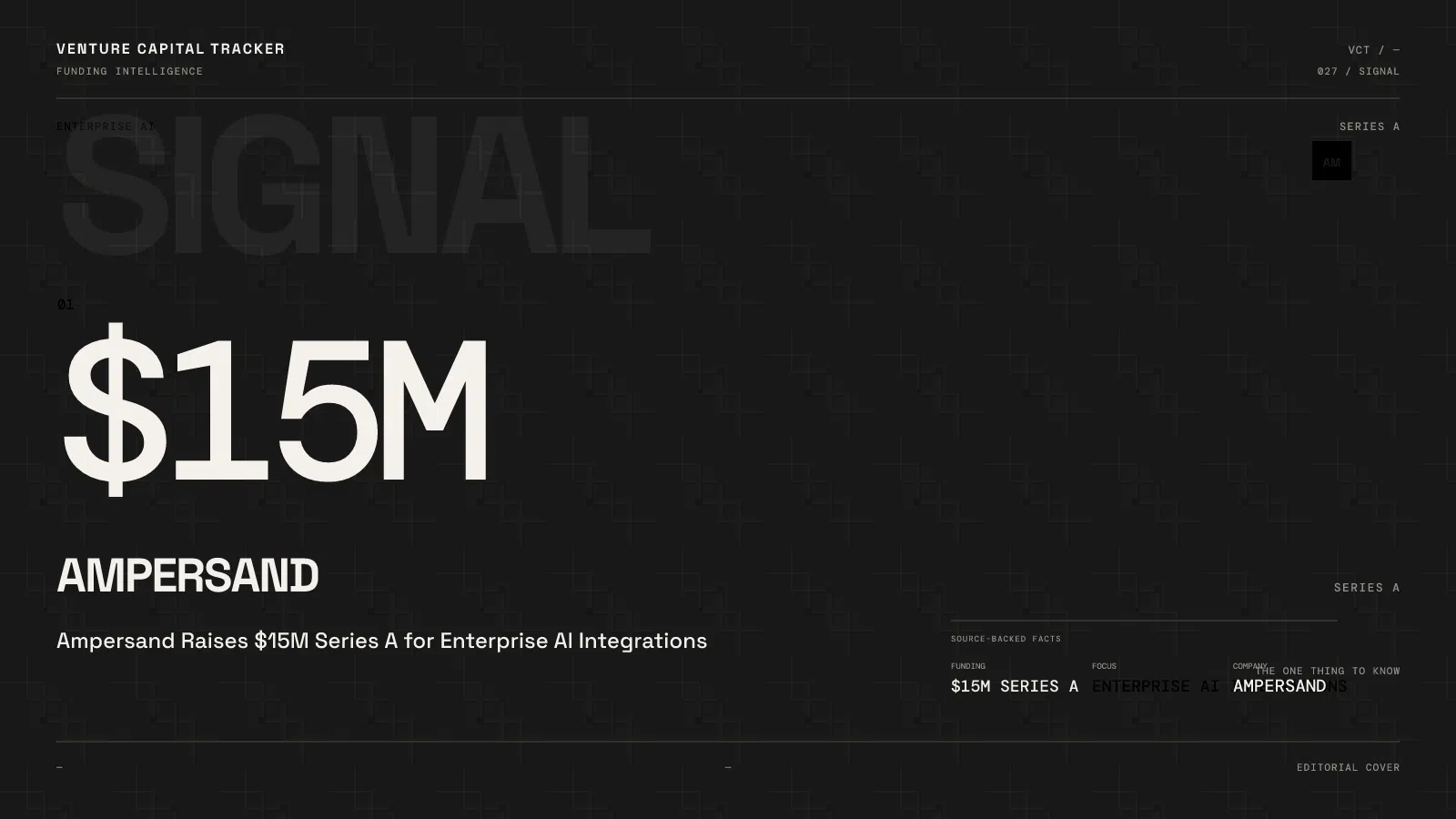
Ampersand has raised a $15 million Series A to build integration infrastructure for enterprise AI agents. Bessemer Venture Partners led the round, with existing investors Matrix and Flex Capital participating alongside Yelp, Tenacity Capital, CTO Fund, Mana Ventures and angel investors.
The financing brings Ampersand's total disclosed funding to $20 million. The company did not disclose a valuation. Bessemer partner Lauri Moore joined the board.
The round backs a specific enterprise bottleneck: AI agents cannot deliver useful work if they cannot safely read from and write to each customer's customized CRM, ERP and other systems of record.
Ampersand Series A terms
| Term | Detail |
|---|---|
| Amount | $15 million |
| Stage | Series A |
| Lead investor | Bessemer Venture Partners |
| Other investors | Matrix, Flex Capital, Yelp, Tenacity Capital, CTO Fund and Mana Ventures |
| Total disclosed funding | $20 million |
| Valuation | Undisclosed |
| Board appointment | Bessemer partner Lauri Moore |
The company says it has spent three years developing the platform alongside customers including 11x, Orb and Square. Those customer references and operating claims should remain attributed to Ampersand.
Enterprise agents need more than an API call
Many AI-agent demos work because they use clean sample data and predictable tools. Production deployments confront a different environment: customer-specific Salesforce objects, NetSuite workflows, custom permissions, renamed fields, expired credentials and legacy applications.
Ampersand describes this as “Tripartite Drift”—simultaneous change across the software provider, the application vendor and the customer implementation. A connector can remain technically online while quietly failing to reflect the customer's actual workflow.
That is the core investment thesis. If enterprise agents are expected to investigate overdue invoices, update pipeline records or follow approval policies, integration quality becomes part of the agent's reasoning boundary. Incorrect schema mapping is not merely a data problem; it can cause an agent to take the wrong action.
How Ampersand's runtime works
Ampersand provides five primitives:
- Read data from customer systems.
- Subscribe to events and changes.
- Search for specific records or context.
- Write approved changes back into systems of record.
- Proxy calls to underlying provider APIs.
Developers define integrations through an amp.yaml configuration. The runtime handles authentication, token refresh, retries, backfills and monitoring. This puts a deterministic execution layer around agent behavior rather than asking a language model to invent new integration code for every task.
The company is also developing Andi, an AI integration agent currently in beta. Andi is intended to help understand customer implementations, map data, configure integrations and diagnose failures while operating inside Ampersand's controlled infrastructure.
That division of labor is important. AI may accelerate the implementation work, but permissions, validation and observability remain conventional software responsibilities.
The opportunity is customer-specific complexity
Unified API providers reduced the cost of connecting to standard categories such as CRM, accounting and HR systems. Enterprise-agent vendors face a harder problem: two customers using Salesforce may have different objects, fields, policies and definitions of the same business concept.
Ampersand says some engineering teams spend one or two months understanding and configuring a single Salesforce implementation. The figure is an anecdotal company observation, not an independently measured industry benchmark. It nevertheless captures why integrations can delay enterprise sales and consume product-engineering capacity.
The Series A will fund three priorities:
- Expansion from CRM connections into ERP and industry-specific systems.
- Development of Andi and other agent-assisted implementation tooling.
- Hiring experts in platforms such as Salesforce, NetSuite, SAP, Workday, ServiceNow, Oracle and Epic.
The third priority exposes both the opportunity and the risk. Domain expertise can unlock difficult deployments, but a growing forward-deployed services team can limit software margins if customer complexity cannot be standardized.
Competition will come from several directions
Ampersand competes directly with embedded-integration platforms such as Merge and Paragon. Workato and Tray.ai approach the market from broader enterprise automation. Agent-framework companies, model providers and large application vendors can also add deeper connectors.
The company's differentiation is depth: customer-specific reads, writes, events, search and proxy calls on top of a configuration model built for changing systems. Its platform must show that this produces faster deployment and fewer failures than unified APIs or internal engineering.
The market may not settle on a single integration layer. Enterprises already have iPaaS products, API management, workflow automation and internal platform teams. Ampersand must become the preferred runtime for agent vendors without appearing to duplicate tools their customers already own.
What competitors covered—and the remaining gap
FinSMEs and The SaaS News published concise transaction summaries. RuntimeWire and Value Add VC connected the financing to the enterprise-agent integration problem. Ampersand's own announcement provides the deepest product description.
The missing analysis is that better integrations do not automatically create a pure software business. As Ampersand moves into ERP, healthcare, insurance, logistics and financial services, each vertical brings specialized permissions, data models and implementation work. The company must prove that Andi and the runtime convert this complexity into reusable product capability rather than a larger services organization.
Search results reinforce the need for precise entity language. “Ampersand AI funding” is crowded with unrelated companies, investment firms and biotech results. The article therefore targets “Ampersand Series A”, “enterprise AI integrations” and the exact $15 million amount.
What the $15 million must prove
Three operating metrics matter more than connector count:
- Time to production: How quickly can a new customer-specific integration move from requirements to validated use?
- Reliability: How often do schema, permission and API changes break agent workflows?
- Implementation leverage: Does revenue grow faster than forward-deployed and domain-expert headcount?
The Series A positions Ampersand at a genuine infrastructure layer. Enterprise agents cannot create value if they remain trapped outside the systems where work occurs. But the company must show that the messiness of those systems can become repeatable software economics rather than permanent consulting work.
Follow Venture Capital Tracker in Google
Add VCT as a preferred source to make our venture-capital coverage easier to find in Google Search.
Last updated:
Editorial note: AI tools assisted with research, structure, or drafting. Venture Capital Tracker retains human editorial responsibility for factual accuracy, relevance, and source quality before publication.