· Venture Capital Tracker · venture-capital
Rivian Draws $1B Volkswagen Loan at 6.03% Fixed
Rivian received a $1 billion, 10-year Volkswagen-funded term loan at 6.03%. The non-recourse facility is secured only by its 50% software-joint-venture stake.
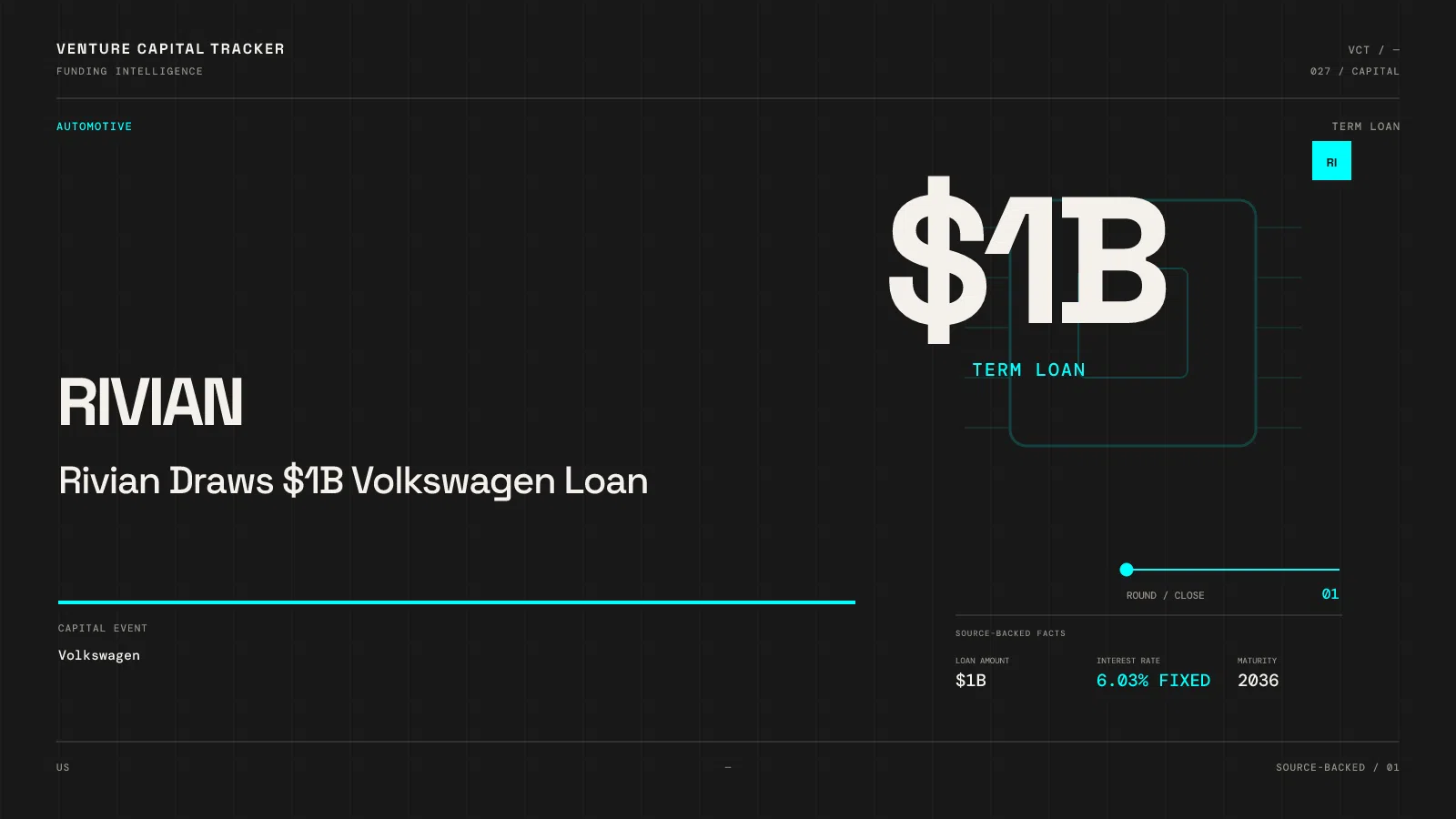
Rivian has received the full $1 billion available under a 10-year term-loan structure funded by Volkswagen Group, converting a commitment negotiated with the companies' 2024 software joint venture into cash on Rivian's balance sheet.
The financing is debt, not a new Volkswagen equity investment. Rivian's October 7 Form 8-K says the Rivian-facing loan carries a 6.03% fixed annual interest rate, matures on October 7, 2036, and is non-recourse to Rivian Automotive. Its only collateral is the 50% interest in Rivian and Volkswagen Group Technologies held by a Rivian special-purpose subsidiary.
That structure gives Rivian substantial non-dilutive liquidity for general corporate purposes while ring-fencing Volkswagen's claim. It does not make the capital cheap: at the initial $1 billion balance, 6.03% represents $60.3 million of annual interest accrual before principal begins amortizing.
Rivian Volkswagen loan terms
| Term | Rivian-facing Loan B |
|---|---|
| Funded amount | $1 billion |
| Interest rate | 6.03% fixed annually |
| Maturity | October 7, 2036 |
| First interest payment | October 7, 2028 |
| Principal amortization | $100 million annually from October 2029, paid in two $50 million installments |
| Prepayment | Permitted without premium or penalty, subject to notice |
| Collateral | Rivian's 50% equity interest in the Volkswagen joint venture |
| Parent guarantee | None |
| Use of proceeds | General corporate purposes |
The delayed first payment should not be confused with an interest-free period. Interest accrues at the contractual rate; the filing specifies that the first semiannual payment is due on the second anniversary of funding.
How two $1 billion loans create only $1 billion of liquidity
The transaction uses two linked facilities:
- Loan A: Volkswagen Specter LLC lends $1 billion to Rivian and Volkswagen Group Technologies, the jointly owned software company, at a 5.93% fixed rate.
- Loan B: The joint venture lends the same $1 billion to Rivian JV SPC LLC, a Rivian-owned special-purpose vehicle, at 6.03%.
- Distribution to Rivian: Rivian JV SPC distributes the proceeds to Rivian Automotive for general corporate purposes.
The repeated $1 billion figures do not mean that Rivian received $2 billion. They describe the same capital passing through two contracts. Payments from Rivian's special-purpose vehicle are expected to fund the joint venture's corresponding payments to Volkswagen's lending vehicle.
The 10-basis-point difference between the two stated rates is economically meaningful to the joint venture but small relative to Rivian's wider cash needs. The main purpose of the structure is to isolate collateral and payment obligations around the joint venture rather than place a general claim on Rivian Automotive.
What non-recourse means here
Neither loan is guaranteed by Rivian Automotive or another entity. For Loan B, Volkswagen's economic recourse in a default is limited to the pledged collateral: Rivian's 50% joint-venture stake.
That protection matters because the joint venture is strategically valuable. It is developing zonal electrical architecture and software-defined vehicle systems intended for future Rivian and Volkswagen Group vehicles. The collateral is narrow in legal scope but potentially significant in commercial value.
Rivian remains party to limited agreements, representations and warranties, and the loan contains covenants broadly consistent with its senior secured asset-based revolving facility. “Non-recourse” therefore does not mean covenant-free or consequence-free. It means the lender cannot generally pursue Rivian Automotive's other assets for Loan B repayment.
A planned draw, not a surprise financing
The facility was not newly negotiated in October 2026. Volkswagen and Rivian established the loan agreements when they formed their joint venture in November 2024. Rivian's new filing records the point at which the conditions were satisfied and the full committed amount was actually funded.
That distinction explains the muted novelty in some market coverage. The transaction is an important cash event, but it was already part of Volkswagen's previously announced program to invest as much as $5.8 billion in Rivian and the joint venture through a mixture of convertible debt, equity, intellectual-property consideration and lending.
The funded loan should therefore be evaluated as execution of an existing strategic commitment—not as evidence that Volkswagen suddenly increased its maximum exposure.
Why the structure suits Rivian's R2 phase
Rivian is using the proceeds for general corporate purposes rather than restricting them to the joint venture. That gives management flexibility during the R2 production ramp and the continuing build-out of manufacturing capacity.
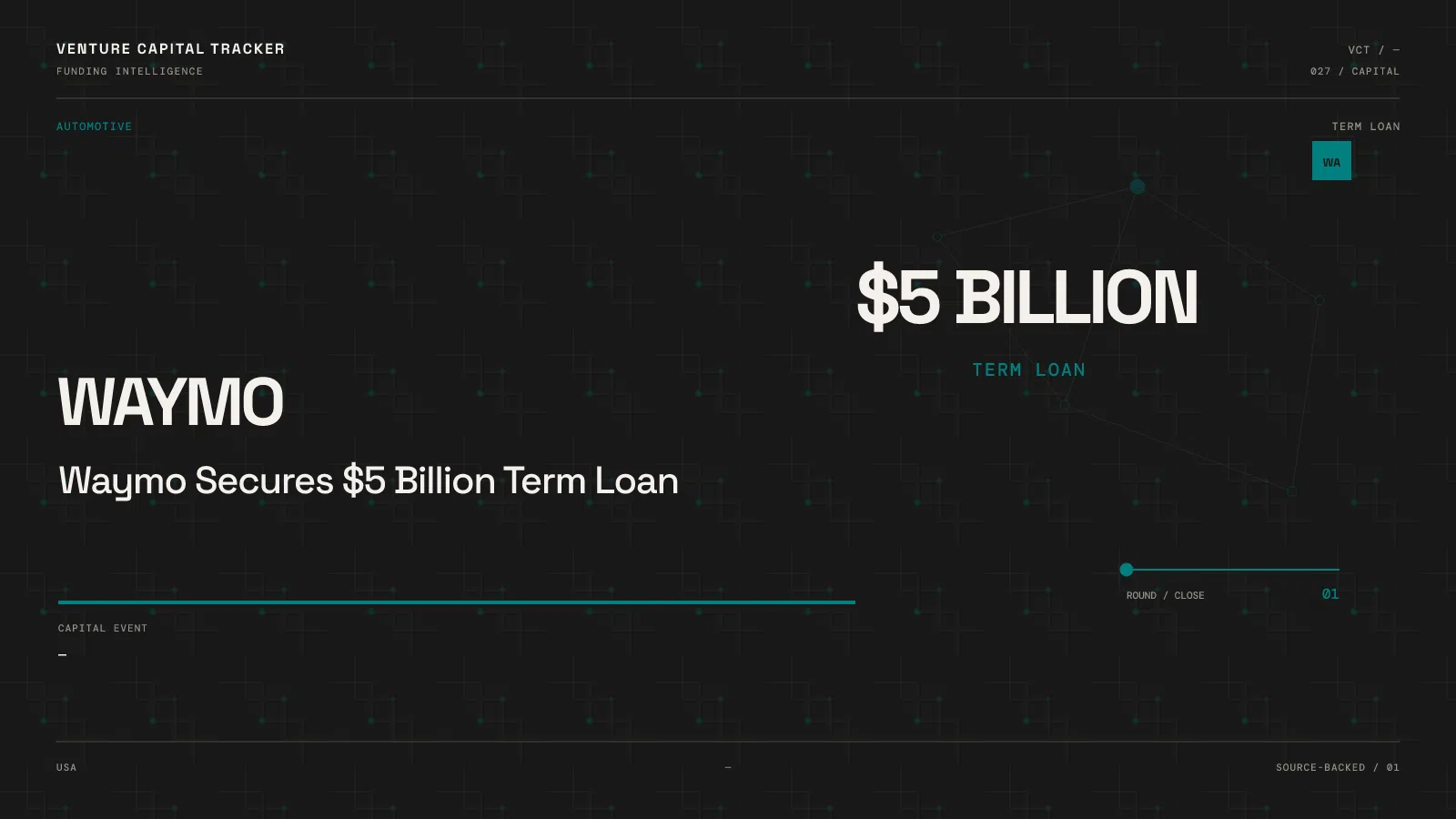
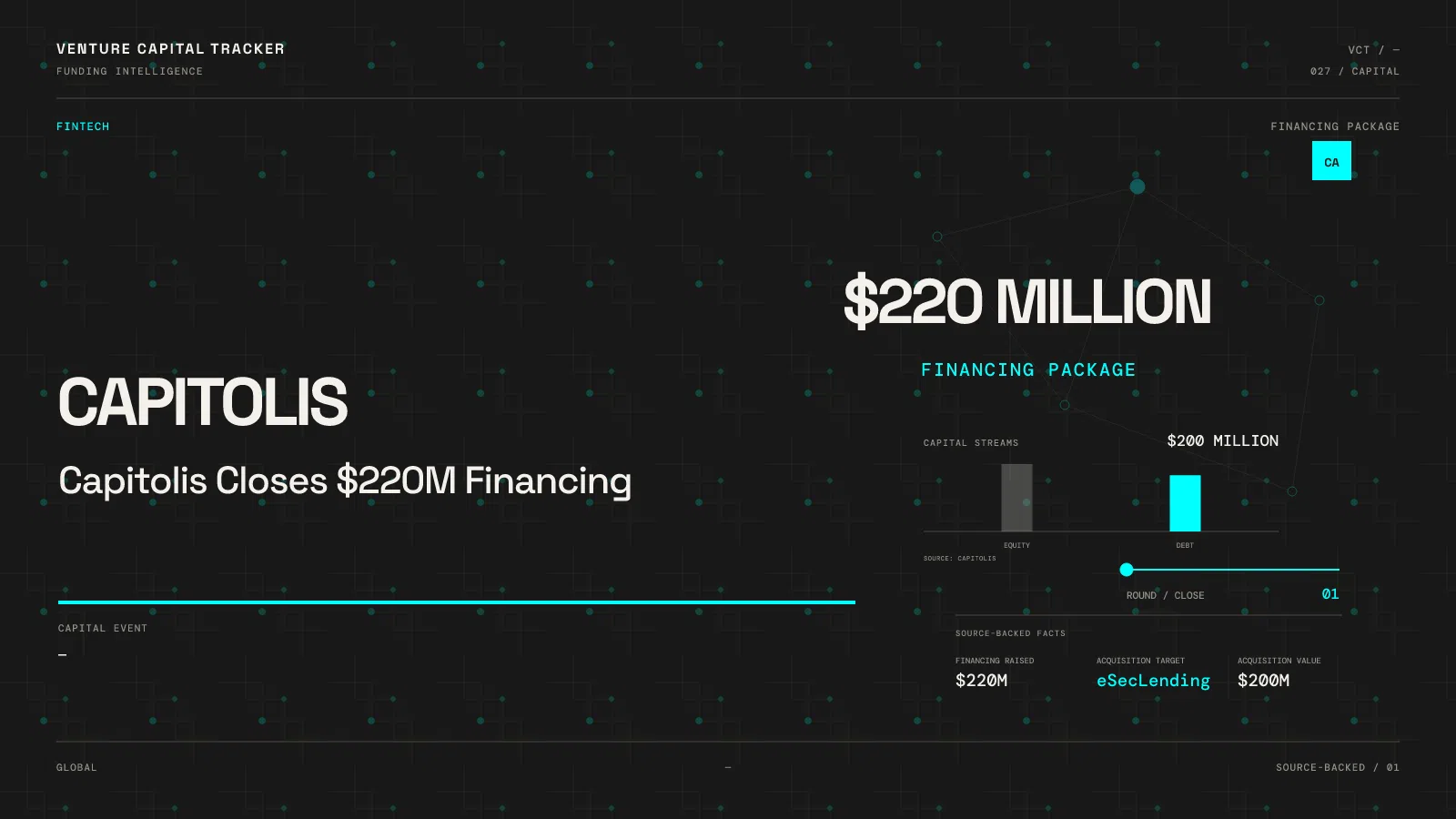
Debt avoids immediate shareholder dilution. It also creates a fixed claim on future cash flows at a time when Rivian is still working toward durable automotive profitability. The trade-off resembles other large structured financings, including Waymo's first $5 billion term loan, while Capitolis's recent package shows how equity and debt can be combined around an acquisition. The trade-off is especially visible after annual principal repayments begin in 2029.
The timing creates a three-year operating window before principal amortization starts. Rivian must use that period to improve vehicle gross margins, scale R2 production and demonstrate that software and joint-venture income can become a meaningful complement to vehicle sales.
What competitors emphasized—and what they missed
Barron's framed the loan through Rivian's negative share-price reaction, while Auto Finance News highlighted the $1 billion amount and delayed first interest payment. AlphaPilot reconstructed the two-tier facility and connected it with R2 production.
The missing analytical point is the interaction between financing protection and strategic dependency. Rivian avoids a parent guarantee and preserves shareholders from immediate dilution, but it pledges its half of a software venture intended to influence future vehicle architecture across both companies.
That makes the loan safer for Rivian's broader asset base while putting a strategically important collaboration directly inside the creditor structure.
What to watch next
Three questions now matter more than the headline amount:
- R2 economics: Can Rivian reach sufficient scale and gross-margin improvement before principal repayments begin?
- Joint-venture value: Does the Volkswagen partnership produce licensing, engineering or software revenue that supports the pledged stake's value?
- Remaining Volkswagen commitments: Which technical and operational milestones govern any still-undelivered portions of the broader $5.8 billion program?
The $1 billion draw materially strengthens Rivian's liquidity, but it does not resolve the company's manufacturing and cash-generation challenge. Its favorable elements—fixed pricing, no parent guarantee, narrow collateral and penalty-free prepayment—buy time. The return on that time will be measured in R2 output, margins and the commercial value of the Volkswagen software platform.
Follow Venture Capital Tracker in Google
Add VCT as a preferred source to make our venture-capital coverage easier to find in Google Search.
Last updated:
Editorial note: AI tools assisted with research, structure, or drafting. Venture Capital Tracker retains human editorial responsibility for factual accuracy, relevance, and source quality before publication.