· Venture Capital Tracker Editorial
Multiply Labs Raises $75M for Drug Manufacturing Robots
Multiply Labs raised a $75 million Series B led by NantWorks to scale robotic systems for manufacturing cell, gene and other advanced therapies.
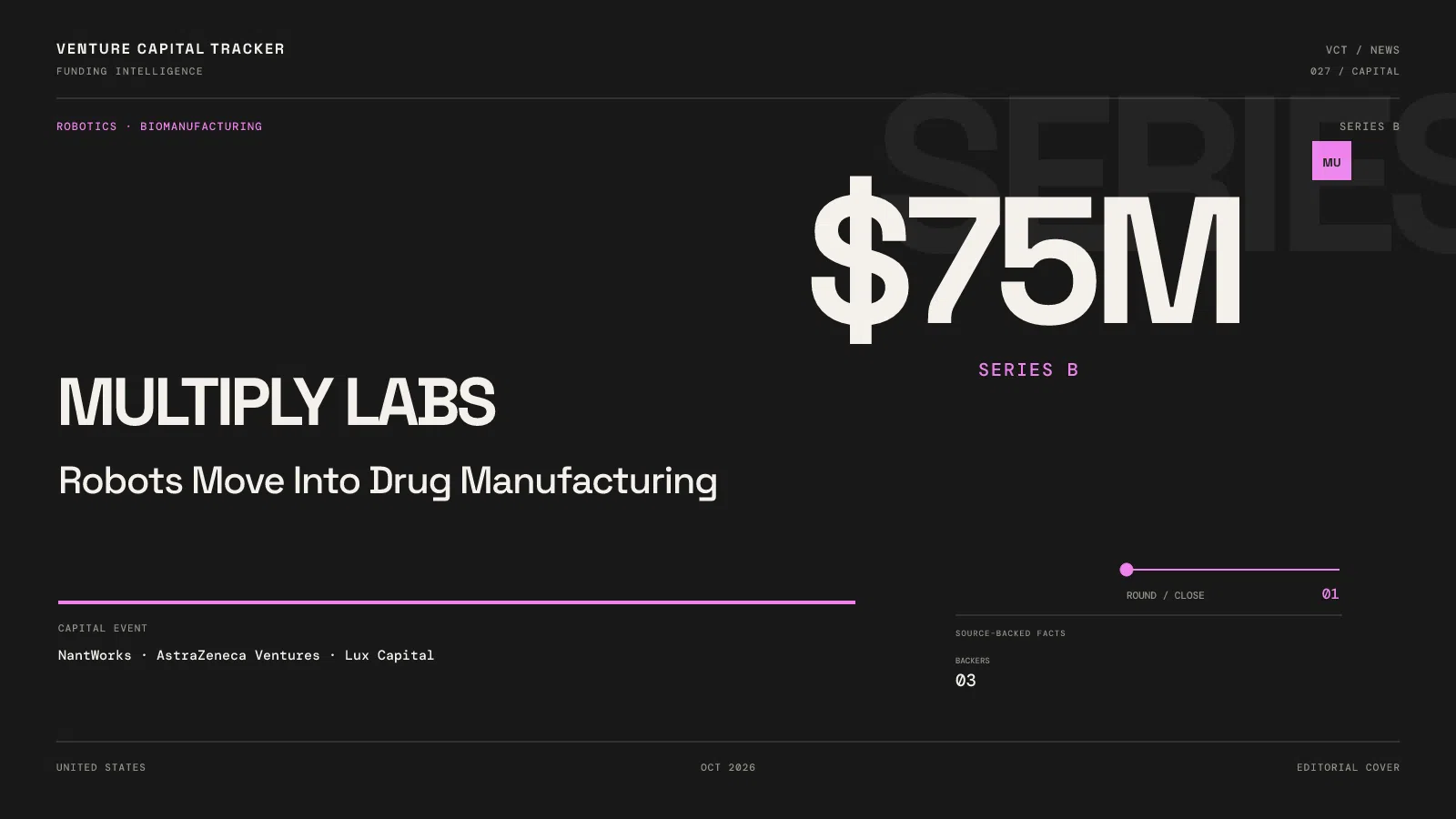
Multiply Labs has raised a $75 million Series B to expand robotic manufacturing systems for cell therapies, gene therapies and other complex medicines.
NantWorks, the investment group founded by physician and entrepreneur Patrick Soon-Shiong, led the round. AstraZeneca Ventures, Lingotto Innovation, Legend Biotech, Fifty Years, Ora Global, Teradyne Ventures, Strange Ventures and Casdin Capital participated, while Lux Capital and Founders Fund returned. The financing takes Multiply Labs’ disclosed funding above $100 million.
Multiply Labs Series B at a glance
- Financing: $75 million Series B
- Lead investor: NantWorks
- Stage: Series B
- Sector: Biomanufacturing robotics
- Use of proceeds: Commercial deployments, manufacturing capacity and product development
- Status: Company-announced and confirmed
The round targets a bottleneck that sits downstream from AI drug discovery. New therapies can be designed faster than the industry can reliably manufacture them. Cell and gene therapies require many sterile, tightly controlled steps, and production often depends on skilled technicians working inside expensive cleanrooms.
From drug discovery to the factory floor
Investment in biological models and AI-designed medicines has grown quickly, but discovery is only the first stage of the value chain. A therapy that cannot be produced consistently, at sufficient volume and within regulatory specifications is not commercially viable.
Multiply Labs builds modular robotic clusters designed to perform manufacturing processes with less manual intervention. Its system uses multiple robotic arms and disposable cartridges to reproduce laboratory workflows. The company says the approach can make production more parallel, traceable and flexible than conventional facilities.
That proposition is particularly relevant for personalized medicines, where manufacturers may need to process many patient-specific batches rather than one enormous batch of an identical drug. Automation could reduce labor costs and contamination risk while preserving an electronic record of each step.
Strategic investors matter here
This syndicate brings more than capital. AstraZeneca Ventures and Legend Biotech connect Multiply Labs to potential pharmaceutical customers. Teradyne Ventures contributes expertise from industrial automation. NantWorks and Patrick Soon-Shiong add experience spanning biotechnology, manufacturing and healthcare delivery.
Those relationships can help with validation, but they do not remove the central adoption challenge. Drug manufacturers change processes cautiously because equipment, software and consumables may all become part of a regulated manufacturing method. A robot must do more than work in a demonstration: customers need evidence that it can produce repeatable results under good manufacturing practice standards.
Multiply Labs has disclosed only a small number of commercial deployments, and current systems can cost millions of dollars. Management has said it aims to drive the cost down substantially as production scales. Until then, the business will depend on whether savings from labor, cleanroom space and higher throughput offset the upfront investment.
A hardware, consumables and service model
The company’s opportunity is larger than selling robotic arms. Its platform combines machines, proprietary cartridges, software and ongoing support. If customers standardize production around that stack, Multiply Labs could generate recurring revenue from consumables and service contracts.
That model also creates execution risk. Hardware companies must finance inventory, support field deployments and manage supply chains. Biopharma customers may request substantial customization, which can slow installations and pressure margins. The strongest outcome would be a standardized platform that accommodates many therapies without turning each deployment into a bespoke engineering project.
Competition comes from established laboratory automation suppliers, contract development and manufacturing organizations, and internal automation teams at large pharmaceutical companies. Multiply Labs must show that its modular architecture is faster to deploy and more flexible than those alternatives.
What to watch after the Series B
Four milestones will reveal whether the new capital is creating a scalable business:
- Production use: Growth in systems running regulated or late-stage manufacturing, not only research workflows.
- Deployment economics: Falling system cost and shorter installation times.
- Recurring revenue: A rising contribution from cartridges, software and support.
- Regulatory repeatability: Evidence that customers can validate the platform across multiple therapies and sites.
The financing gives Multiply Labs the balance sheet to move beyond pilots. It also raises expectations. A $75 million Series B is large for a manufacturing-equipment company with a limited installed base, so the company now needs to convert strategic partnerships into repeatable deployments.
The bottom line
Multiply Labs is building infrastructure for an industry that has invested heavily in discovering new medicines but still relies on labor-intensive production. If its robots can reduce cost without compromising regulatory control, the platform could become an important layer of advanced-therapy manufacturing. The Series B funds that transition from promising automation technology to an industrial system customers can trust at scale.
Editorial note: AI tools assisted with research, structure, or drafting. Venture Capital Tracker retains human editorial responsibility for factual accuracy, relevance, and source quality before publication.