· Venture Capital Tracker Editorial
Linse Capital Raises $150M Ignition Strategy
Linse Capital's $150 million Ignition strategy combines a $75 million early-stage deep-tech fund with $75 million of co-investment vehicles.
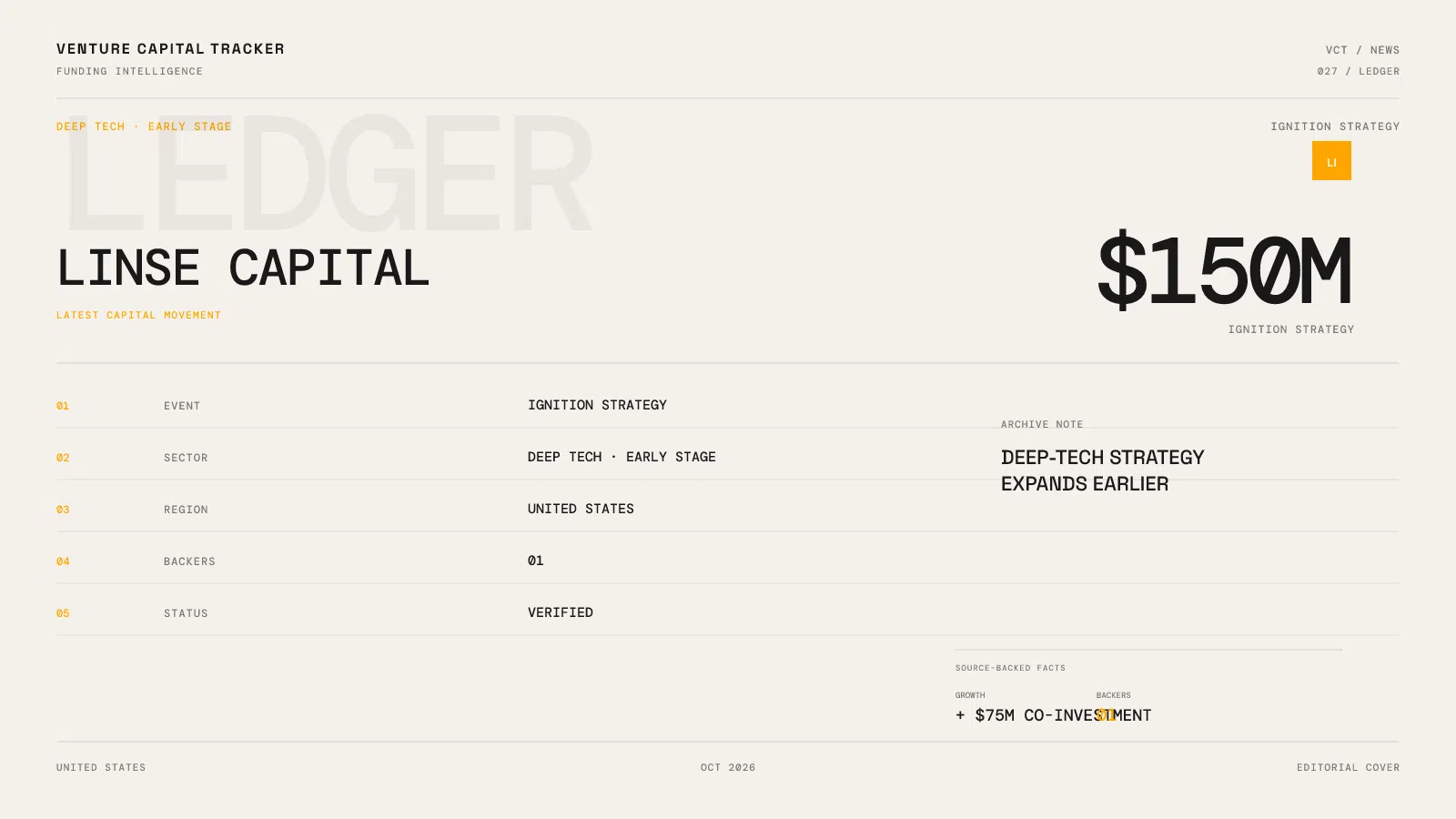
Linse Capital has raised $150 million for an early-stage deep-technology strategy, but the structure matters: the announcement combines a $75 million venture fund with $75 million of dedicated co-investment vehicles.
Calling the full amount a single fund would overstate the blind-pool capital available for new investments. The firm says the early-stage fund is already largely deployed across 14 companies, while the co-investment vehicles provide additional capital for selected portfolio businesses.
Linse Capital Ignition at a glance
- Total strategy: $150 million
- Core fund: $75 million early-stage deep-tech fund
- Additional capital: $75 million in co-investment vehicles
- Stage: Early stage, with follow-on capacity
- Manager: Linse Capital
- Status: Firm-announced and confirmed
Linse calls the program its Ignition strategy. It expands the firm’s historical focus on later-stage technology companies into earlier company formation and first institutional rounds.
Why the structure matters
A conventional venture fund gives managers discretion to invest committed capital across a portfolio. A co-investment vehicle is usually tied to a specific company or opportunity and may be funded by a smaller subset of limited partners.
That distinction changes how the headline should be interpreted. Linse has not announced a single $150 million pool available for initial checks. Instead, it has assembled a $75 million early-stage portfolio fund and an equal amount of targeted follow-on capital.
For founders, the structure can provide continuity: the core fund can invest early, while co-investment vehicles can support capital-intensive winners without consuming an outsized share of the main fund. Limited partners can choose more concentrated exposure to specific later rounds. They also accept more company-specific risk than they would in the diversified core fund.
A later-stage manager moves earlier
Linse Capital has invested in technology businesses approaching commercial scale, including companies in autonomy, aerospace, energy and industrial systems. Moving earlier gives the firm access before valuations rise, but it also changes the work required.
Early-stage deep-tech companies often face technical, regulatory and manufacturing risk simultaneously. They may need years of development before meaningful revenue. Investors must evaluate engineering milestones, capital plans, customer validation and supply-chain constraints—not only software growth metrics.
Linse says the early-stage fund has already backed 14 companies. Because the capital is largely deployed, the announcement is partly a disclosure of an existing portfolio rather than the launch of a completely uninvested vehicle.
The deep-tech funding gap
The Ignition structure reflects a persistent problem in venture finance. A seed investor may be willing to fund a prototype, while growth investors wait for commercial traction. Between those points, companies building hardware, factories or regulated systems can require tens of millions of dollars.
Co-investment vehicles are one way to bridge that gap. They allow a manager to back a company at formation and then assemble more capital around proven milestones. The model is especially relevant in aerospace, defense, energy and advanced manufacturing, where ownership can otherwise be diluted heavily before revenue arrives.
The trade-off is concentration. A co-investment pool tied to a few companies carries more company-specific risk than a diversified fund. Its success depends on Linse selecting follow-on winners and avoiding the temptation to support underperforming portfolio companies simply because it already owns them.
What founders and LPs should watch
The announcement does not disclose several points that will determine how the strategy works:
- Initial check sizes: How much of the $75 million core fund remains available for new investments.
- Reserve policy: Whether the main fund retains capital for follow-ons or relies primarily on co-investment vehicles.
- Access: Which limited partners can participate in the $75 million of co-investment capital and on what economics.
- Deployment pace: Whether the 14-company portfolio leaves room for meaningful diversification.
- Commercial milestones: How many portfolio companies reach production, regulatory approval or large customer contracts.
Those details will determine whether Ignition functions as a repeatable early-stage franchise or mainly as a one-cycle extension of Linse’s later-stage investing.
The bottom line
Linse Capital’s announcement is meaningful, but precision improves the story. The manager has assembled a $150 million strategy, not closed one $150 million venture fund. The combination of a diversified early-stage pool and targeted co-investment capacity is designed for capital-intensive deep tech, where the best companies often need much more money after the first institutional round.
Editorial note: AI tools assisted with research, structure, or drafting. Venture Capital Tracker retains human editorial responsibility for factual accuracy, relevance, and source quality before publication.