· Updated · Venture Capital Tracker · venture-capital
General Intuition Raises $220M at $6.2B as Gameplay Data Fuels World Models
General Intuition raised $220M at a $6.2B valuation from Valor, Atreides, 776, Point72, Khosla and General Catalyst, taking disclosed funding above $650M.
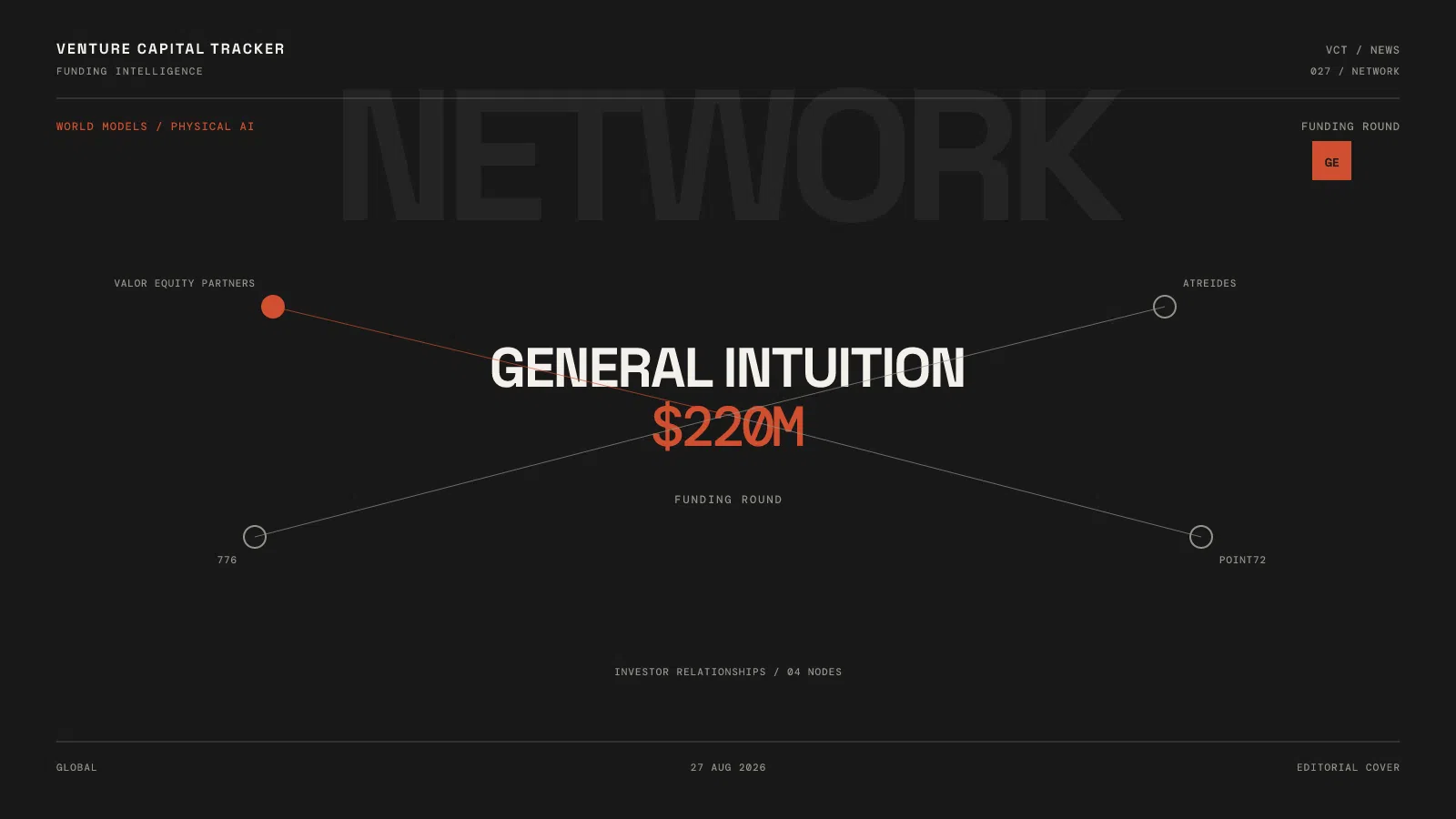
General Intuition has raised $220 million at a $6.2 billion valuation, converting the world-model developer’s reported fundraising talks into a confirmed financing. Valor Equity Partners, Atreides, Seven Seven Six, Point72, Khosla Ventures and General Catalyst participated.
The stage was not publicly disclosed. The round follows a $320 million Series A at a $2.3 billion post-money valuation announced in June 2026 and takes company-disclosed funding to more than $650 million.
General Intuition funding at a glance
| Date | Financing | Valuation | Named investors |
|---|---|---|---|
| October 2025 | About $133.7M seed | Not disclosed | Khosla Ventures, General Catalyst |
| June 2026 | $320M Series A | $2.3B post-money | Khosla Ventures, General Catalyst, Raine, Hedosophia, Bezos Expeditions and others |
| September 2026 | $220M; stage undisclosed | $6.2B | Valor, Atreides, 776, Point72, Khosla, General Catalyst |
The simple sum of those disclosed rounds is approximately $673.7 million. The company uses the more conservative description “more than $650 million,” which avoids implying cap-table precision from rounded public figures.
What General Intuition is building
General Intuition develops world models and large action models intended to predict how an environment changes after an action. Its research system, MIRA, generates interactive video and is positioned as a step toward agents that can operate across games, simulations and physical systems.
The company spun out of Medal, the gameplay-video platform founded by CEO Pim de Witte. Medal is central to the thesis because game clips can be paired with player inputs and outcomes. That produces action-labeled sequences rather than only static text, images or unstructured video.
General Intuition says Medal is on track to upload billions of videos each year. The scale is a company claim, but the data structure is the important part: movement, timing, collisions and goal-directed actions can teach a model how interventions change an environment.
Why the valuation jumped
The valuation rose from $2.3 billion in June to $6.2 billion in September. That does not mean the underlying business became 2.7 times larger on a comparable public-market basis. Private financing marks can reflect new preferred terms, investor competition, technical milestones and expectations about future markets.
Investors are underwriting three connected assumptions:
- gameplay data is legally and technically usable as a durable training advantage;
- learned representations transfer from games into robotics, simulation and other physical environments; and
- customers will pay for models or tools before research and compute costs outrun revenue.
The first assumption creates scarcity. The second creates market size. The third determines whether the company can become a business rather than an expensive laboratory.
What competitors covered—and what they missed
SiliconANGLE and GamesBeat correctly led with the $220 million amount, $6.2 billion valuation and investor group. Gaming publications emphasized Medal and MIRA. The harder diligence question is transfer: a model that predicts a stylized game does not automatically handle partial visibility, safety constraints, sensor error or mechanical variation in the real world.
That makes commercial deployment more useful than another benchmark. General Intuition says it is working with a limited group of customers in robotics, simulation and entertainment, but names, contract sizes and production outcomes remain undisclosed.
Data rights are part of the moat
Quantity alone does not guarantee defensibility. Customers and investors need to know whether gameplay data can be used consistently across jurisdictions, whether rights survive changes in platform policies, and whether models can generalize beyond the most common games.
The Medal relationship could be hard to reproduce, but it also concentrates dependency. If the affiliate relationship, user consent framework or data economics change, the perceived moat could weaken.
Bottom line
General Intuition’s $220 million financing is confirmed, but the formal stage remains undisclosed. The company is now valued at $6.2 billion and has disclosed more than $650 million of funding. The investment case is unusually focused: action-labeled gameplay may become a low-cost training ground for agents that act in dynamic environments.
The next proof point is not another valuation. It is evidence that models trained on games produce reliable, economically useful results in robotics, simulation or other real-world systems.
_Funding figures, valuations and company claims are presented for research and educational purposes and are not investment advice._
- ai-ml
- robotics
- startup-funding
- +2 more
Last updated:
Editorial note: AI tools assisted with research, structure, or drafting. Venture Capital Tracker retains human editorial responsibility for factual accuracy, relevance, and source quality before publication.