ComfyUI Funding: $30M at a $500M Valuation, Investors & Revenue
ComfyUI raised $30 million at a $500 million valuation in April 2026, bringing company-reported total funding to $47 million. Here is the funding history, investors, open-source model, and revenue caveat.
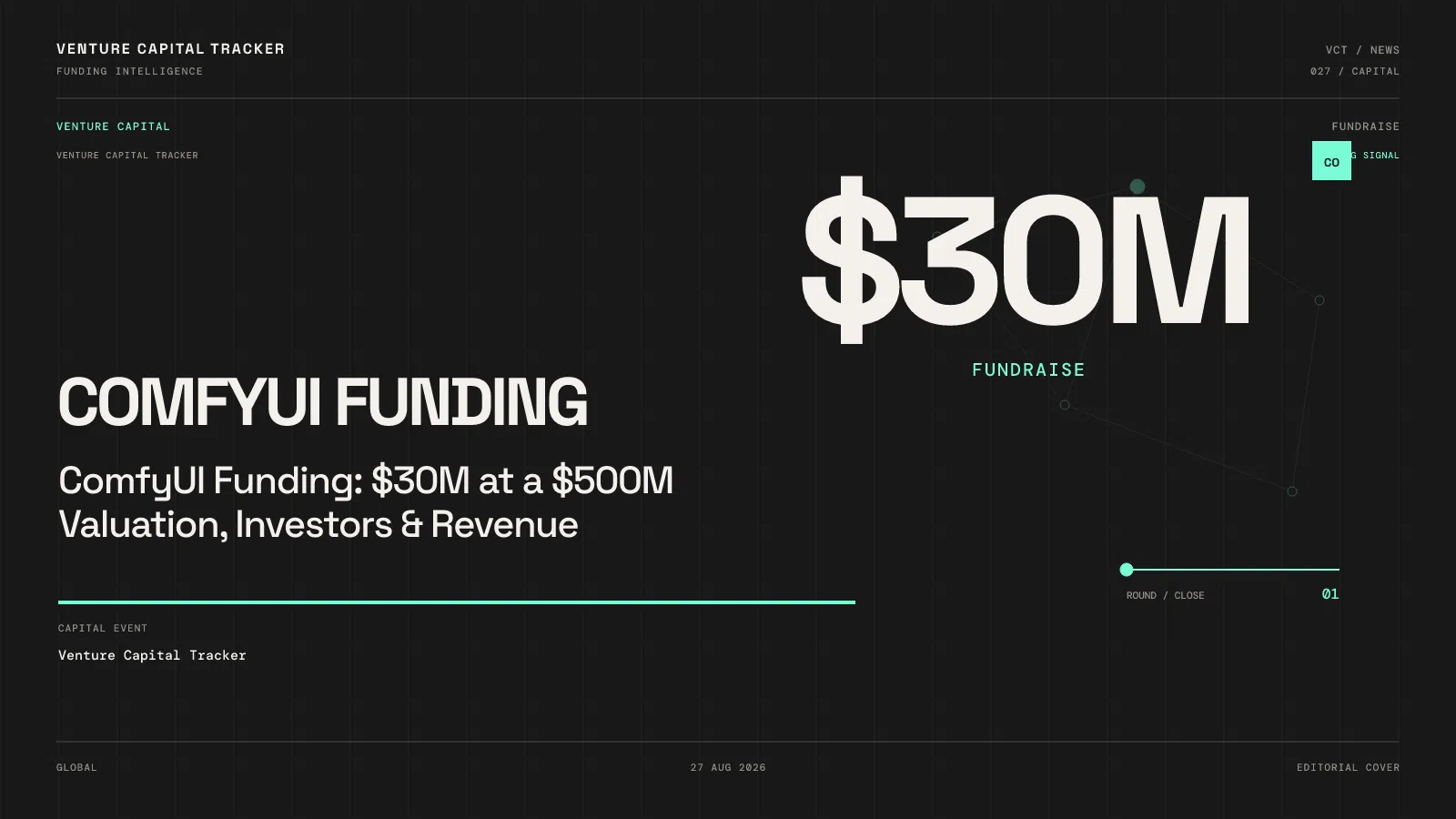
ComfyUI funding: Comfy announced $30 million in financing at a $500 million valuation in April 2026, bringing company-reported total funding to $47 million. Craft led the financing, with Pace Capital, Chemistry, TruArrow, and other investors participating.
ComfyUI is the open-source, node-based workflow engine at the center of the company’s product ecosystem. The investment story is not simply “an AI image tool raised money.” It is the attempt to build durable commercial infrastructure around an open creative-AI workflow without closing the local core.
ComfyUI funding and valuation at a glance
| Question | Answer | Evidence or caveat |
|---|---|---|
| Latest financing | $30M | Announced April 24, 2026 |
| Latest valuation | $500M | Private financing mark |
| Company-reported total funding | $47M | Comfy’s April announcement |
| Latest lead investor | Craft Ventures | Pace Capital, Chemistry, TruArrow, and others participated |
| Earlier announced round | $17M | Announced September 2025 by Comfy |
| Core product | Open-source node-based workflow engine | Runs locally or through Comfy Cloud |
| Audited revenue | Not publicly disclosed | Cloud, API, partner nodes, and enterprise are the commercial layers |
What does ComfyUI do?
ComfyUI lets users build generative-AI workflows by connecting nodes. Each node can represent a model, a prompt, an image transformation, a control step, a sampler, an audio or video operation, or another part of a production pipeline.
That graph-based approach gives creators more control than a single prompt box. A technical artist can make each step visible, change one component without replacing the rest of the workflow, save the process as a portable file, and reproduce the result across projects or machines.
ComfyUI’s official documentation describes it as an open-source node-based application and inference engine for generative AI. It supports workflows across image, video, audio, and 3D use cases. The same flexibility that attracts technical users also creates the company’s main product challenge: an open ecosystem can be powerful while still feeling difficult for new users.
ComfyUI funding history
| Date | Financing | Amount | Valuation or context |
|---|---|---|---|
| September 2025 | Funding round | $17M | Comfy said the money would support Comfy Cloud, local experience, and the open-source ecosystem |
| April 2026 | Financing | $30M | $500M valuation; led by Craft |
| April 2026 | Cumulative total | $47M | Company-reported total funding after the $30M financing |
The company’s own numbers are the cleanest way to present the history. Some third-party databases and press summaries report slightly different totals or round labels. This page uses Comfy’s April statement: $30 million at a $500 million valuation and $47 million total funding.
Who invested in ComfyUI?
The April 2026 financing was led by Craft Ventures. Comfy named Pace Capital, Chemistry, and TruArrow as participants, alongside other investors.
The earlier September 2025 funding announcement named Pace Capital, Chemistry, Abstract Ventures, and other investors. TechCrunch also reported earlier financing involving Chemistry Ventures, Cursor Capital, and Vercel founder Guillermo Rauch. Because private-company round labels and cumulative totals can differ across databases, the most defensible summary is to anchor the page to Comfy’s own $17 million and $30 million announcements and list the investors those announcements identify.
Investors are underwriting more than the desktop application. They are funding the ecosystem: cloud compute, creator collaboration, enterprise deployment, model integrations, node reliability, and the infrastructure that makes open workflows usable at production scale.
Is ComfyUI open source?
Yes. The core ComfyUI project is open source and can run locally on a user’s hardware. That promise is central to the company’s positioning. Comfy’s funding announcement says the product will remain open and that users will retain the ability to run workflows on their own machines.
The commercial model sits around the open core:
- Comfy Desktop or local ComfyUI: run workflows on your own hardware.
- Comfy Cloud: use Comfy-managed GPUs without setting up local infrastructure.
- Partner Nodes: access supported third-party models and services through paid credits.
- Comfy API: run workflows programmatically in cloud infrastructure.
- Comfy Enterprise: provide organization-level controls and support for professional teams.
Comfy’s cloud documentation explicitly distinguishes the paid cloud product from the free local version. That separation is important to the funding case: the company can monetize convenience, compute, integrations, and enterprise requirements while allowing the community to keep building on the open workflow engine.
What is ComfyUI revenue?
Comfy does not publish audited revenue in the April financing announcement. That means a precise answer such as “ComfyUI revenue is X” would overstate what is public.
The available business model is clearer than the available income statement. Comfy can generate revenue from:
- subscriptions for Comfy Cloud;
- GPU usage and cloud execution;
- paid Partner Nodes and model access;
- API calls that run workflows in production; and
- enterprise licensing, support, and deployment requirements.
The open-source local core can remain free while these surrounding services pay for infrastructure and company operations. This resembles other open-source commercialization models, but the economics still depend on conversion: how many free users become cloud users, how much compute each workflow consumes, and whether professional teams will pay for reliability and collaboration.
Comfy’s community scale is part of that funnel. In its April announcement, the company said the ecosystem had more than 4 million users, 60,000-plus community-built nodes, and 150,000-plus daily downloads. Those are company-reported adoption metrics, not audited revenue or proof of profitability.
Why the $500M valuation matters
The valuation says investors believe creator-controlled AI workflows can become a durable layer of the creative stack. Generative models may get better, but production teams still need repeatability, editability, version control, and the ability to combine several models and tools in a specific order.
ComfyUI is positioned around that control point. A studio can swap models without rebuilding the whole process. An artist can inspect the graph instead of accepting a black-box output. An enterprise can move part of the workflow into managed infrastructure while retaining a familiar local format.
The risks are equally concrete:
- Open-source monetization: a large free user base does not guarantee paid conversion.
- Ecosystem safety: community nodes can create security, dependency, or compatibility problems.
- User experience: professional adoption may require a smoother path from graph experimentation to team workflow.
- Model platform pressure: model providers and closed creative tools can bundle more workflow functionality themselves.
- Infrastructure cost: cloud GPUs and storage can grow faster than subscription revenue if pricing is not disciplined.
Who owns ComfyUI?
The product is operated by Comfy, the company building the open-source project and its paid services. The open-source repository and community contributors are not the same thing as the private company’s cap table.
Comfy’s April announcement identifies Yannik Marek as a co-founder and the creator of ComfyUI. Other public company materials and coverage identify a broader team, including Yoland Yan. The complete founder ownership, investor percentages, and governance rights are not public.
Bottom line
ComfyUI raised $30 million at a $500 million valuation in April 2026 and said total funding reached $47 million. Craft led the round, with Pace Capital, Chemistry, TruArrow, and others participating.
The investment case is an open-core bet: keep the local workflow engine open, then monetize the cloud, compute, API, partner-model, and enterprise layers around it. Comfy has disclosed meaningful adoption, but not audited revenue. The next proof points are paid conversion, cloud gross margins, ecosystem stability, and whether professional teams make ComfyUI a durable production standard.
_Funding, valuation, and company-reported adoption figures are presented for research and educational purposes. They are not investment advice._
Sources
- ai-ml
- developer-tools
- startup-funding
- +2 more
Follow Venture Capital Tracker in Google
Add VCT as a preferred source to make our venture-capital coverage easier to find in Google Search.
Last updated:
Editorial note: AI tools assisted with research, structure, or drafting. Venture Capital Tracker retains human editorial responsibility for factual accuracy, relevance, and source quality before publication.